Anthropic released Claude Fable 5 yesterday, their first Mythos-class model open to the public.
With every AI update - a new model, a new tool, a new harness - the same question pops up everywhere: whose job does this replace?
That question is driven by anxiety (some of it justified).
But lately, the more exciting question for me is: what will my team build with this?
Builders have never had more leverage.
For a builder who knows what's worth building, curiosity >> paranoia.
For most of history, we had no choice but to do manual labour. Then the machines came, and that effort became optional. But physical fitness didn't lose its value. It became more valuable. We train our bodies deliberately now.
AI is doing the same to the mind. So we won't think less. We'll train to think, deliberately.
Time to build better gyms for the brain.
PS:
Everything above is a utilitarian argument. Math matters because of what it builds. That is true, but it's incomplete.
AI writes better poems than most humans today. Does that take away the joy of writing one yourself? Not mine. It never will.
Math is the same. Set aside whether your child becomes "useful" by knowing it. The act of sitting with a problem and watching the solution arrive in your own head is one of the best feelings a person can have. AI cannot take that. It is not a result. It is the having-done-it. And that is where the growth is.
See for yourself. A small problem, in the same family as the one OpenAI just solved. Try it with your child this weekend.
Draw a 3 × 3 grid of nine dots, each dot exactly 1 unit from its nearest neighbors. How many pairs of dots are exactly 1 unit apart? Then try a 4 × 4 grid. Then a 5 × 5. Look for the pattern.
The answer for an n × n grid is 2n(n − 1).
The harder question, and the one Erdős asked 80 years ago, is whether you can arrange n points more cleverly than a grid to get many more unit-distance pairs. Erdős conjectured that this is barely possible. The model showed otherwise.
AI just solved one of math's most famous unsolved problems. So, is learning math a thing of the past?
Last Tuesday, an internal OpenAI model disproved one of Paul Erdős's longest-standing conjectures: the planar unit distance problem.
https://t.co/VF5ZVaE67P
Tim Gowers (Fields Medalist) said he would have recommended the solution to the Annals of Mathematics without hesitation.
As parents and teachers, the fear (a very valid one) that follows is: if AI can do the math, why should our children still learn it?
The answer is: it was never a competition with AI.
You can outsource your thinking to AI. You cannot afford to outsource your understanding. The day a person stops trying to understand, they outsource not just their thinking but their taste, their judgment, and eventually their agency, which are all the qualities we need to steer these LLMs to get the output that we want.
Terence Tao saw this coming two years ago. AI is a co-pilot, not the pilot. The humans are still driving.
AI multiplies what you bring. This is the era of leverage. The era of depth.
Depth matters in many domains. Mathematics is one. Communication is one. The ability to regulate your own emotions is one. AI does not diminish the value of any of them. It amplifies them exponentially.
Mathematics is a life skill. Not just a subject. And math as a life skill is getting more important each day in the AI age. I wrote about why last October.
https://t.co/qGpr53FcvH
The news this week did not make it less true. It made it more urgent.
At Cuemath, we are building children for this. Not to solve more problems faster than AI, but to be the kind of mind that asks the right question, catches AI when it is confidently wrong, and stays with a hard problem long enough to understand it.
We call this being #MathFit. The news this week is the strongest case for it I have seen yet.
@Cuemath turned 10 this Dec 22nd! 🔥 This date is Ramanujan’s bday and the National Math Day in India. This video captures our 10 year journey beautifully, as we get closer to becoming the leading math learning brand of the world. https://t.co/0BJ2lnGLt6
Today represents an inflection point for Cuemath. We are re-anchoring around our mission, but also saying farewell to some colleagues. https://t.co/UJtMiPU4yc
@NayantaraRai@JM_Scindia Same mess today. Most of it from people trying to jump queues. One solution could be a “late” queue which you can only join if boarding time less than x minutes away. Jumping of queues strictly banned. Security chaos will go away
LIVE: Watch Russian cosmonauts conduct a spacewalk to continue preparing the @Space_Station's new European robotic arm for operations: https://t.co/z1RgZwyJyi
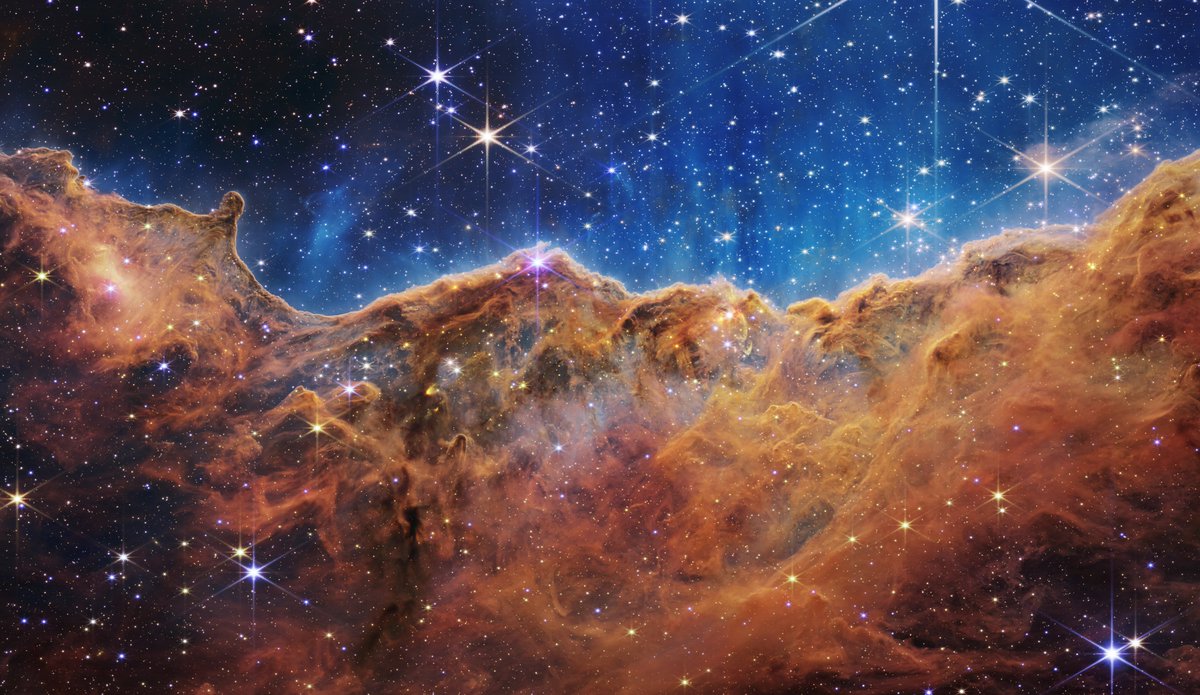
Cosmic cliffs & a sea of stars. @NASAWebb reveals baby stars in the Carina Nebula, where ultraviolet radiation and stellar winds shape colossal walls of dust and gas. https://t.co/63zxpNDi4I #UnfoldTheUniverse
In today’s The Turning Point, we reveal how Manan Khurma went about building a new kind of teacher-driven mathematics-learning programme.
@Cuemath@MananKhurma
https://t.co/YwgnlROALL
Edtech startup @Cuemath has raised $57 Mn in a fresh equity funding round led by Alpha Wave
Existing investors, including @Lightrock_India, @Sequoia_India, Alphabet's @CapitalG, Manta Ray, and @UnitusVentures also participated in the round
@MananKhurma
https://t.co/wElkgjKN1E