My point is that I understand when #India doesn't name the perpetrator when it condemns the Israeli bombing of Qatar. I understand when India doesn't name when it condemns the Russian attacks in Ukraine. I also understand if India doesn't want to name when it condemns the Iranian attack on Persian Gulf monarchies. That's strategic balancing. But I don't understand why India doesn't name the country that fired missiles at vessels carrying Indian nationals, and killed three of them, in India's neighbourhood waters!
What idioticity is this!? Seriously!
If the Air Force is needed to transport NEET examination papers, it is not a sign of “strong security” but rather reverberates a strong exhibit of a failed examination system.
NEET paper leaks are not happening because trucks are unsafe. They happen because of deep-rooted corruption, insider involvement, lack of accountability in the administration and system.
Using the Air Force for NEET exam management is a dramatic distraction from the real issue. I can imagine how this idioticity would strongly resonate with the BJP bhakts and in certain newsrooms.
The Indian Air Force exists to protect national security, not to compensate for BJP’s incompetence and deep-rooted corruption in the Ministry of Education!
Dharmendra Pradhan, should be ashamed of himself. Instead of resigning for ruining the future and careers of 23 lakh students, he is indulging in to idiotic tactics to divert the attention from the real issue!
Absolutely shameful!
When PM had to impose restrictions on public movement against the poor during COVID, he used the might of police force. Now, if patriotism is about shunning foreign trips, abandoning car, and not buying gold, responsibility of which falls upon the rich, a gentle appeal is given.
Take a step back and look at the arc of the war, or the trap of escalation. One Day 1, trump sought regime change. Didn't happen. Then he said he authorised talks. The Iranians rejected it. He demanded unconditional surrender. Iran stepped up retaliatory attacks. He said he wanted a say in the election of the new leader and that Mojtaba was not acceptable to him. The Iranians picked Mojtaba as the leader. He said Iran would be hit '20 times harder' if the Strait of Hormuz is closed. The number of ships passing through the Strait has come down from hundreds to single digits, creating havoc in energy markets. #Iran is not just rejecting all of trump's demands and threats. They are escalating.
The Law of Unintended Consequences
The law of unintended consequences is playing out openly in the Trump-Netanyahu war on Iran. What was meant to break the Iranian regime is instead triggering a cascade of strategic and economic shocks, some with global impact.
The decapitation strike that killed Iran’s ailing and aging supreme leader, Ali Khamenei, on February 28 was intended to unravel the Islamic Republic’s regime. Instead, it has accelerated the rise of a more uncompromising generation. Khamenei had opposed the idea of his son succeeding him, mindful that the 1979 Islamic Revolution had overthrown a monarchy partly to end hereditary rule. Yet, in a move meant to honor the slain leader and signal continuity, the Assembly of Experts chose his son, Mojtaba.
Having lost his father, mother and other family members in the U.S.-Israeli attack, Mojtaba’s leadership is likely to be shaped by a quest for revenge.
The war’s economic fallout, meanwhile, is reverberating globally. Energy markets have been jolted, sending prices sharply higher and transmitting the shock directly to international consumers, including American consumers. The skyrocketing energy prices are likely to add fresh inflationary pressure to the global economy and potentially slow growth.
History shows that killing leaders has rarely produced the political collapse its architects expect. More often, it radicalizes the system that survives them.
Trump, though, believed he could replicate his “Venezuela model.” Instead, he and Netanyahu may have achieved the opposite — empowering a younger, more hardline Iranian leadership fueled by a narrative of martyrdom and national survival, while imposing steep economic costs on the world, especially the Global South.
Regime change was the goal. Regime hardening may be the result — while the rest of the world picks up the bill for the Trump-Netanyahu war of aggression.
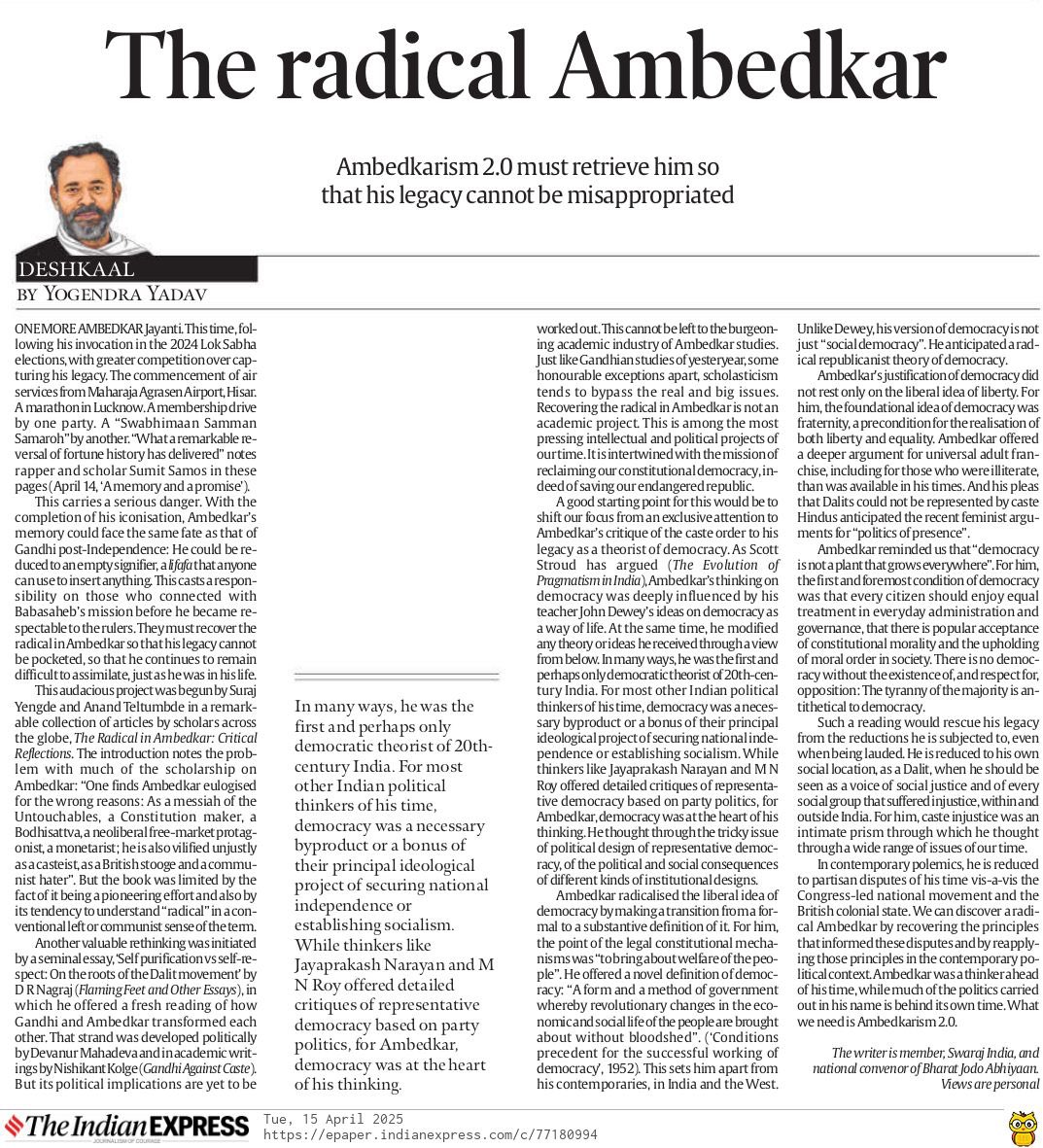
Thanks @SumitSamos for this thoughtful response to my article on “The radical Ambedkar” that takes the discussion forward.
My passing reference to a phrase from your insightful piece was an affirmative nod; my article was not a response to yours. It mainly takes off from Teltumbde et al.
Actually I agree with much of what you say here on Babasaheb’s iconization being driven “from below” (so was Gandhi’s in 1930s and 1940s) and double standards in not asking such questions of others (I, for one, routinely question Gandhi worship). Of course, Ambedkarism 2.0 is not just a burden of Dalits. Like all great thinkers or leaders, the burden of renewing their ideas and preventing appropriation lies on all those who draw inspiration from them.
Where we may have a real difference is our assessment of how real is the danger of Babasaheb’s appropriation by RSS-BJP. If you look at the near successful appropriation of Bhagat Singh by RSS, you would appreciate my concern.
Thanks again for initiating a dialogue.
https://t.co/UtWhG5PQte
Great news from my beloved Göttingen City in Germany!
@CeMIS_unigoe has advertised one *fully funded* PhD position in #Development#Economics for "a student from a socially marginalized background with commitment to social change."
Please share this widely!
#Dalits#bahujan
@Dalit_Swag I am also living in "fear of repercussions and calculating loss" since last six year. You hide the portrait, people asked me directly my caste atleast 8 times. It is very difficult to find a house and do everything to hide identity.