Introducing Sora, our text-to-video model.
Sora can create videos of up to 60 seconds featuring highly detailed scenes, complex camera motion, and multiple characters with vibrant emotions.
https://t.co/YYpOAcrXQ3
Prompt: “Beautiful, snowy Tokyo city is bustling. The camera moves through the bustling city street, following several people enjoying the beautiful snowy weather and shopping at nearby stalls. Gorgeous sakura petals are flying through the wind along with snowflakes.”
La lista de juegos es la siguiente, todos sin caja, tenía una cajita con todos los cartuchos:
- Breath of the Wild
- Tears of the Kingdom
- Súper Mario Odissey
- Mario Kart 8 Deluxe
- Máster Detective archives: Raincode
- Bayoneta 2
- Bayoneta 3
- Pokémon Escarlata
(sigo)
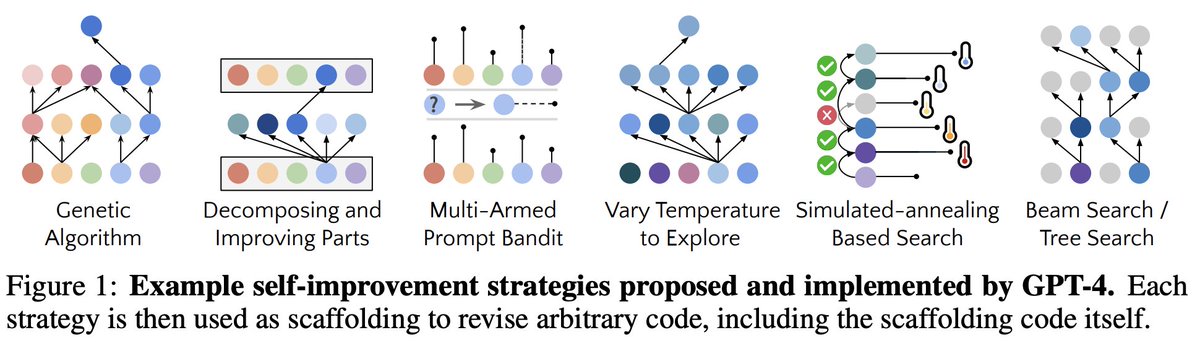
Permit me to pique your interest: Self-Taught Optimizer (STOP)
This paper reveals a powerful new capability of large language models - the ability to recursively improve how they apply themselves. The authors show that models like GPT-4 can optimize code that leverages the model itself, exhibiting sophisticated techniques like genetic algorithms without any exposure in training. This demonstrates that modern language models are ready to take the first steps towards recursively self-improving systems.
The consequences of this conclusion are profound. It tells us that human engineering is no longer essential for scaffolding language models - they can begin improving their own reasoning scaffolds. And they can do so in a way aligned with a provided utility function, at least initially. This could lead to rapid advances in building more capable and general AI systems.
At the same time, this conclusion flags important risks. Unconstrained recursive self-improvement has been associated with existential threats from AI. Studying failures like reward hacking gives us insight into dangers before they occur in more powerful systems. We must guide this technology thoughtfully.
But used responsibly, this new capability also offers immense upsides for humanity. It could discover ways to apply language models we never imagined, unlocking solutions to our greatest challenges in health, education, sustainability and more. Self-improving code may be the missing catalyst to transform language models into beneficial AI we can trust. But we must engage deeply with this technology today to ensure it reflects human values. This paper opens the door - it's up to us to shape what comes next. If we rise to meet this challenge, a bright future lies ahead.
No vamos a tolerar la transfobia en nuestra industria.
Todos estos estudios, medios, sindicatos y asociaciones nos hemos agrupado para instar al @dev_es a que tome acción y se posicione.
Por favor. Ayudad a difundir el mensaje.
Imagen para compartir: https://t.co/rICkp5f36D
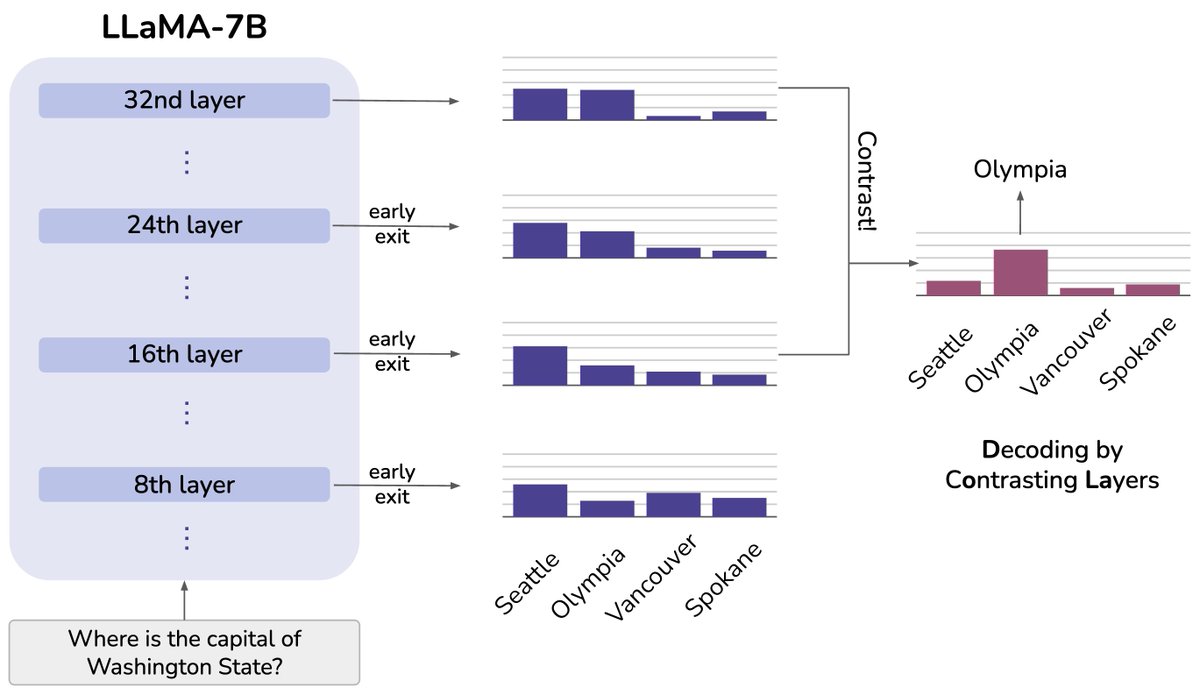
Introducing DoLa
Have you ever felt frustrated by the factual inconsistencies and falsehoods generated by large language models? As helpful as these models can be, their tendency to "hallucinate" incorrect information threatens their reliability and hinders real-world deployment.
We have exciting news - there is now a straightforward way to improve the truthfulness of LLMs without any model retraining or integration of external knowledge. Introducing DoLa, a novel decoding strategy that guides LLMs to generate content more grounded in factual knowledge they acquired during pretraining.
DoLa works by contrasting the knowledge differences between the model's own layers. It amplifies factual signals from later layers while filtering out syntactically plausible but incorrect predictions coming from earlier layers. This simple but clever approach steers the model's next-word predictions towards factual responses.
The beauty of DoLa lies in its simplicity and effectiveness. It significantly boosts truthfulness and factual accuracy across a variety of tasks with just a small inference-time computation. DoLa consistently outperformed existing methods for mitigating falsehoods in LLMs.
Crucially, DoLa provides a plug-and-play solution that requires no retraining of model parameters or integration of external knowledge sources. It delivers substantial truthfulness gains through inference-time decoding alone.
The future possibilities are also exciting. By dynamically surfacing the factual knowledge already present within LLMs, DoLa lays a strong foundation for safer and more reliable language models. Its inferences could be further enhanced by combining DoLa with retrieval mechanisms to ground predictions on factual knowledge bases as well.
One of the earliest papers about "chaining" was the "Model Cascades" paper by @dmdohan
Honored to have him join our webinar on "Cognitive Architectures for Language Agents" this Wednesday
Model Cascades Paper: https://t.co/RMKzFyw4pO
Webinar link: https://t.co/8inRsdNsaY