Echo is one of the more skilled ultrasound exams you can do. Having learnt it and now teaching it, I see the same mistakes being made over and over again. I have put together thread on beginner mistakes in echo. #tweetorial#POCUS#FUSIC#askpocus
Recent job release of a senior clinical fellow job in the Bradford anaesthetic department. Can vouch that this is a fantastic place to work with lots of opportunities! Been asked to share recent job listing for Bradford for senior clinical fellow. https://t.co/Wd4vybdDAk
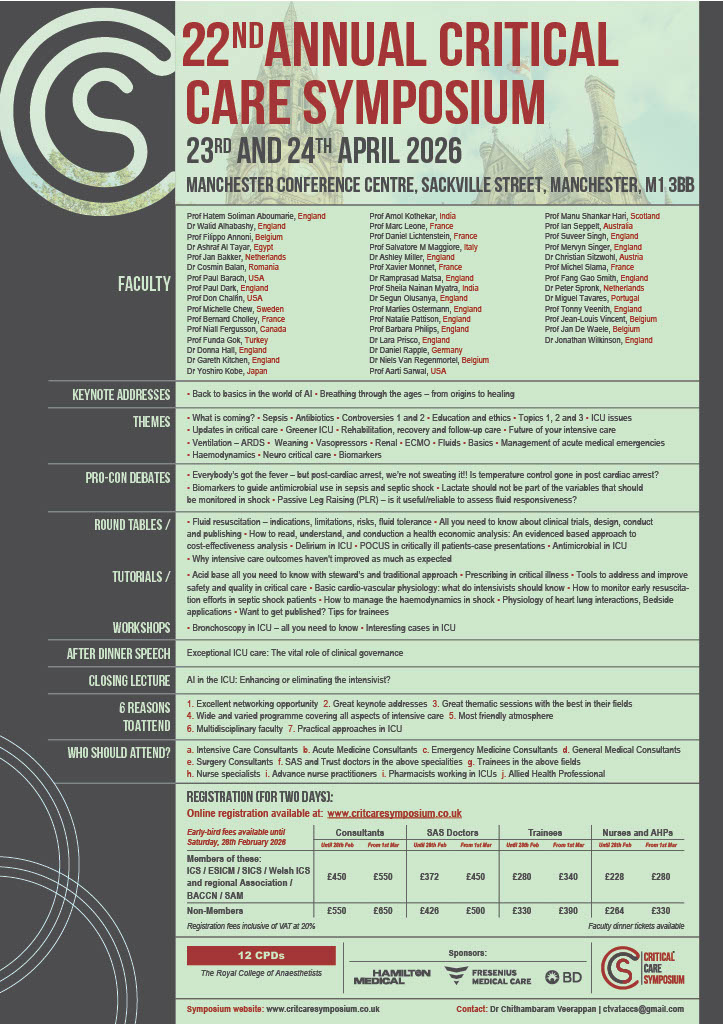
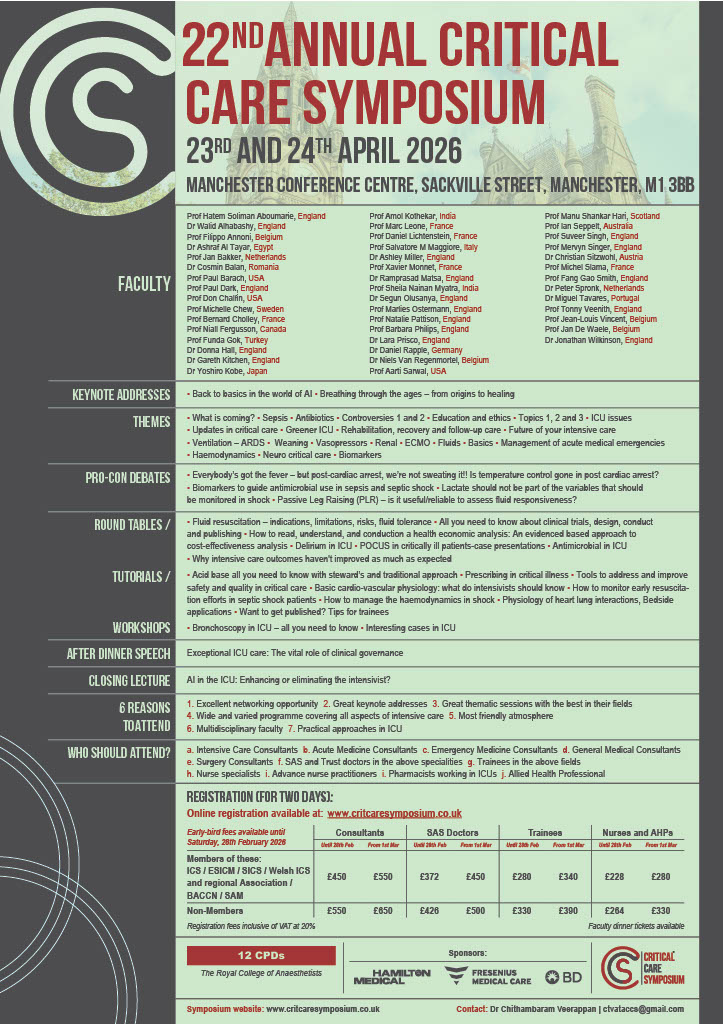
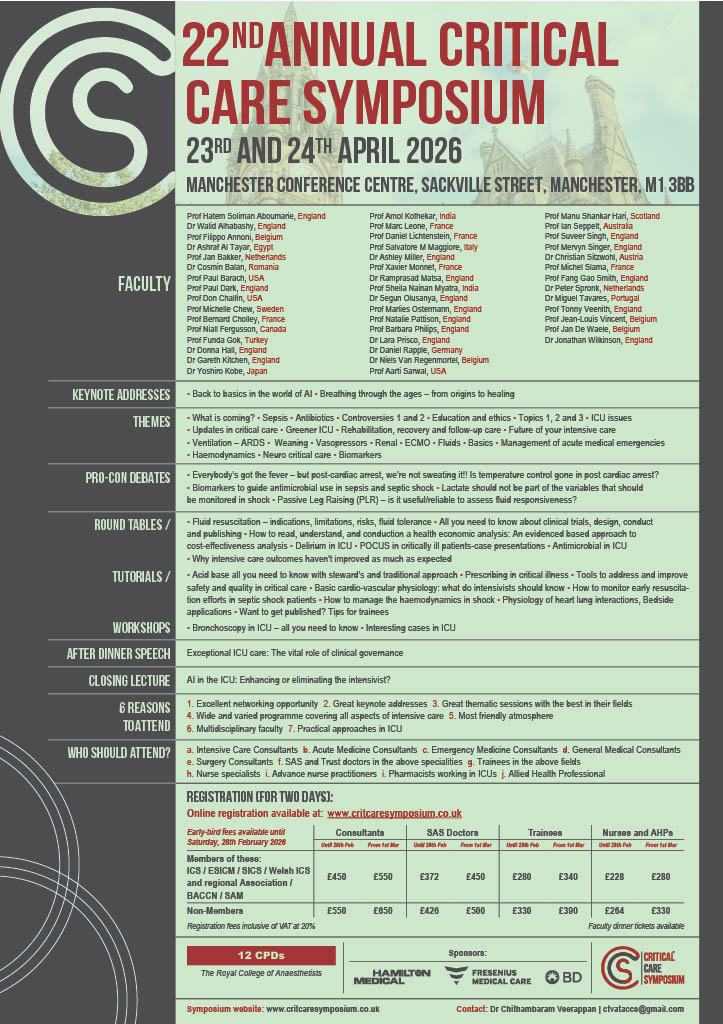
The 22nd Annual Critical Care Symposium is approaching, offering high educational content and excellent networking opportunities with faculties, friends, and delegates from the UK and beyond. This event will take place at the Manchester Conference Centre, Sackville Street, Manchester M1 3BB on April 23rd and 24th, 2026.
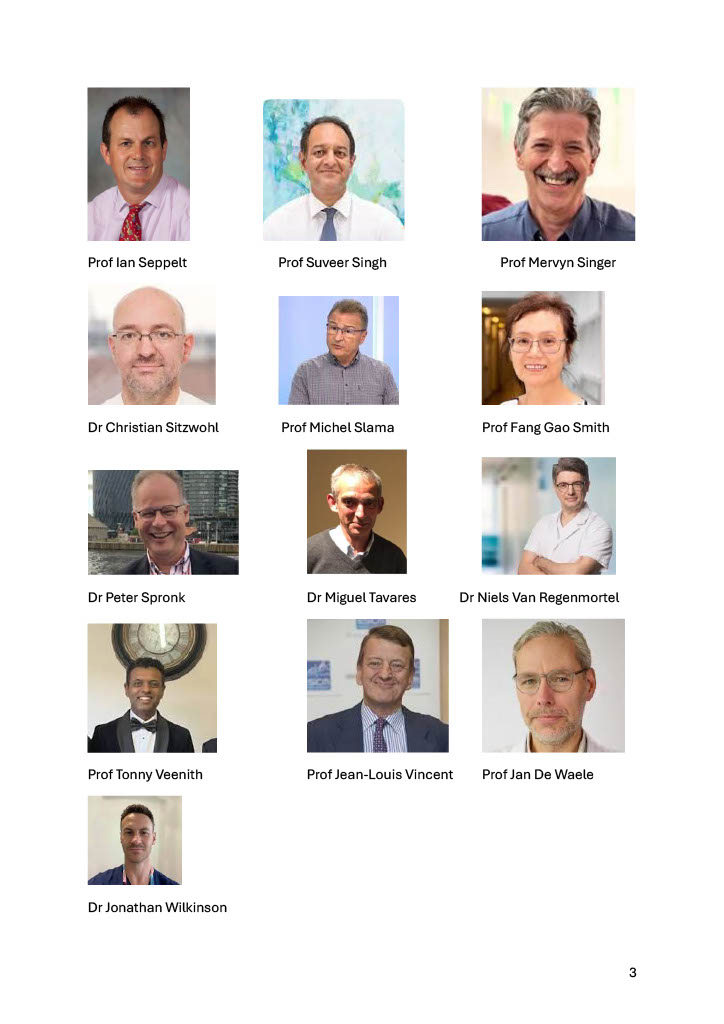
We are proud to feature an outstanding lineup of faculties, including:
- Dr. Lara Prisco - Neuro Critical Care
- Dr. Donna Hall - Cardiovascular Critical Care and Echo
- Prof. Michelle Chew - Sepsis, Cardiovascular, and Echo
- Prof. Fang Gao Smith - Anaesthesia, Postoperative Pain, Research
- Prof. Michel Slama - Cardiovascular and ECHO, including TOE
- Prof. Tonny Veenith - Neuro Critical Care, Research
- Prof. Funda Gok - Echo
The program encompasses a wide range of critical care topics, including rehabilitation and end-of-life care.
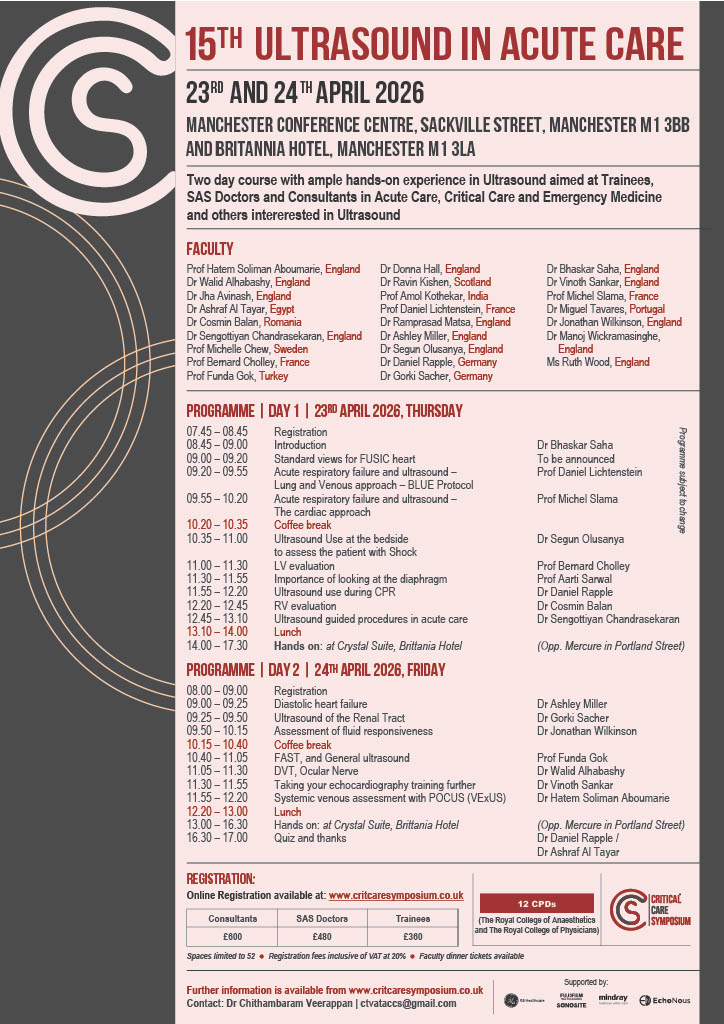
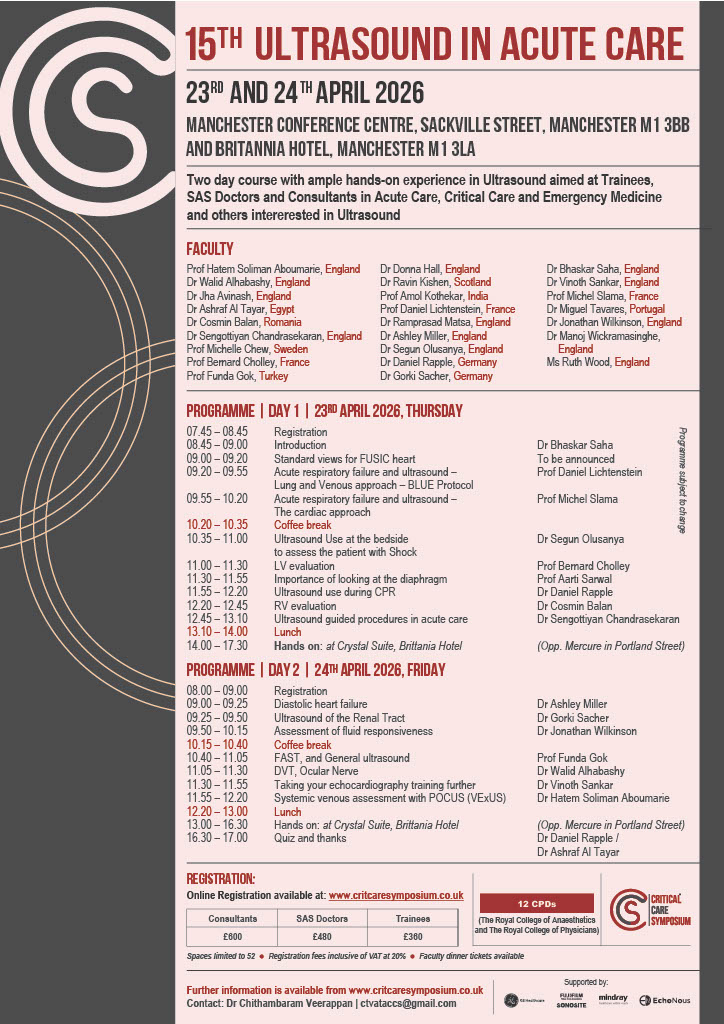
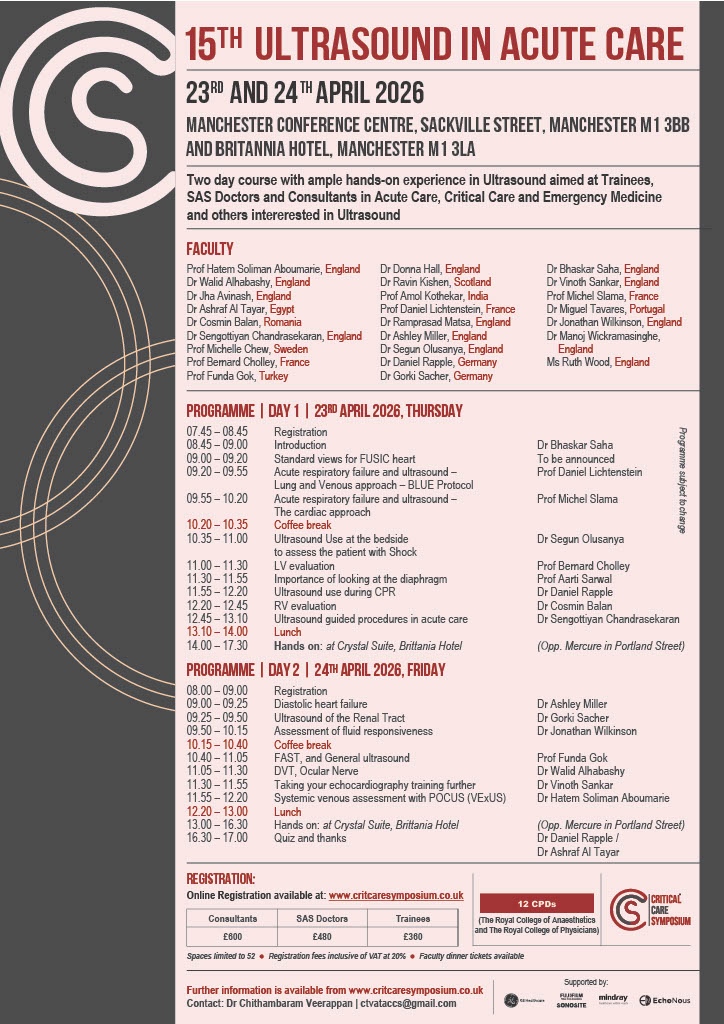
Additionally, the 15th Ultrasound in Acute Care will run concurrently, featuring over 20 faculties from the UK, Austria, France, Germany, India, Portugal, Sweden, Turkey, and the USA.
Participants will earn 12 CPDs. With limited places available, we invite you to join us. For the program details and online registration, visit https://t.co/fK6j5KdElq @OldhamICU@StockportICU@icm_yorkshire@ICULewisham@ICUbreeno@iceman_ex@Manoj_Wickram@Wilkinsonjonny@APMIC_Imperial@NW_ICM@APMIC_Imperial@icmteaching@DarkNatter@SCCM_EM@SICStrainees@SICStrainees@Welshanaesthes@WelshICS@CCOT_Kingston@BacrUob@AccpWessex@ACCP_NoECCN@accpheartlands@johnjandtrish@NWACCP@ELHT_DERI@ELHTresearch@KingsCritCare@GSTTanaesthesia@GSTT_ICU
🧵 Energy Reserve
The physics of circulation part 9
In the last thread we described an operating limit of the circulation:
• Volume reserve.
The heart cannot accept unlimited venous return.
But 'reserve' has a second component.
The heart must also generate the energy required to eject blood into the arterial system.
Less than five weeks remain until the 22nd Annual Critical Care Symposium and the 15th Ultrasound in Acute Care, taking place on April 23rd and 24th, 2026, at the Manchester Conference Centre and Britannia Hotel (for Hands-on Ultrasound).
This event features a lineup of esteemed experts, including:
- Prof Jan De Waele, discussing antibiotics, abdominal compartment syndrome, and environmental care
- Prof Marlies Ostemann, focusing on renal care and greener ICU practices
- Dr Ashley Miller, Dr Jonathan Wilkinson, and Dr Segun Olusanya, covering POCUS, FUSIC, and more
- Prof Don Chalfin, addressing health economics and biomarkers
- Prof Paul Dark, specializing in biomarkers and antibiotics
- Prof Hatem Soliman Aboumarie, focusing on cardiovascular intensive care, among others
Don't miss the two keynote addresses from Prof Jan Bakker and Prof Suveer Singh.
For the provisional program and online registration, visit https://t.co/fK6j5KdElq
@iceman_ex@Wilkinsonjonny@ManualOMedicine@icmteaching@GSTT_ICU@ICUltrasonica@ICUsteps@ELHTCritCare@cc_sn1@JasonKatzMD@GSTTanaesthesia@GSTT_ICU@AjEusuf@SuveerS@FICMNews@RCoANews@RCEMLearning@DrNeilStone
This is a really important Doppler physics point that influences how you interpret renal doppler signals in VExUS.
What you are seeing here is not a physiological change in renal venous flow. It's a change in Doppler sensitivity.
The velocity scale on colour or PW Doppler is essentially the PRF (pulse repetition frequency). When the scale is set high, the system is tuned to detect higher velocities and very slow flow may fall below the detection threshold. When that happens, the slower parts of the venous waveform simply disappear from the display.
The result is that only the faster portions of the waveform are visible, which can make flow appear interrupted or pulsatile.
If you progressively lower the scale, the machine becomes sensitive to lower velocities and those previously invisible parts of the waveform reappear. The same flow can therefore go from:
no visible flow → interrupted flow → continuous flow
purely as a function of Doppler settings, not physiology.
This matters because renal venous velocities are extremely low (often just a few cm/s), so inappropriate scale settings can easily create pseudo-pulsatility.
For renal venous Doppler the scale therefore needs to be reduced until low-velocity venous flow is fully visible (while avoiding noise). Only then can waveform morphology be interpreted.
The important implication is that some apparent renal venous “pulsatility” may reflect machine sensitivity rather than true flow interruption. This is something that I have not seen discussed in the VExUS literature.
@ThinkingCC@khaycock2@NephroP@ArgaizR thoughts?
Neurological emergencies demand rapid bedside insight into cerebral physiology.
In this review we summarise the evidence for NeuroPOCUS—including TCD, TCCD and optic nerve sheath ultrasound���and outline the new UK accreditation pathway for paediatric & adult practice.
🧠 Non-invasive neuromonitoring is coming of age.
#FUSIC
https://t.co/Vv5atJBtNr
Two educational meetings with a high learning content - 22nd Annual Critical Care Symposium and 15th Ultrasound in Acute Care is just 6 and half weeks away on 23rd and 24th April 2026 in Manchester Conference Centre, M1 3BB and M1 3LA.
The reasons to attend 22nd ACCS are:
Best networking opportunity
Great Keynote addresses
Great thematic sessions with the best of the best faculties
Wide and varied programme covering all aspects of critical care
Most friendly atmosphere
Multidisciplinary faculty from the UK and 4 continents
You will learn the real practical approaches in ICU
12 CPDs you will get
The best aspects of 15th UAC are
The. real pioneers are in the faculty
They are veery friendley
Fusic accredited
12 CPDs you will get
Only recommended groups in the hands on.
6 hours of hands on experience
15 spaces available at the minute.
Programme and online registration at https://t.co/fK6j5KdElq
@iceman_ex@icurehab@JasonKatzMD@icmteaching@ANWICU@DarkNatter@FICMNews@RCoANews@RCEMLearning@DrSimonAshworth@SOCCA_CritCare@cc_sn1@ICU_Management@ICUsteps@AjEusuf@Wilkinsonjonny@Manoj_Wickram@OldhamICU@WoSICS@sicsmembers@SICStrainees@WelshICS@ManualOMedicine
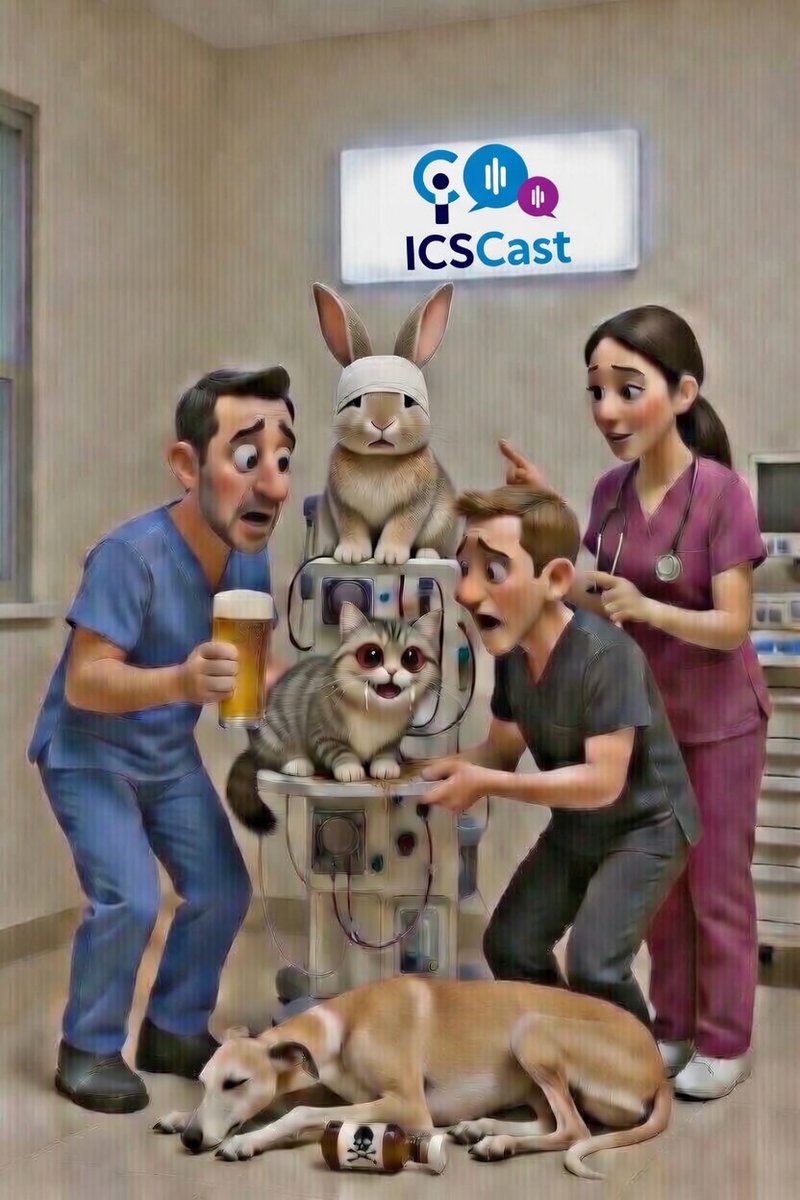
Want a light hearted laugh?😂🤣
See what happened when I interviewed a Veterinary Intensivist, and a Medical Intensivist together...
We talk anatomy, physiology, ventilation of giraffes, dialysis for dogs, drunk cats, head injured rabbits and more....
https://t.co/KJjPMgv791
To all healthcare professionals out there….no deliberate exclusion intended to offend:
What’s your A.I platform of choice and free text why as a reply to this.
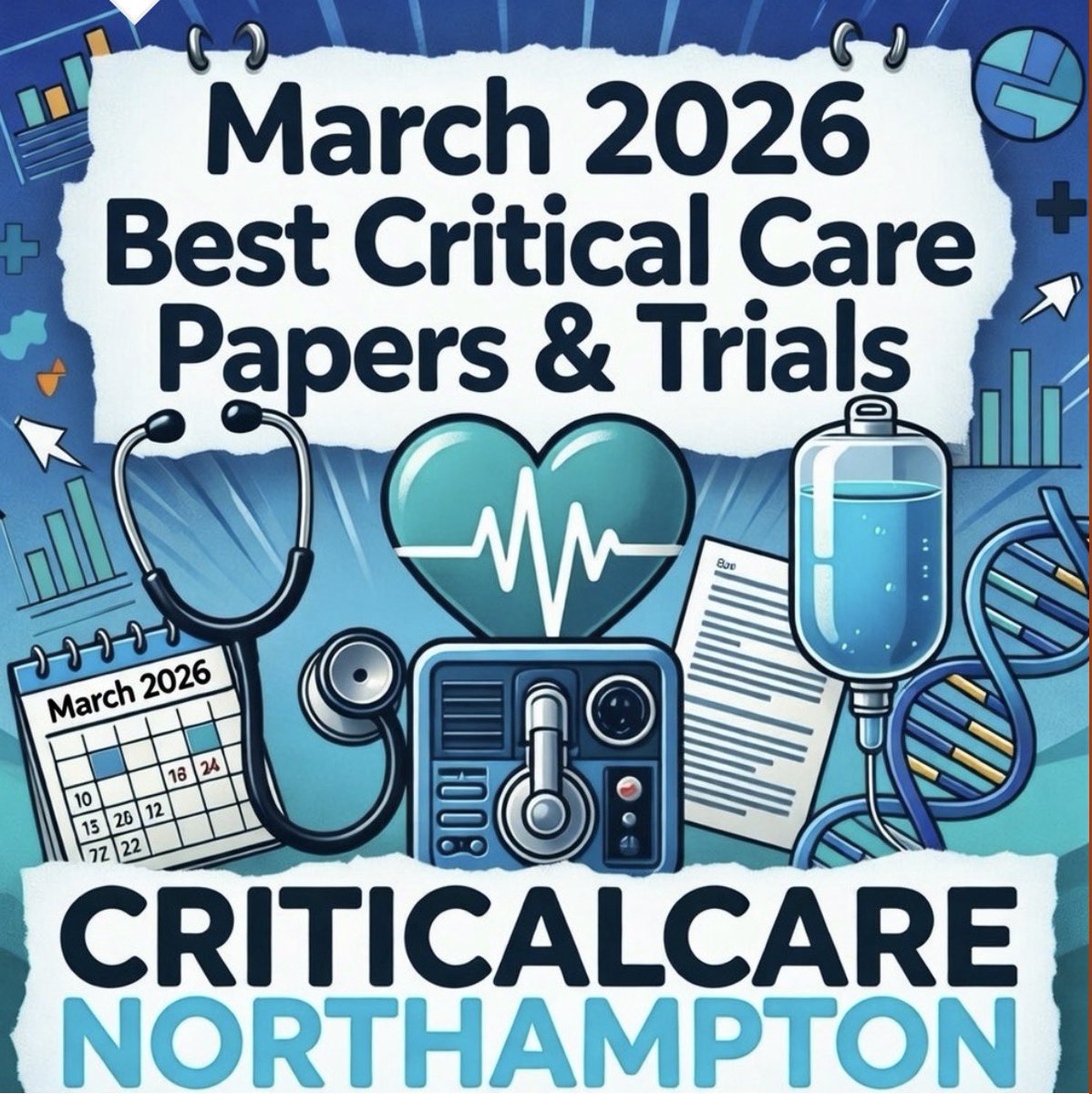
It’s out - March 26 grabs of the latest goodies in critical care papers, guidelines and more…
There’s so many, as @CritCareReviews says (featured in this edition).👇👇
https://t.co/LatHwHXpz1
#FOAMed#POCUS#FOAMcc#CriticalCare#ICU#IntensiveCare#Anaesthesia#Anesthesia #Anesthesiology #CritCare #ICUnurse #ICUMedicine #Medicine #Medical #MedEd #EmergencyMedicine #Resuscitation
Tomorrow marks the final day to take advantage of Early Bird registration for the 22nd ACCS, scheduled for April 23rd and 24th, 2026, in Manchester.
This event is recognized as one of the most welcoming gatherings in Critical Care, featuring an exceptional level of educational content. Experts in Intensive Care from the UK and four continents will share their knowledge and insights.
Attendees and faculty alike appreciate the informal atmosphere of this meeting, which fosters learning and collaboration.
Participants will earn 12 CPD credits from the RCoA and RCP.
Register now at https://t.co/fK6j5KdElq.
Looking forward to seeing you in April.
@iceman_ex@ICUltrasonica@icmteaching@ManualOMedicine@RCEMLearning@RCoANews@FICMNews@sicsmembers@SICStrainees@WelshICS@ANWICU@Wilkinsonjonny@yourICM@AjEusuf@AACNme@icurehab@IM_Crit_@sas_sobauk@nialldferguson
Efficiency 🧵
The physics of circulation part 7
Coupling tells us whether contractility (Ees) appropriately matches arterial load (Ea).
But matching is not just about tolerating the load.
It determines how efficiently the ventricle converts chemical energy into useful work.
🙌If you haven’t had the change to catch @icmteaching’s amazing tutorials…we’ve put them all onto a page so you can!
❤️Cardiovascular physiology, fluid paradigms and indoctrinated dogma, all thrown in the air! #FOAMed#POCUS#FOAMcc 👇👇
https://t.co/hHdGH63WGQ
#CriticalCare #ICU #IntensiveCare #Anaesthesia #Anesthesia #Anesthesiology #CritCare #ICUnurse #ICUMedicine #Medicine #Medical #MedEd #EmergencyMedicine #Resuscitation #cardiovascular
Don't miss the opportunity to register early for the 22nd ACCS, scheduled for April 23rd and 24th, 2026, at the Manchester Conference Centre, M1 3BB.
This event provides a unique chance to learn from an elite faculty who will be present on the floor, offering insights that are often unavailable at larger meetings or international congresses. The program encompasses the entire ICU spectrum, covering foundational topics and the latest advancements.
Early Bird registration closes on February 28th, 2026.
Additionally, the 15th UAC will take place concurrently on both days at split venues - MCC and Britannia Hotel, with limited places still available.
Participants will earn 12 CPDs from the RCoA and RCP for both meetings.
Register now to avoid disappointment at https://t.co/fK6j5KecaY.
@nialldferguson@icmteaching@ICMRDELHI@iceman_ex@Wilkinsonjonny@IM_Crit_@sas_sobauk@WelshICS@sicsmembers@SICStrainees@EchoSoliman@drshahrul80@ANWICU@iamritu
There are 25 days remaining to take advantage of the early bird registration for the 22nd ACCS. This event will be held at the Manchester Conference Centre, M1 3BB, on 23rd & 24th April 2026.
The symposium stands as the premier face-to-face meeting for Critical Care in the Northwest of England. It will feature over 40 distinguished faculty members from the UK and across four continents.
The programme encompasses a broad spectrum of critical care topics, including a dedicated half-day focused on recovery, rehabilitation, and follow-up care. A key highlight of the meeting is the approachability of the esteemed faculty, who will be available for engagement and discussion throughout the event.
Concurrent Event: 15th Ultrasound in Acute Care
Concurrently, the 15th Ultrasound in Acute Care (UAC) will be hosted on the same dates. Lectures are scheduled at the Manchester Conference Centre, while the hands-on sessions will take place at the Britannia Hotel on Portland Street, just a short 10-minute walk away. The UAC course will be led by pioneers in Critical Care, Acute Medicine, Emergency Medicine, and Anaesthesia ultrasound, all of whom have made significant contributions to peer-reviewed publications.
For further details on the programme and to register online, please visit https://t.co/fK6j5KdElq.
@iceman_ex@Wilkinsonjonny@icmteaching@GSTT_ICU@KingsCritCare@MarliesOst@ItensiveEcho@HSJnews@FICMNews@RCollEM@RCoANews@AnnaBatchelor@ANWICU@AjEusuf@sicsmembers@SICStrainees@WelshICS@sas_sobauk@drpferris@Sonosite@HamiltonMedical@MindrayUK@EchoSoliman@OldhamICU@DarkNatter@MerseyICM