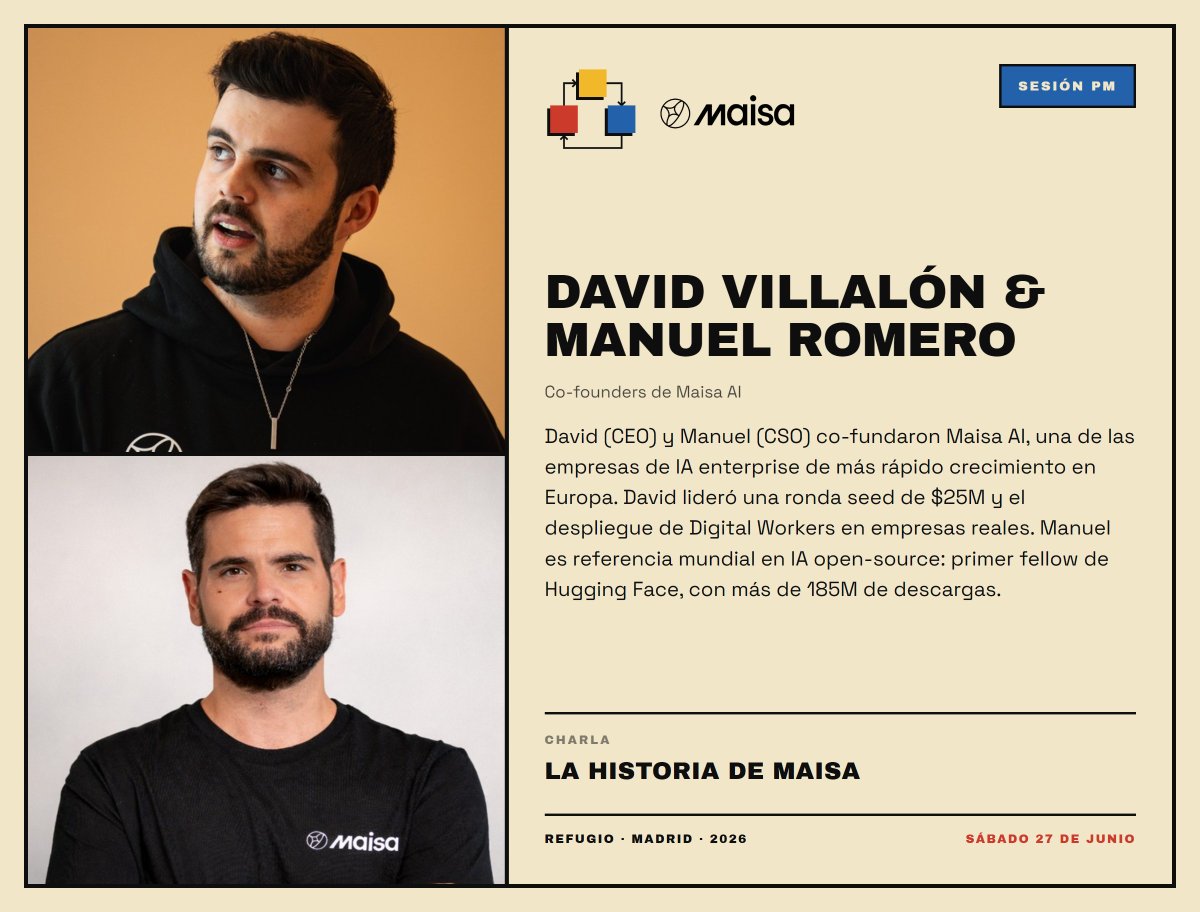
Yesterday I had the chance to share how I built my Hermes plugin for Hermes @NousResearch agent in an event for a bunch of students in Madrid. Glad to see the people getting their hands into Hermes 🥳
"Lo bueno, lo malo y lo feo... de la IA"
📄Un nuevo paper publicado por académico/as UC: Jocelyn Dunstan, Gabriela Arriagada y Domingo Mery, usa el clásico western de Sergio Leone para analizar la ética de la inteligencia artificial.
📲Paper disponible: https://t.co/wqnhbJGGLF
🔴 MIÉRCOLES: Un modelo de IA es un algoritmo que aprende y toma decisiones. Quien logre entrenar al mejor ganará la competencia y en este #ROCADICTOS Felipe Bravo (@dccuchile y @idiauchile) contextualizará esta discusión.
🗓️17/06
⏰16:00h
🎙️102.5 FM
➡️https://t.co/sfUzbvKR7t
🎓 La comunidad académica de la FCFM eligió a la nueva directora y directores que encabezarán diez departamentos durante el período 2026-2028.
Les deseamos éxito en esta nueva etapa al servicio de sus comunidades académicas y de la Facultad.
🔗 https://t.co/QpldGmcWSh
🐝🔬 La @utem recibió la visita del investigador francés Quentin Griette, de la Université Le Havre Normandie, en una instancia que fortaleció la colaboración internacional impulsada por el Departamento de Matemática de la casa de estudios.
Lee la nota ➡️ https://t.co/CKgMyB8MEd
🛰️ La @uchile, a través de la FCFM, lidera el desarrollo de SUCHAI 4, el nuevo nanosatélite que fortalecerá las capacidades espaciales del país.
Tecnología desarrollada desde Beauchef para seguir expandiendo la presencia chilena en el espacio.
🔗Más info https://t.co/4CqY3OINQr
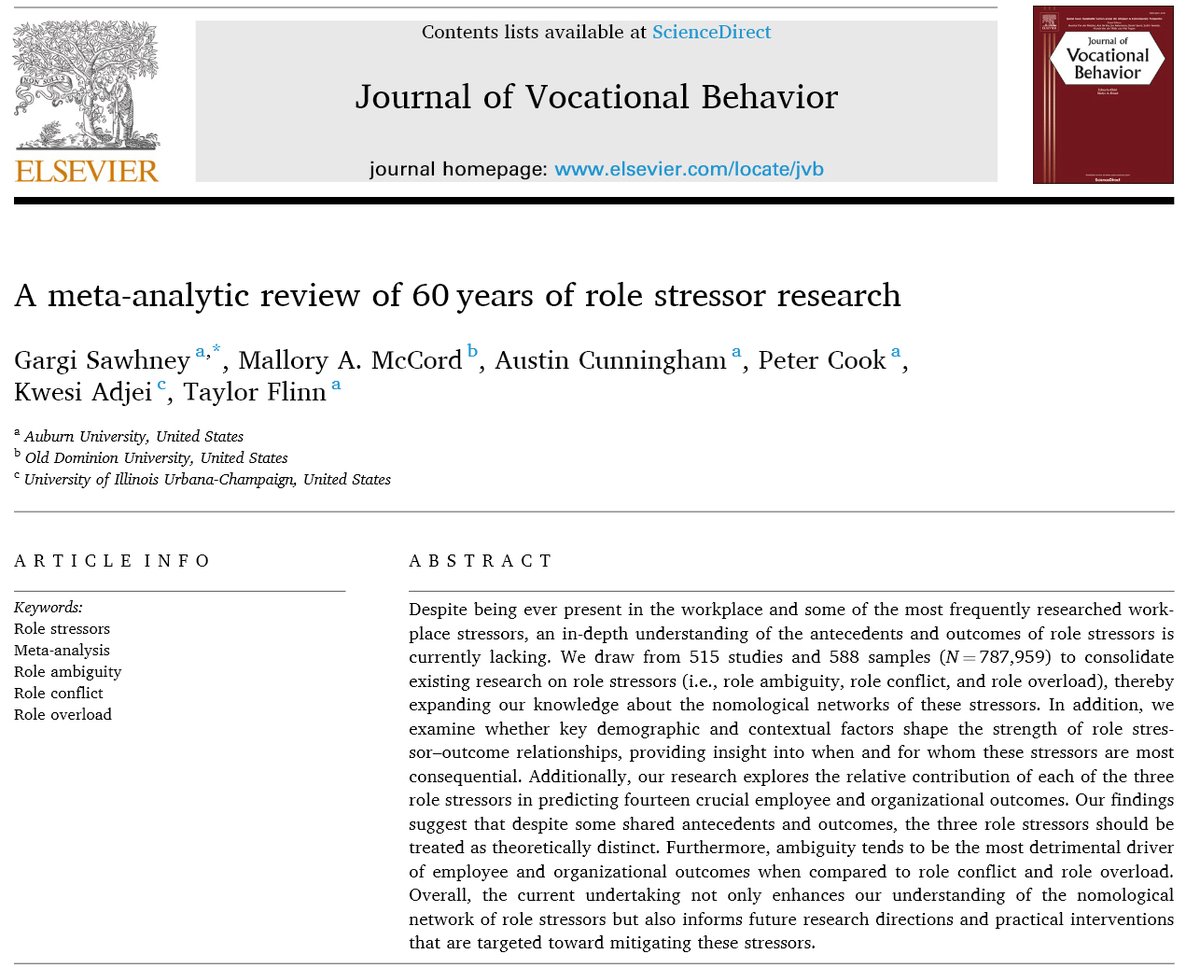
Not knowing what to do is as stressful as having too much to do.
515 studies, 787k people: Role ambiguity and role conflict are at least as detrimental to well-being and performance as role overload.
Setting clear, consistent expectations is a foundation of good leadership.
Since Google revealed its plans for an AI search overhaul, visits to our "No AI" search page have tripled…and they’re still rising!
Want to make it your default on Chrome or Firefox? Grab our No-AI extensions and banish AI-assisted answers, chat, and AI images.
People are realizing that AIs are nowhere near human intelligence and learning abilities.
Yet they have become very useful by compensating for their lack of common sense, lack of understanding of reality, and limited reasoning and planning abilities, by the accumulation of enormous amounts of declarative knowledge.
SPEAKERS #4: @davipar y @mrm8488
David y Manuel van a venir a REFUGIO a contar a la xavalada la historia de Maisa, las cosas wapas que están haciendo y cómo es eso de levantar una ronda de 25M en España con una empresa de inteligencia artificial
locurote, yo si fuera tú iría
Many suspect AI is to blame for growing unemployment among graduates in America. To find out whether this is the case, we compared labour-market outcomes before and after the arrival of large language models. Register for free to discover our findings https://t.co/BwM7mYGbDO
🌎 Somos 600M de hispanohablantes y 265M de personas lusófonas en el mundo. Necesitamos #LLMs que representen la rica diversidad cultural de nuestros países.
Este mayo llega la 5ª edición del #HackathonSomosNLP: +500 participantes, +20 países... ¡a por ello! 🚀
LLM Knowledge Bases
Something I'm finding very useful recently: using LLMs to build personal knowledge bases for various topics of research interest. In this way, a large fraction of my recent token throughput is going less into manipulating code, and more into manipulating knowledge (stored as markdown and images). The latest LLMs are quite good at it. So:
Data ingest:
I index source documents (articles, papers, repos, datasets, images, etc.) into a raw/ directory, then I use an LLM to incrementally "compile" a wiki, which is just a collection of .md files in a directory structure. The wiki includes summaries of all the data in raw/, backlinks, and then it categorizes data into concepts, writes articles for them, and links them all. To convert web articles into .md files I like to use the Obsidian Web Clipper extension, and then I also use a hotkey to download all the related images to local so that my LLM can easily reference them.
IDE:
I use Obsidian as the IDE "frontend" where I can view the raw data, the the compiled wiki, and the derived visualizations. Important to note that the LLM writes and maintains all of the data of the wiki, I rarely touch it directly. I've played with a few Obsidian plugins to render and view data in other ways (e.g. Marp for slides).
Q&A:
Where things get interesting is that once your wiki is big enough (e.g. mine on some recent research is ~100 articles and ~400K words), you can ask your LLM agent all kinds of complex questions against the wiki, and it will go off, research the answers, etc. I thought I had to reach for fancy RAG, but the LLM has been pretty good about auto-maintaining index files and brief summaries of all the documents and it reads all the important related data fairly easily at this ~small scale.
Output:
Instead of getting answers in text/terminal, I like to have it render markdown files for me, or slide shows (Marp format), or matplotlib images, all of which I then view again in Obsidian. You can imagine many other visual output formats depending on the query. Often, I end up "filing" the outputs back into the wiki to enhance it for further queries. So my own explorations and queries always "add up" in the knowledge base.
Linting:
I've run some LLM "health checks" over the wiki to e.g. find inconsistent data, impute missing data (with web searchers), find interesting connections for new article candidates, etc., to incrementally clean up the wiki and enhance its overall data integrity. The LLMs are quite good at suggesting further questions to ask and look into.
Extra tools:
I find myself developing additional tools to process the data, e.g. I vibe coded a small and naive search engine over the wiki, which I both use directly (in a web ui), but more often I want to hand it off to an LLM via CLI as a tool for larger queries.
Further explorations:
As the repo grows, the natural desire is to also think about synthetic data generation + finetuning to have your LLM "know" the data in its weights instead of just context windows.
TLDR: raw data from a given number of sources is collected, then compiled by an LLM into a .md wiki, then operated on by various CLIs by the LLM to do Q&A and to incrementally enhance the wiki, and all of it viewable in Obsidian. You rarely ever write or edit the wiki manually, it's the domain of the LLM. I think there is room here for an incredible new product instead of a hacky collection of scripts.
GLM-4.5 looks like a big deal!
> MoE Architecture
> Hybrid reasoning models
> 355B total (32B active)
> GQA + partial RoPE
> Multi-Token Prediction
> Muon Optimizer + QK-Norm
> 22T-token training corpus
> Slime RL Infrastructure
> Native tool use
Here's all you need to know:
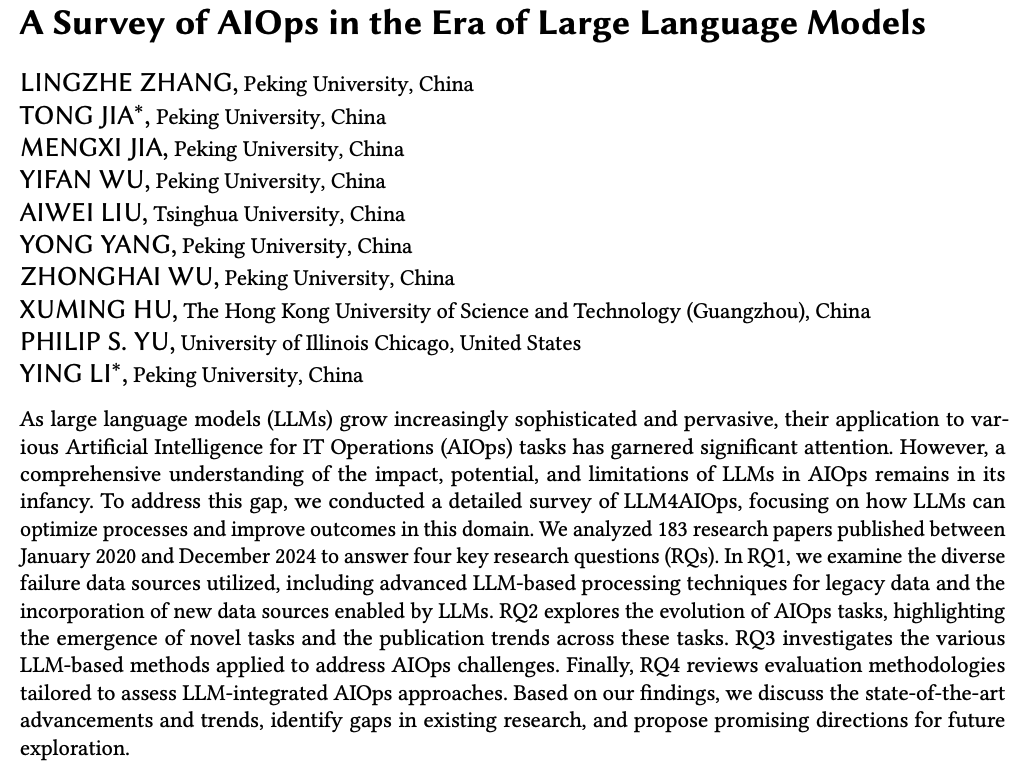
AIOps in the Era of LLMs
Specifically, it looks at LLM4AIOps by analyzing 180+ papers.
This is one of the many interesting ways to use LLMs in production.
Pay attention, devs!
My notes below:
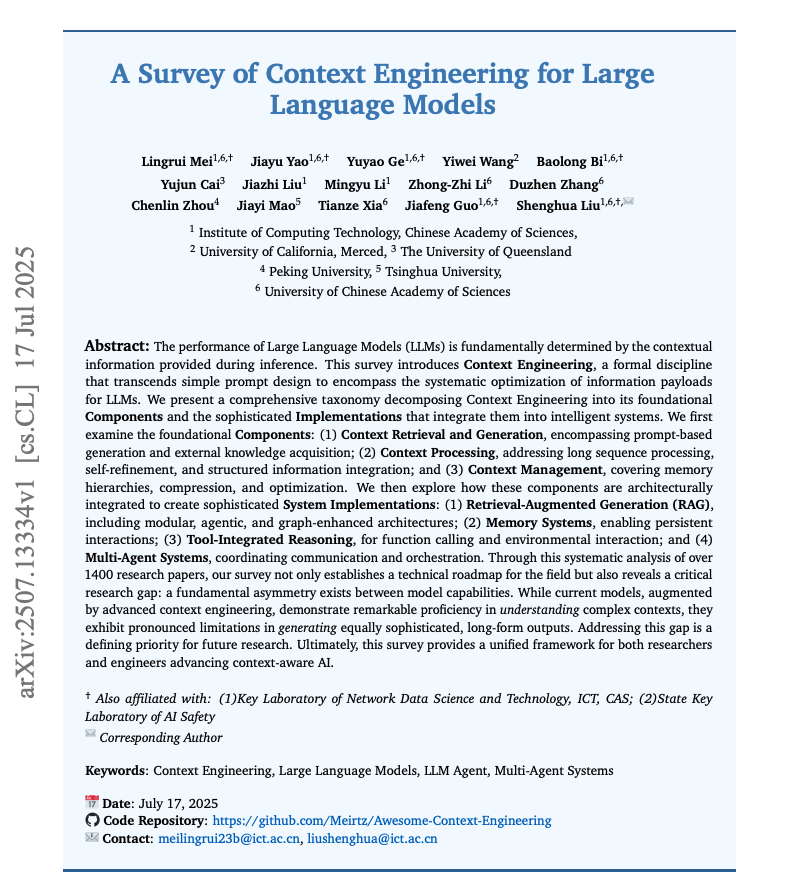
A Survey of Context Engineering
160+ pages covering the most important research around context engineering for LLMs.
This is a must-read!
Here are my notes:
Knowledge or Reasoning?
Evaluation matters, and even more so when using reasoning LLMs.
Look at final response accuracy, but also pay attention to thinking trajectories.
Lots of good findings on this one.
Here are my notes: