Ghana has made history at the 2026 Robofest World Championships in Michigan, USA, after reportedly emerging winners of the Junior Division competition ahead of 26 teams from 19 different countries.
[🎥: Wako TV]
The University has secured a major Erasmus+ international partnership under the German-African Project 2026–2028 to advance career development, entrepreneurship training and intercultural learning across Africa and Europe.
Read more: https://t.co/k3OXRhY50r
#UG
Instead of watching an hour of Netflix, watch this 60 minute lecture from Steve Jobs after being fired from Apple. It will teach you more about building companies than most startup books ever will.
And now @Visa.
The world's largest payment network has turned on Polygon rails for its global stablecoin settlement program. Visa's partners can now move money instantly on @0xPolygon.
$2.4 trillion in volume already moves through these rails. The names settling here: @Mastercard, @theFlutterwave, @stripe, @Revolut, @BlackRock, and @Visa.
Polygon was built for payments. Visa just confirmed it.
USD 1 billion.
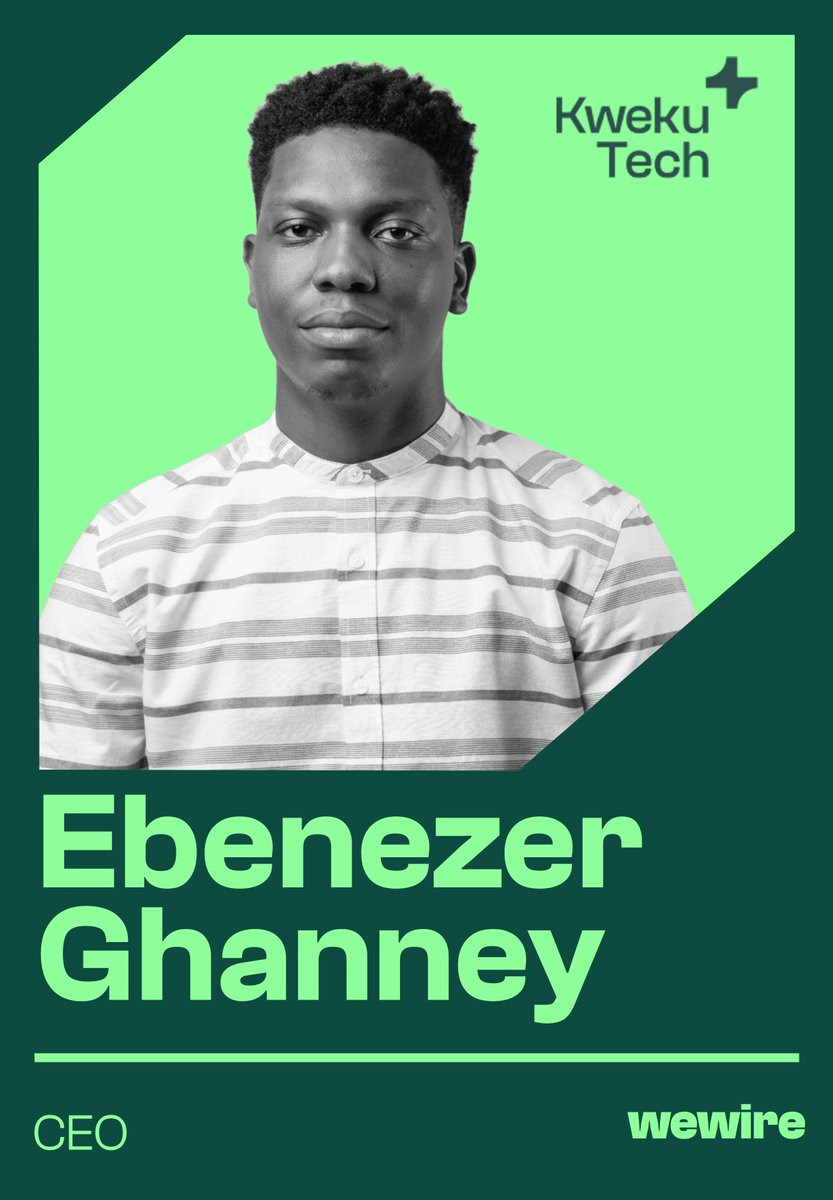
That is how much money has moved through Ebenezer Ghanney's(@_Iampkay) hands since 2021.
Not through a legacy bank. Not through a global payments institution. Through a company he built from a desk in Accra, four years ago, with the receipts from two companies that did not survive.
His company is @usewewire. And if you read our thread (link in cs) from yesterday, you already know exactly what problem he woke up every morning to solve.
The story starts at the @upsaccra, where Ebenezer studied accounting. Not code. Not product. Money. The movement of it. The mechanics of it. The gap between what a transaction should cost and what it actually costs when it crosses an African border.
From UPSA, he moved through @GetLiquidgh, first as an accounting clerk, then leading business development and campus activations at KNUST and Legon. He was learning how financial products actually get adopted. Not in a classroom. On the ground.
Then the startups. HostelMate: a student accommodation booking platform. He listed over a thousand beds across seven hostels in Accra. Could not find product-market fit. Closed.
Powrsale: built to solve social commerce fraud, a real problem with real victims. Did not survive. He does not hide these. He says they shaped how WeWire was built from the ground up.
In September 2020, @yellowcard_app brought him in to launch their Ghana operations. No users. No transaction history. Zero paid marketing budget.
By end of month one: USD 450,000 in transactions. By year one: 150,000 users. Over USD 20 million in volume.
That is not a statistic. That is a system built by someone who knew exactly what he was doing.
But running cross-border payments from inside a crypto platform showed him a different kind of gap.
Not the consumer remittance story. The business infrastructure story. The importer in Accra paying a supplier in Nairobi. The regional company with payroll in three currencies. The operation that loses margin every single time money crosses a border.
In April 2022, he left to build the answer.
WeWire is a B2B cross-border payments company. Banking and treasury services for businesses moving money across Africa and the world. Today it operates in Ghana, Nigeria, Kenya, Uganda, the UAE, the USA, and Canada. Seven markets. Four years.
Yesterday we asked why sending money from Accra to Lomé costs more than from Accra to London. Lomé is three hours away. London is six thousand kilometres.
Ebenezer did not wait for someone to answer that question. He built the infrastructure that makes it answerable.
Who else do you think is quietly building cross-border payment solutions Africa actually needs?
Drop their name below🔽.
I am genuinely stoked for @tempo's new virtual addresses feature that they announced yesterday. I think this could be a real sleeper hit and I'm guessing that most people who don't have first-hand experience building on-chain don't realize it.
In almost 8 years building in crypto I've had to solve the deposit-address problem at literally _every single company_ I've worked at. Every time its the same build out:
Generate a unique address per customer
Sweep funds back to a master wallet
Manage gas in every leaf address
Reconcile timing differences
Handle the edge cases
It's the kind of thing that sounds simple in a design doc and then can end up eating a quarter of your team's roadmap.
It is _so cool_ to make this a protocol primitive - and totally obvious in hindsight. No sweeps, no per-address gas, no state bloat from millions of customer accounts sitting around with minuscule amounts of dust in them.
This is another one of those things that - if you've built any kind of systems in payments before - seems like an absolute no-brainer, yet somehow we don't have any blockchains with virtual accounts as a first-class citizen yet (Solana's ATAs partially get there but you still need to pay rent per account).
Bullish on how much friction this will remove for teams bringing AR / AP on chain and on more protocols bringing more "obvious" payments primitives on chain in general. Hat tip.
Turn Claude into the best creative agent in the world!
Our users generate over 1 billion images and videos every year.
Now Claude can too.
RT and comment "Pixa" for free access!
Tasklet (@taskletai) is the cloud agent OS for knowledge work. It connects to all your tools, uses computers in the cloud, and runs 24/7 to get real work done.
Started by Firebase founder @startupandrew and @jonnydimond, it’s grown >1,200% this year to $5M ARR and just raised $20M.
Congrats to the team!
https://t.co/SX3EyYDmWb
Before you build a stablecoin product, go work at a Payments & FX Firm for at least a year (minimum). Then, and only then, go and ship.
The amount of data points that you will get on what can be optimised will definitely change the product you had in mind a year prior (this is a guarantee).
73 product releases in 52 days. That's not a launch cadence — that's a different kind of company.
I tracked every Anthropic release from Feb 1 to Mar 23 by going through @bcherny, @trq212, @noahzweben, @felixrieseberg, @lydiahallie, @amorriscode, @feldman, @dickson_tsai, and @claudeai. Built a calendar with first-announcement attribution.
Look at the acceleration. February had bursts with gaps between them. March 9 onward is almost every single day — Code Review, Channels, Dispatch, Computer Use, back to back.
The individual features get coverage. The shipping velocity doesn't. It should.