Agriculture is clearly critical to our lives and economy. But the San Joaquin Valley shows the detrimental effects it can have. Here, farms pump a lot of groundwater and can pollute with fertilizers and pesticides. This often leaves people with dry wells or dirty water.
I’m enjoying seeing different water #infrastructure in California than I see back east. The Friant-Kern Canal is 152 miles long and provides #water for one million acres of crop land and 250,000 people in the San Joaquin Valley.
Learn more at https://t.co/Lz6EBKOsP9
Advice from @DenverWater CFO Angela Bricmont on how utilities should figure out funding the replacement of lead service lines?
"Don't go it alone."
There are many resources available and colleagues that are willing to help.
#podcast ▶️ https://t.co/O4UL1M61mm
It is crucial for #water utilities to communicate effectively with customers as they build inventories of lead service line locations by 2024.
@LeadCopperRule can help.
Learn more at https://t.co/tmf3Bo37QB
Thanks https://t.co/MyTOSzkoPH for supporting our series on lead!
“We should judge water by its quality, not its history.”
That’s the point of beer made with recycled water and a #PureWaterBrew tagline (shout out @JockersM)
Great article on the beer made by @ATartakovsky and @EpicCleantec. Glad I could add a few words.
https://t.co/codlzzV8Jq
Agriculture uses 80% of the #water from the Colorado River.
So @americanrivers is working with farmers and ranchers to pilot new techniques for growing crops that use less water.
#podcast ▶️ https://t.co/V7cZUEMqrn
Always happy to have a #PureWaterBrew, a #beer made with recycled #water.
This Kolsch is made with purified water from San Francisco's first approved greywater reuse system, found in an apartment building.
Cheers to @ATartakovsky & @EpicCleantec for the tasty, sustainable beer!
There is much work to be done to educate people about sources and risks of #PFAS in their lives.
When are regulators going after cosmetics and the other household products and consumer goods that are responsible for vast majority of our exposure?
Or is industry too powerful?
It may cost around $50 billion to remove all the nation's lead service lines.
States should clarify that utilities can use public funds for work on private property, which allows them to tap into bonds, says Tom Neltner of @EnvDefenseFund.
#podcast ▶️ https://t.co/DYPIIQZgAN
Analysis has shown a significant lack of diversity in the sources cited in media coverage. So the Color of Water was created. It’s a directory that journalists can use to connect with a diverse set of #water experts, explains @JoseLAranda1 of @water_hub. https://t.co/1wdMQPLkwI
When @CFPUA found high levels of #PFAS in the #water, it couldn't wait for government regulators to provide direction.
The utility evaluated treatment options and built a $43 million granular activated carbon system, says @kennyraywald.
#podcast ▶️ https://t.co/rLLlzyo5g7
MOSAIC is a committee of @ASCETweets that works to ensure the #engineering industry is equitable and inclusive, including in leadership positions, the workforce, and infrastructure in communities, says Tim Alston.
#podcast at https://t.co/3ffCZzukVi
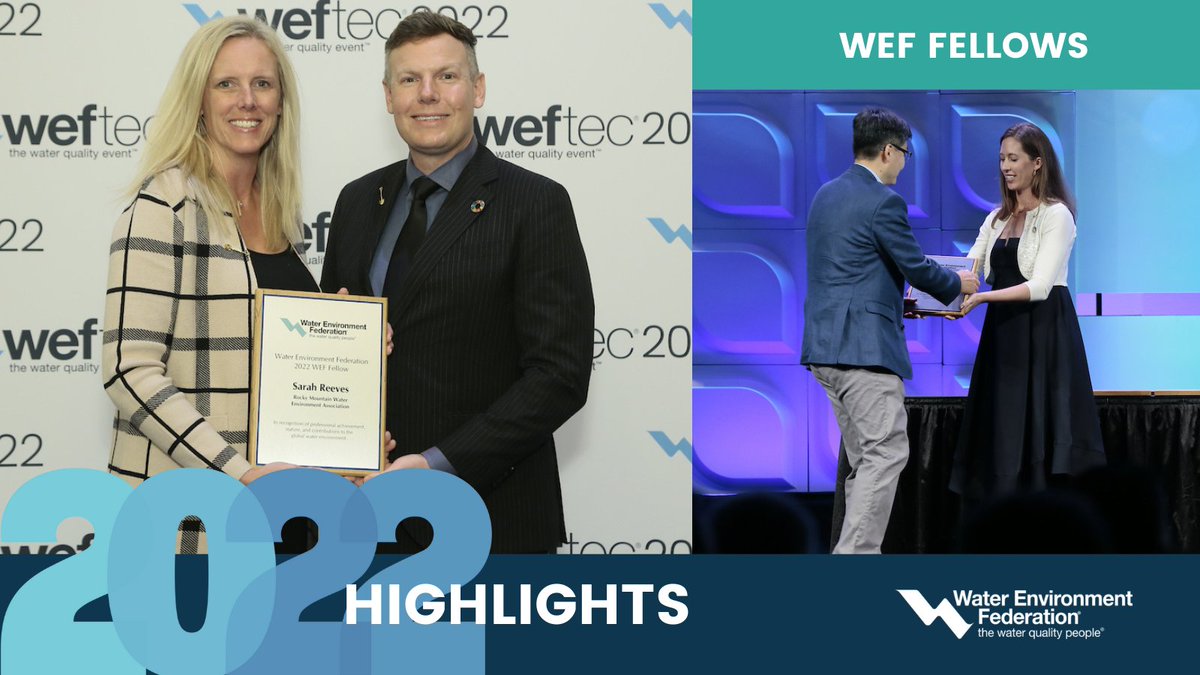
This year, we honored 14 WEF Members with the distinguished WEF Fellows Award. We truly appreciate your dedication and service to the #watersector and enjoyed celebrating with you at #WEFTEC 2022! Meet the WEF Fellows: https://t.co/ppcGCK8dIl
#WEFAwards#WEFfellows