Announced roughly a year ago, MAPTISM is finally out
MAPTISM dot org serves as a repository for all Maptism maps, animations, threads, graphics and other materials, easily and quickly accessible in full resolution and also in "tiled view".
Currently host to a selection of curated maps, most with their respective articles and sources, over the coming days it will be updated to contain all Maptism maps and animations, as well as ported and reformatted twitter threads for easier viewing and reading.
~160 maps are on the backlog and will be ported over in the coming days.
The site also includes a Commission form for easier Commission processing and more information for what type of Maps and Services we are able to provide: its not just prehistory!
Right now, the main highlights are the Corded Ware and 2nd century Germanic threads ported over as well as the Mycenaean Maps.
We're also stripping the "non-commercial" aspect of the licensing, and simply using CC BY 4.0 on the maps. Free for reuse, provided there is attribution.
Interpolated regional frequency map of R1a-L664, a paternal lineage of R1a unique to Scandinavia, while the majority of other R1a clades are usually associated with Baltic, Slavic and Indo-Iranic populations.
Based on FTDNA regional and national DNA projects as well as Poreklo and Rrënjëts public datasets.
R-M458 Interpolation over a map of Europe
Although clearly an Early Slavic dispersed branch with Migration Period and Early Medieval samples showing this it has been argued for some time now as to what its Pre-Slavic origin could be:
1/2
There, in Phrygian Anatolia, the cult of Cybele stood since the most ancient of times. There, the eunuch priests, the Galli, whipped themselves in a frenzy during the Dies Sanguinis ("Day of Blood") to atone by sprinkling the altars and effigies with their blood, while new initiates self-castrated. The Roman writer Lucian wrote:
"On these days..A young man who has come for this purpose throws off his clothes, steps into the middle of the crowd with a loud cry, and draws a sword... He immediately gelds [castrates] himself, and then runs through the city holding in his hands the parts he has severed. He throws them into whatever house he pleases"
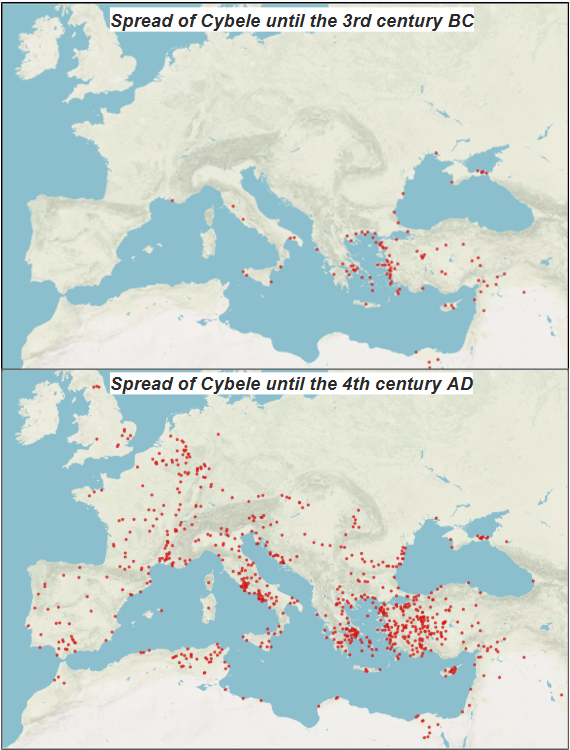
At the temple of Pessinus, the aniconic image of the goddess stood in the form of an "unshaped stone of black meteoric iron," known to the Semites as a baetyl. From there, the religion spread to Anatolia and the Aegean, and much further. For in the Second Punic War, after Cannae, when things seemed most desperate for Rome, they consulted the Sibylline prophecies, which told them to bring a goddess from their Trojan homeland. So the sacred black stone and the Galli priests were brought to Rome and made part of the state religion. Rome won the war and placed the goddess named Magna Mater in the Temple of Victory, and the cult of Cybele spread throughout the empire.
Interpolated regional frequency map of E-V13, a paternal lineage found most frequently from Ancient Thracian Samples.
Based on FTDNA regional and national DNA projects as well as Poreklo and Rrënjëts public datasets.
Interpolated regional frequency map of R1b-DF27, a paternal lineage originating in the Bell Beaker culture, downstream of R1b-P312.
Based on FTDNA regional and national DNA projects as well as Poreklo and Rrënjëts public datasets.
The complete map of Migration Period spread of Early Slavs during the 5th to 7th century A.D
This expansion had permanent effects on the ethnogenetic landscape of Europe, almost replacing the entirety of the preceding groups before their arrival.
Interpolated regional frequency map of R-U106, a paternal lineage originating in 2700bc, possibly in Corded Ware or Bell Beaker contexts.
Based on FTDNA regional and national DNA projects as well as Poreklo and Rrënjëts public datasets.
I maintain that the roots of both Celtic and Germanic languages lie within this triangle which is the cross over zone where the Beaker folk, themselves derived from Corded Ware folk, back migrated and mixed with/lived alongside Corded Ware people.
The actual start of Proto-Celtic and Paleo-Germanic in the Bronze Age both post date these back migrations by over 1000 years so there is no point trying to ascribe either language family exclusively to one BB or CW origin. We know each owes something to these complex mixings
@wacistwigga I dont see why they wouldn't speak the ancestor of Proto-Germanic. Ofc, it would be different stages with Single Grave being late PIE, Dagger Period and early NBA being Palaeo-Germanic and late NBA being Pre-Proto-Germanic, with Proto-Germanic emerging in 600bc