How will your country's demographics change this century?
At Our World in Data we built a tool to let you see for yourself.
The UN's assumptions are the starting point.
But then you can adjust the three drivers of change — births, deaths, and migration — to what you expect.
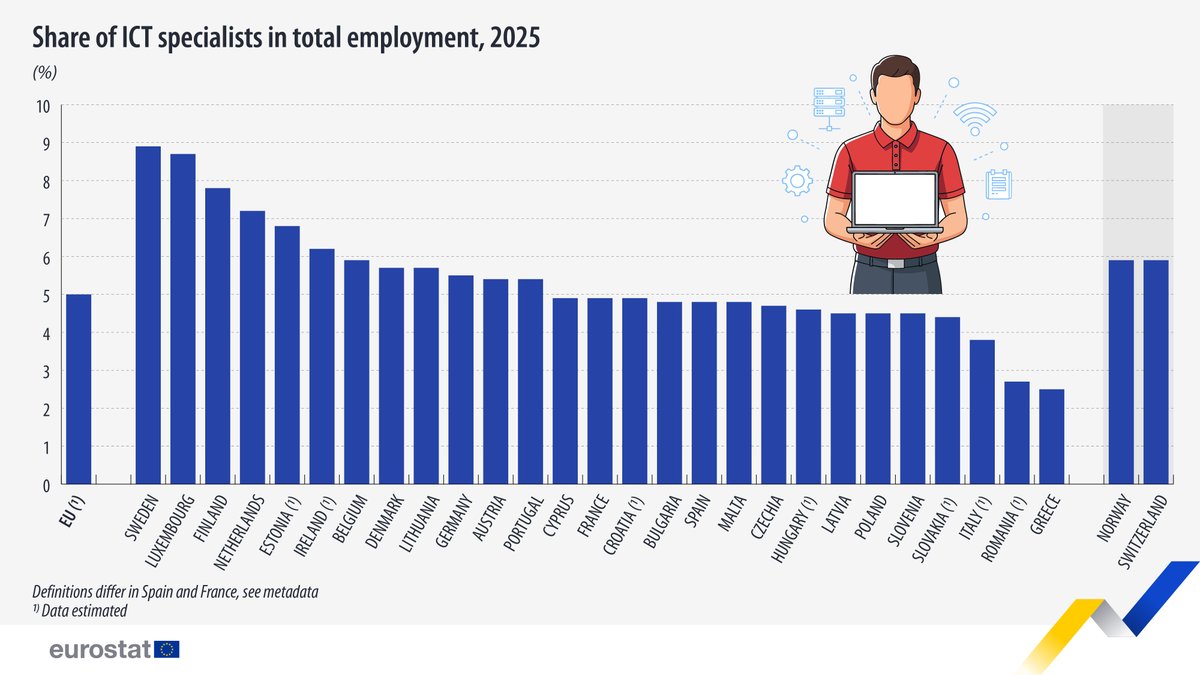
In 2025, 10.45 million people were employed as information and communication technology specialists across the EU (5.0% of all employed people).💻
Highest shares in:
🇸🇪Sweden (8.9%)
🇱🇺Luxembourg (8.7%)
Lowest in:
🇬🇷Greece (2.5%)
🇷🇴Romania (2.7%)
👉https://t.co/Zm3vE9tfIl
Why do we need to know about progress if we are concerned about the world's largest problems?
Let’s look at one of the very worst global problems of all — the death of children. One of the leading causes of death for children is malaria, which kills more than 300,000 children each year.
The death rate from malaria has decreased significantly in the past 20 years, as you can see in the chart.
People who study malaria see several reasons that make it very likely that continued progress against this disease is possible.
The factors that are holding us back in the fight against malaria are the three factors that often limit our progress:
1) More money would make more progress possible — e.g., buying more insecticide-treated bed nets, which are a very effective way to reduce malaria’s death toll.
2) More people who set themselves the goal to work towards progress can make a difference — e.g., researchers and others who developed not one but two vaccines against malaria and are now rolling them out to those most in need.
3) More attention and the understanding that it is a solvable problem would make more progress possible — it’s likely we would not see a lack of funding and talented people working on malaria if malaria were to get the *attention* it deserves.
300,000 child deaths per year means 820 dead children on any average day.
What is true about malaria is true about many of the problems the world faces. Making progress is hard, but it is possible.
The progress made over the last two centuries has not ended in our lifetimes. There are possibilities to make the world a better place. It is on us to realize this.
Kasparov: Trump always plays for Trump: his money, his glory, his family. But in the Ukraine war, he is playing on Putin’s side.
He never says a bad word about Putin, always explains Putin’s actions, and every concrete step helps Putin’s war effort. 1/
The world is warming despite natural fluctuations from the El Niño cycle—
In 2025, the world was around 1.4 °C warmer than it was in pre-industrial times. But temperatures haven’t increased linearly; there have been spikes and dips along the way.
Many of these spikes and dips are caused by the El Niño-Southern Oscillation (ENSO), a natural climate cycle caused by changes in wind patterns and sea surface temperatures in the Pacific Ocean that affects global temperatures and climate.
There are two key phases of the ENSO cycle: La Niña, which causes cooler global temperatures, and El Niño, which brings warmer conditions.
The world cycles between El Niño and La Niña phases every two to seven years. There are also “neutral” periods between these phases where the world is not in either extreme.
As you can see in the chart, global temperatures during recent La Niña years were hotter than El Niño years just a few decades before. “Cool” years today are hotter than “warm” years not too long ago.
Our colleague Veronika Samborska recently updated this data, which she does every month.
Trump’s war against Iran is costing the US hundreds of millions of dollars a day — and about a tenth of that is the price of military equipment destroyed in the fighting, according to recent analysis.
Read more: https://t.co/lLLlC21PXV
Image: U.S. Navy/Handout via Reuters
Ci vuole coraggio.
Vedi alla voce Afghanistan!
E, prima ancora: Iraq
Esclusi dalla dichiarazione di guerra.
Esclusi dalla capitolazione.
Ingiurie ai morti.
Ci vuole proprio coraggio
📊 Data update: How much do people trust their government? How does this vary across countries, and how has it changed over time?
To help answer these questions, the OECD publishes data on trust in government across 47 countries as part of their How's Life? Well-being Database, drawing on the Gallup World Poll.
In the United States, the Pew Research Center has tracked public trust in government going all the way back to 1958.
Our colleague @parriagadap recently updated our charts with the latest releases from both sources.
📊 Explore updated data on self-reported life satisfaction around the world from the 2026 World Happiness Report (@HappinessRpt)—
How satisfied are people with their lives? Are they getting more satisfied over time, or less? How does this vary across cultures and life circumstances?
The World Happiness Report (WHR) is one of the key sources we have for answering these questions. Based on the Gallup World Poll, the WHR has published data on life satisfaction since 2012 and covers more than 140 countries worldwide.
Our colleague Tuna Acisu just updated our charts with the latest data (through 2025) from the 2026 edition of the report, released today.
The WHR is a partnership of Gallup, the Oxford Wellbeing Research Centre, the UN Sustainable Development Solutions Network, and the WHR’s Editorial Board.
“Gli amici dell'America devono aiutarla a uscire da una guerra illegale
La superpotenza ha perso il controllo della sua politica estera, scrive Badr Albusaidi, Ministro degli Esteri dell'Oman.” https://t.co/Ld8XhaDyzk
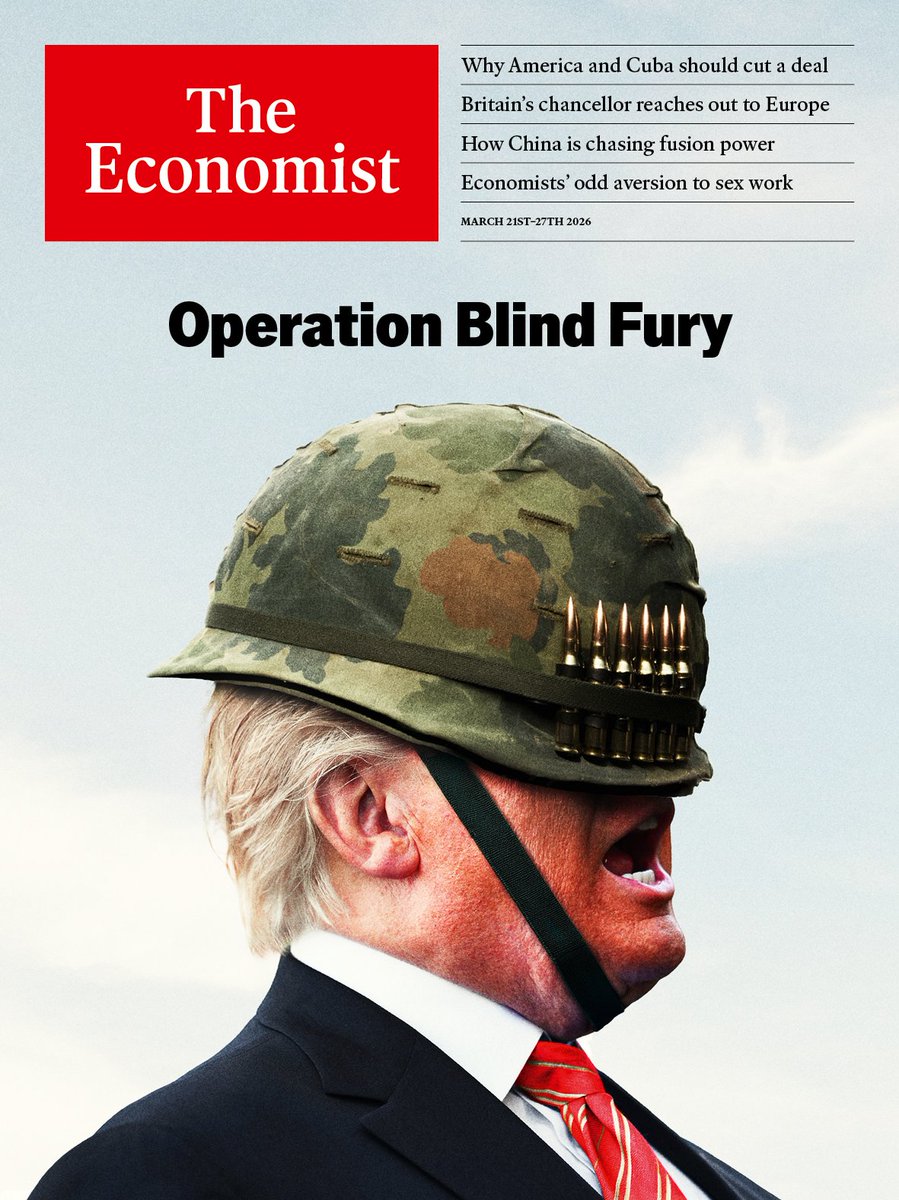
The reckless campaign against Iran will weaken America’s president. That will make him angry. Be warned: he makes a very bad loser https://t.co/UUNQjqewMl
58% of Americans disapprove of U.S. military strikes against Iran. Check out our new roundup of polling related to the Iran conflict to see how people in America, Canada, France, the Netherlands and the U.K. are feeling amid this ongoing crisis https://t.co/9ShQWmA9HL
To achieve European collective security, Europeans must “relinquish the primacy of national sovereignty” and give the EU more power to organize collective defense, argues @maxbergmann.
https://t.co/rNzA1fu232
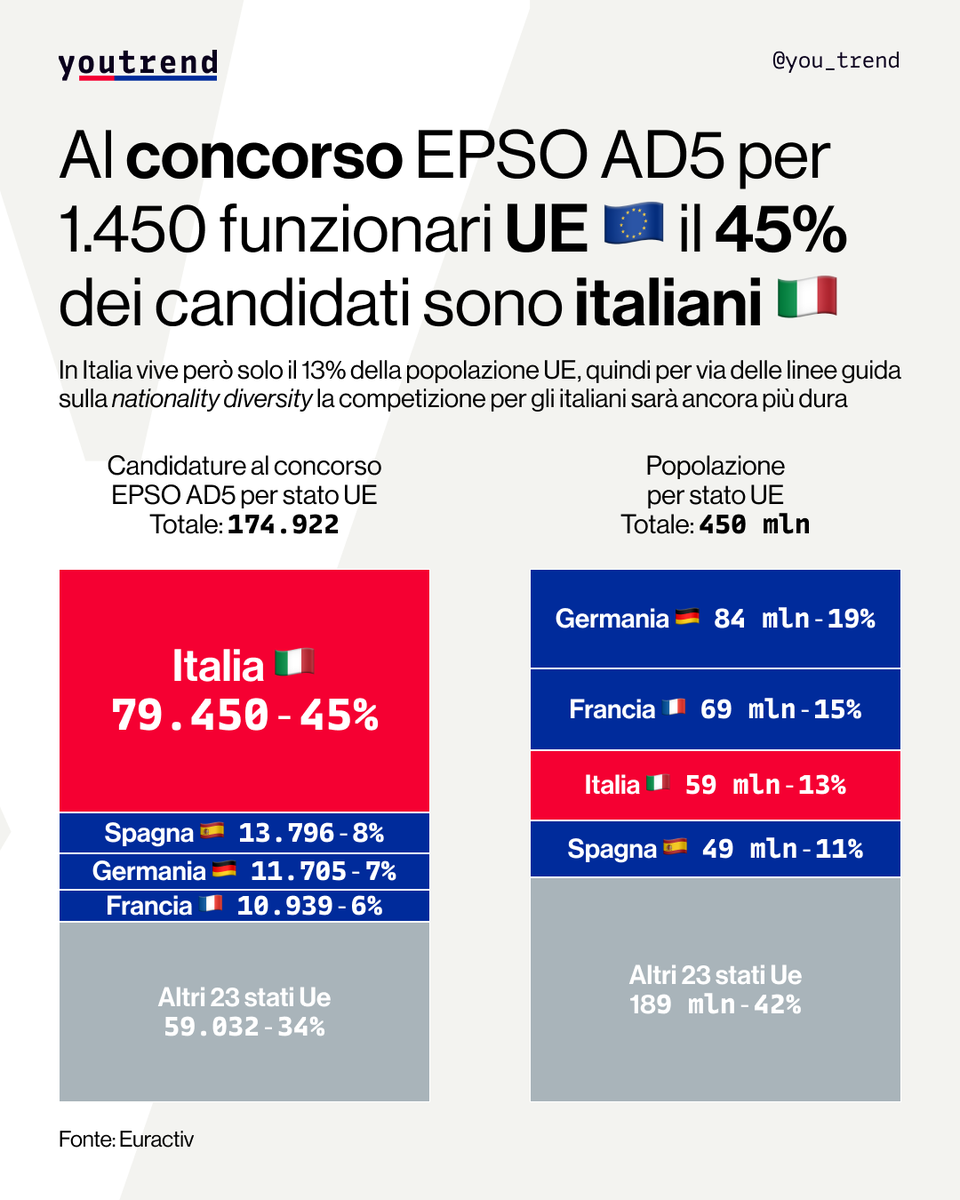
Secondo @Euractiv, quasi 80 mila italiani si sono candidati al nuovo concorso EPSO AD5 per funzionari dell’Unione Europea: rappresentano il 45% delle candidature arrivate da tutta l’UE.
In totale le application sono state 174.922, molto più delle circa 60 mila previste all’apertura del bando. I posti messi a concorso sono però 1.490, quindi passerà circa un candidato su 117.
Le linee guida UE prevedono che le nazionalità siano rappresentate in proporzione al peso demografico: l’Italia conta circa il 13% della popolazione dell’Unione, quindi per i candidati italiani la competizione sarà ancora più dura.