Founder @stoplightio (acquired), now building @getdatanaut. Techstars Austin '15. I talk ui/ux, agentic patterns, company building, and anything coding related.
🚀 After a few months of quiet building, we're ready to start talking about it.
There's something special about building things with people you genuinely love working with. People you can spend hours debating ideas with, challenge each other's thinking, go down rabbit holes, and still have fun doing it. I've been lucky enough to spend the past few months doing exactly that with @marbemac and @scottfaust43.
Together, we've been building @getdatanaut
The problem we're trying to solve actually predates the current AI wave. Even back at Stoplight, we saw how difficult it was to stitch data together across systems, make sense of it, and turn it into genuinely useful insights.
AI has changed that equation in two interesting ways:
- LLMs make it easier to extract, structure, and connect information that was previously difficult to work with.
- Agents make it more important than ever to have reliable, connected business data they can reason over and act on.
That's a big part of what we're building: a unified, continuously updated data model that both humans and agents can understand and operate on.
We've also been working with businesses to explore what becomes possible when these models are enriched with unstructured information:
Commitments: Automatically identifying promises made in conversations that were never followed up on, and turning them into actionable tasks.
Business health: Understanding the health of a customer, project, or deal by connecting signals across emails, messages, financial data, and operational systems.
Proactive insights: Spotting risks to project timelines, margins, and customer relationships before they become obvious.
The use cases are endless and apply to every industry.
The other piece we've been thinking deeply about is how humans and agents actually work together. Agents should be able to take initiative, but autonomy shouldn't mean unrestricted access to change things. We've been building around a few important principles:
Shared context: Humans and agents working from the same underlying data.
Safe execution: Drafts, approvals, and permissions so agents can do useful work without accidentally breaking things for everyone else.
Visibility: Knowing what an agent did, why it did it, and what needs human attention. Every judgment cites its evidence and confidence.
I think the next interesting chapter of AI is less about better chat interfaces or models and more about systems where people and agents can work together, with shared context and the confidence that nothing important gets broken along the way.
We've finally started sharing what we've been working on: https://t.co/rh4YhR2Huj
Would genuinely love to hear what people think, especially about the problems this could solve across different industries.
Still a lot to figure out, but having a great time building it. 🎉
no matter what I do in claude file, skills, output style, system prompt.. the sheer number of comments that opus/fable adds is getting out of control. it's impossible
We switched from @bunjavascript to @nodejs to take advantage of Sentry profiling (bun not supported yet) and were quite surprised by the result.. not sure if a bun + @EffectTS_ thing or what root cause was yet, but safe to say we'll be sticking with node for now.
@jarredsumner@bunjavascript@nodejs@EffectTS_ No worries! And yeah we've been eyeing 1.4, will certainly give it a shot. "canary" has just scared us away from actually giving it a go in prod
Very nice! Any chance these stats are available via the open router API? Ideally with ability to break down by user or even better if we could tag open router requests with a group/tenant (for multi tenant saas apps building on open router) and filter API requests for usage via that tenant id?
Every time i restart my computer and BetterDisplay w this option isn't running, I wonder how folks can live without it. Should be a default option in OSX!
StreamDB - a reactive database in a Durable Stream. Designed for AI apps and agentic session state.
You give it a Standard Schema. You get type-safe, multiplexed data sync into @tan_stack DB.
Links in the 🧵
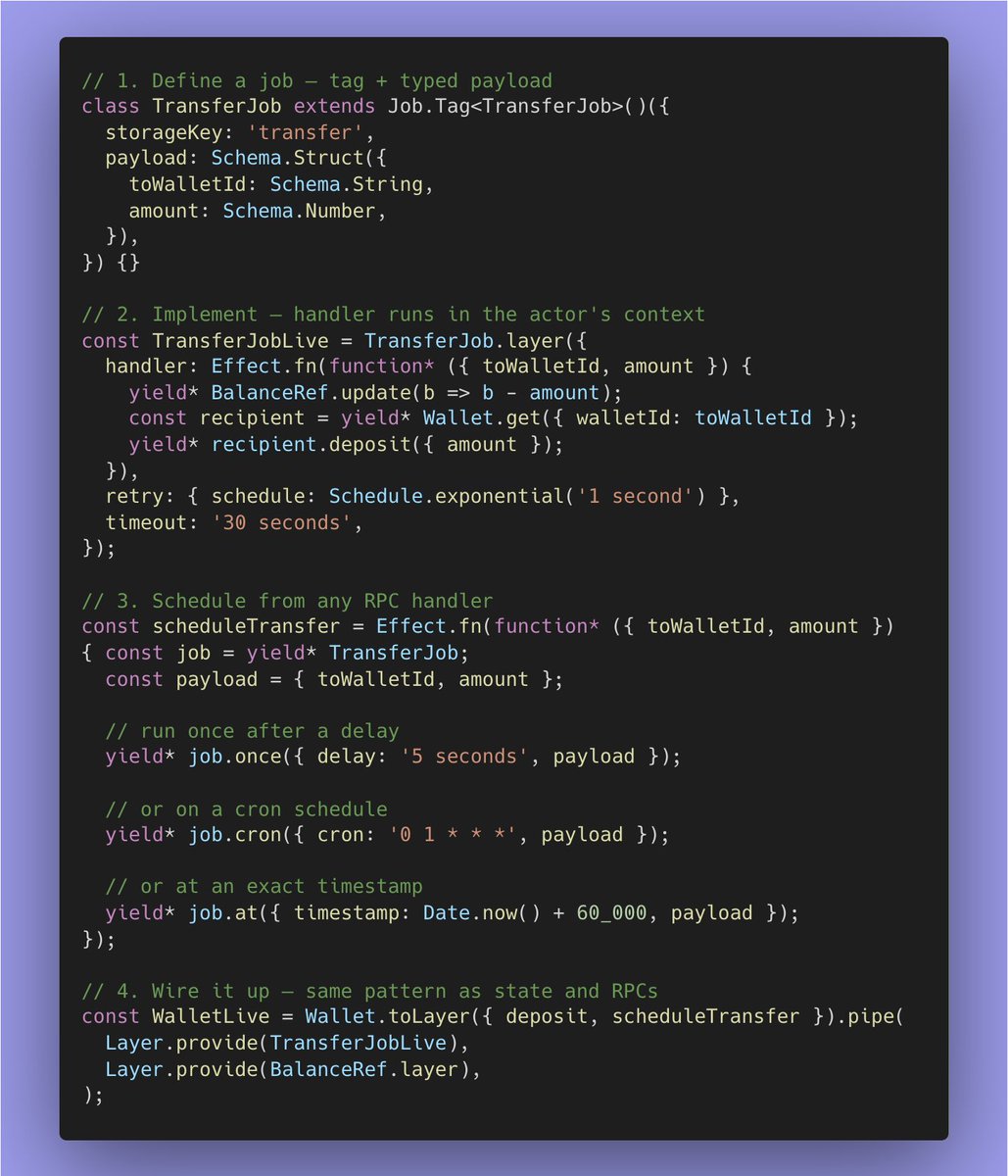
Messing around with formal Job abstraction w @EffectTS_ and @Cloudflare. Define a job like you define state - `Job.Tag`, implement a handler, then schedule from any actor. Works in memory (for tests) or on CF. Builds on https://t.co/ynfvVGD02A -
Been working on an @EffectTS_ lib to smooth over the experience working with actor patterns, with a specific focus on making it trivial to swap out backing implementation between @Cloudflare durable objects and node/bun/memory. Lot more to it than this, but it's coming along nicely!
@MichaelArnaldi@EffectTS_ hmm crazy, just because it's looking at .ts source in node_modules/effect instead of .ts source in repo cloned somewhere on disk? tbf we JUST made this change to try using node modules instead of on disk clone, so it's fresh - will def monitor to see how it does
love that @EffectTS_ ships the ts source with the npm distribution - more libraries should do this. really helps llm's out.. don't need to clone the repo and point them at it if they can just look in node_modules
ah true on the tests, maybe those could be shipped too :). yes increases size on disk but meh, might be worthwhile tradeoff. re de-optimising the model, have you found any degradation if you encourage llm to search source in node modules for specific libs? In our agents file I just instruct it to use node modules for a few key libs we use like effect, that do indeed ship source. It doesn't seem to get confused and try to use node modules for other libs that aren't mentioned. (this is w opus, haven't tried other models)
Been working on an @EffectTS_ lib to smooth over the experience working with actor patterns, with a specific focus on making it trivial to swap out backing implementation between @Cloudflare durable objects and node/bun/memory. Lot more to it than this, but it's coming along nicely!