Well folks, we did it. I have been waiting for this day for almost 10 years.
I am proud to announce @Cruise is now running 24/7 across all of San Francisco!
This is a pivotal moment for our business.
Let me tell you why 👇(1/6)
You'd be hard pressed to find someone in the hacker community that you could have deep tech conversations with & also turn everything they touch into fun. @aloria is a legend that I am privileged to call a friend. We will remember! Photo from 15th anniversary of "Hackers" party.
“Code signing” as sold by CAs is a Microsoft only offering. It doesn’t really belong in CA/Browser Forum at all. Doing so just shunts Microsoft’s responsibility to evolve its own code signing practices to commercial CAs. This is problematic for several reasons.
Where else in our lives do we actively create and promote the infrastructure that allows malicious actors scalable and frictionless destruction?
Why run AD, which enables scalable ransomware? So that we can automatically deploy EDR to maybe detect (but not stop) that ransomware?
My scooter was stolen last week. Unknown to the thief, I hid two Airtags inside it. I was able to use the Apple Find My network and UWB direction finding to recover the scooter today. Here’s how it all went down:
There's a focus that comes with protecting cryptocurrency. Security theater doesn't play at all, there are real direct consequences for breaches, and you can't keep them a secret. There is real useful innovation happening and the rest of infosec ignores it to their own detriment.
Big congratulations to @brian_armstrong, @FEhrsam and the entire @coinbase team on a monster debut today! Huge moment for crypto. To the moon! 👍🏻🚀🍾🥂🥳🎉🎈🎊
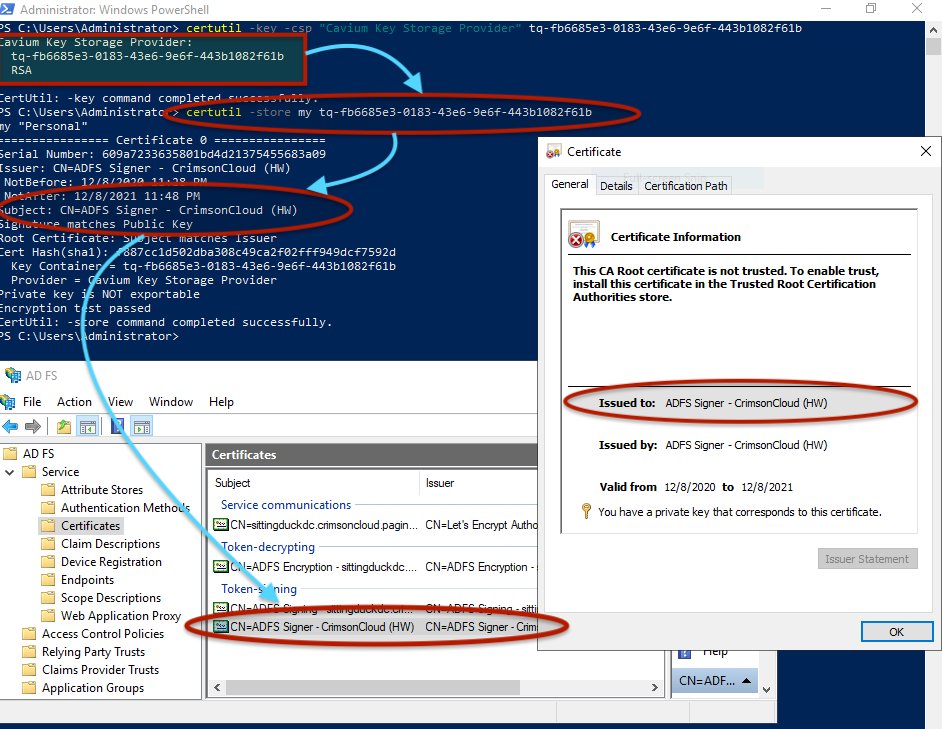
Windows crypto API makes it easy to use keys on hardware eg HSMs
Example: ADFS with SAML signing key on AWS CloudHSM v2 (Marvel Nitrox née Cavium)
Sometimes showing the key is on an HSM is the hard part 🤷♂️
Key container → CSP → certificate → ADFS settings
Common pattern in infosec:
1. Fail at threat modeling (In this case: conflate risks of non-constant time comparison of HMACs vs password hashes)
2. Attempt at "fix" for said "problem"
3. Introduce a more serious & real vulnerability 🤦♂️
Alternative view: given that enterprise IT is a market for lemons, it is the buyer responsibility to manage that risk by making sure untrusted vendor code (read: all except a handful such as MSFT/Google/AWS…) is properly sandboxed & contained assuming it *will* fail
My take: if you have the team on-staff to invent ALTS, use that. Otherwise, use mTLS for your service-to-service communication. You should still use other authn/authz mechanisms that are closer to end-to-end, though.
I grew up on software exploitation, but always thought crypto was beyond me.
In the ~5 yrs since finding Cryptopals, I’ve found & exploited critical crypto bugs in products like secure messengers, and helped design secure protocols.
Thanks @tqbf @spdevlin @marcinw@iamalexalright
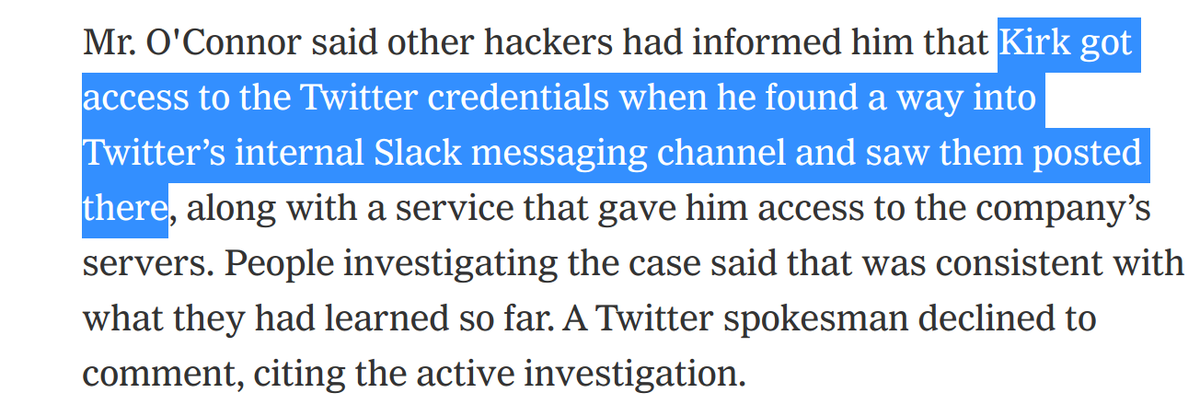
This is why using credentials bound to hardware— smart-cards, USB tokens, TPMs— is crucial
You can not paste them into Slack or share with another colleague even if you wanted to 🤷♂️
1/2