New paper w/ @debra_titone published on Discourse Processes! In an eye-tracking study, we showed how L1 and L2 English readers use direct memory access vs compositional analysis to disambiguate the figurative vs literal meaning of ambiguous idioms.
https://t.co/TeWX1WXfa9
Excited to share our latest work on Development of L1-L2 naming skills in Children and Adolescents using behavioral and ERP data. Cognitive Development edited by Quin Yow & Gigi Luk. @ant_iniesta@MartaRivZ#DanielaPaolieri@bajoteresa@UGRmemory@cimcyc
https://t.co/V2vV9mhVmz
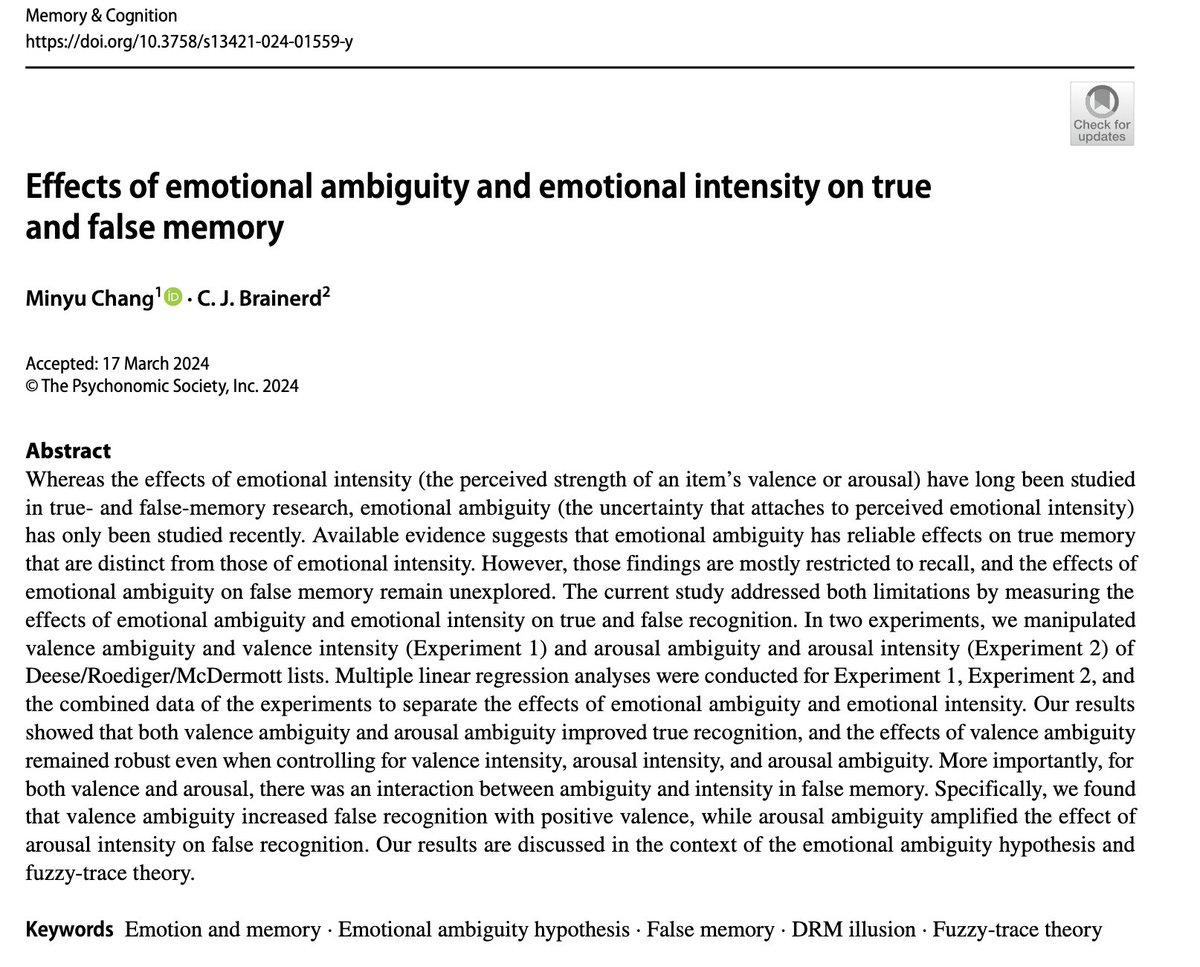
Our latest #research published in Memory & Cognition @SpringerNature showed that higher emotional ambiguity increases #falsememory for positively valenced materials. Welcome to check out at https://t.co/6MWJSmPOez!
New paper w/ @debra_titone published on Discourse Processes! In an eye-tracking study, we showed how L1 and L2 English readers use direct memory access vs compositional analysis to disambiguate the figurative vs literal meaning of ambiguous idioms.
https://t.co/TeWX1WXfa9
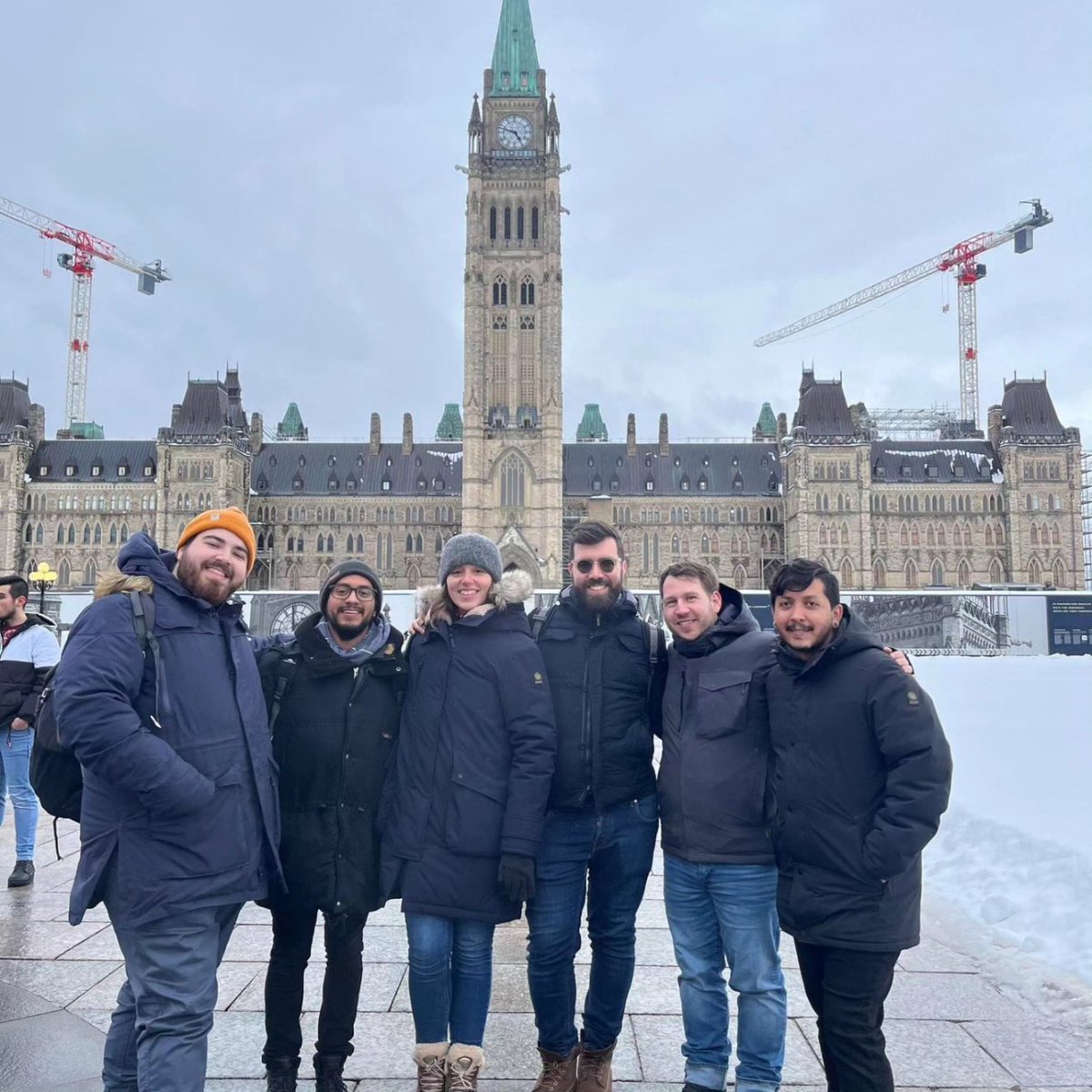
My first year in Montreal 🇨🇦🍁! It was an incredible year, difficult, fun, and a lot of learning. It changed a part of me forever. Away from my people, but finding a new family. Thank you for everything ❤
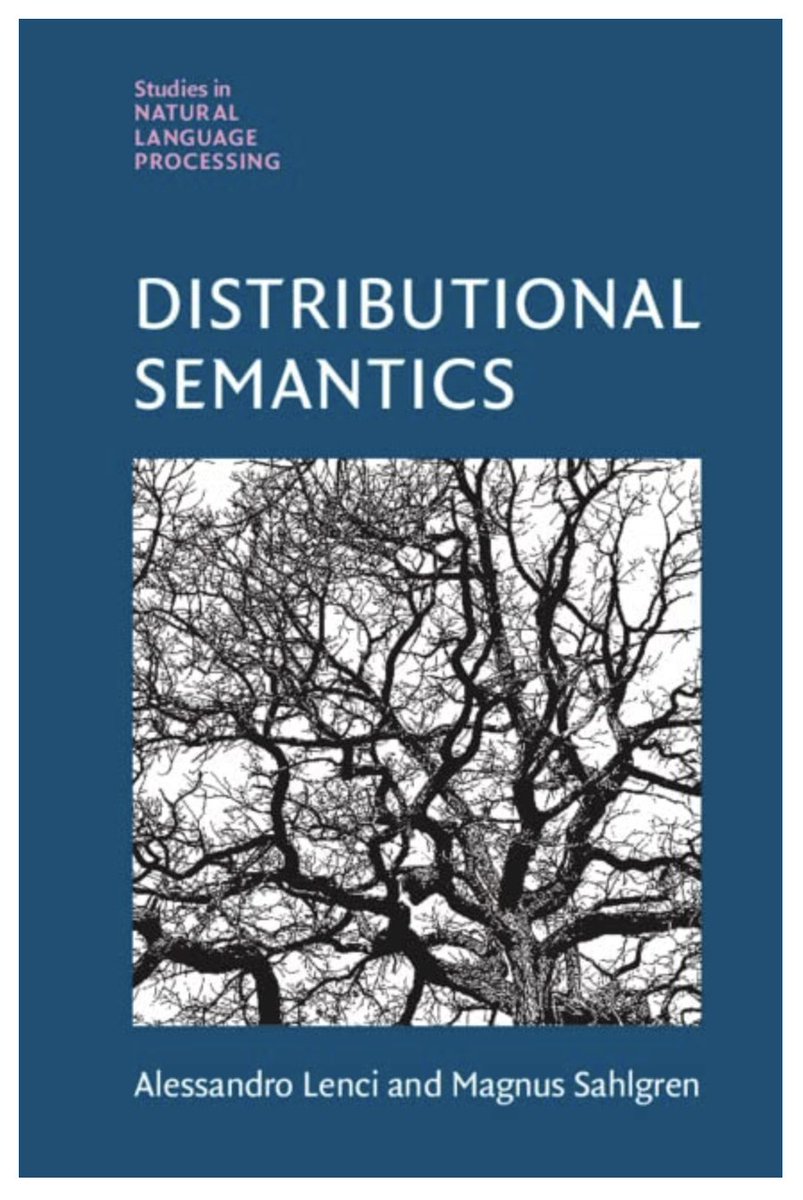
10 yrs ago, my MA and PhD advisor @AlexLenci1966 introduced me to the realm of computational linguistics with a thesis project on Distributional Semantics. Since then, DS and word embeddings have grown even more relevant to the field. I'm really excited to see this published!
https://t.co/9x8nwDBBpu...
I am happy to announce that the book on Distributional Semantics co-authored with Magnus Sahlgren has just been published by Cambridge University Press.#ACL,#NLP,#AI
Best Paper Honorable Mention at the #mwe2023 Workshop🥈:
"Are Frequent Phrases Directly Retrieved like Idioms? An Investigation with Self-Paced Reading and Language Models"
Joint work with the amazing @g_rambelli, @AlexLenci1966@marco_senaldi and Philippe Blache #eacl2023
Idiomatic expressions can greatly differ from their building blocks in terms of meaning.
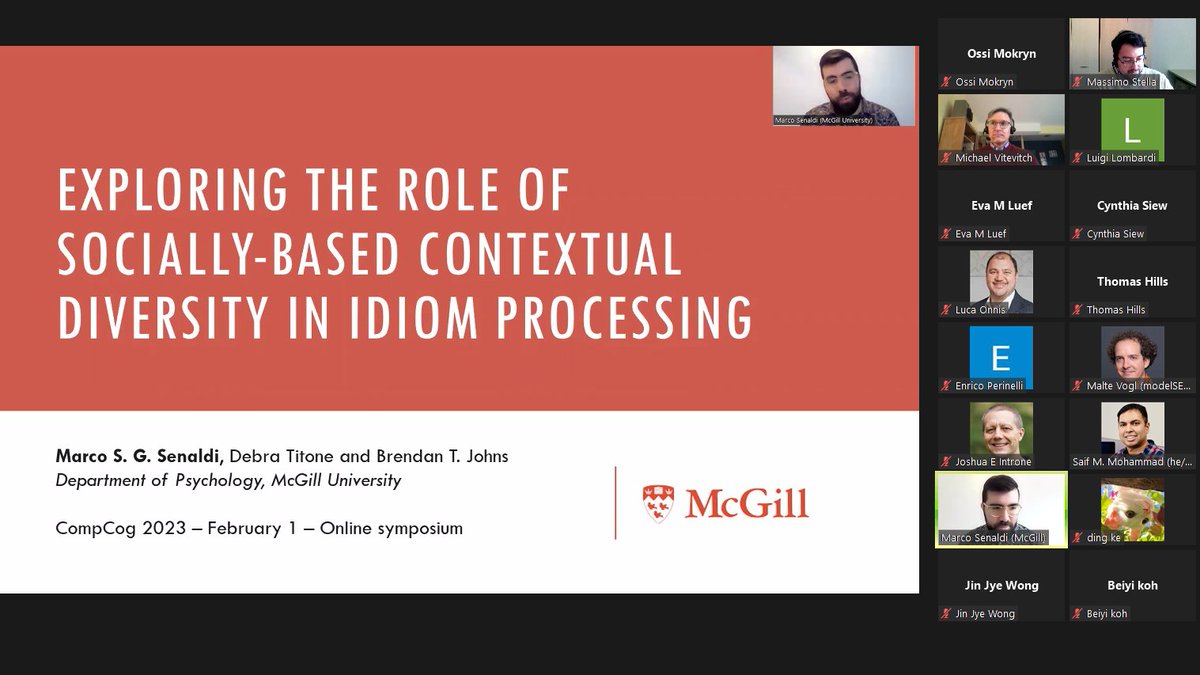
They are an example of #moreisdifferent in #complexity science. A great talk at #CompCog23 by M. Yang discusses key quantitative results about idiom processing:
Idiomatic expressions can greatly differ from their building blocks in terms of meaning.
They are an example of #moreisdifferent in #complexity science. A great talk at #CompCog23 by M. Yang discusses key quantitative results about idiom processing:
Very happy with our new chapter "Age, Bilingualism and Cognition in Translators and Interpreters" for The Routledge Handbook of Translation, Interpreting and Bilingualism with my colleagues @NakamuraMegan @EleRossiNeuro@UfBlab@UFLinguistics
https://t.co/hyv8K6Trpt 💛💚
Have you read our last paper about orthographic transparency and writing to dictation? (ft. @MartaRivZ, #Bajo, & #Paolieri)
Transfer effects from language processing to visual attention dynamics: The impact of orthographic transparency https://t.co/J5MVRJo8HA
@BPSjournals
The Maluma/Takete Effect is Late: New preprint! We tracked infants across their first year and found they are not sensitive to shape sound symbolism (although adults are). w/ @DavidMSidhu@AngelikiAthan@slarcher N. Czarnecki & @suz_l_curtin @SSHRC_CRSH https://t.co/n60kJXNqOq
Can language learners generalize their knowledge of conventional verb-noun collocations they’ve recently learned? And if so, are generalizations made via the second or first language?
I explored this in this paper hot off the press @_LangLearning! https://t.co/cV0b5CcCzg