As I outlined in WSJ (https://t.co/Ute0punjgo), this will keep happening until the U.S. adopts the screening model used by most peer countries: TSA as dedicated security regulator and screening devolved to airports.
See @ReasonFdn’s draft TSA Reform Act: https://t.co/8GXQU9iVOZ
Join us on June 3rd at 9am ET for an @AEI webinar to celebrate the 70th birthday of AI by examining how businesses are shaping AI and transforming American enterprise.
Speakers include @DrJ_Policy, @DrSabyMitra, @John_Bailey, @marcscribner, and more.
RSVP HERE: https://t.co/l4TXgLwbYY
“Congress limiting TSA’s role is the only way to insulate airport security from dysfunctional Washington politics.” — @marcscribner
https://t.co/l9rtUFWRLP
America is an outlier for socialistic aviation policy and the result is worse infrastructure and passenger experience. A rare “be more like Europe” policy opportunity.
Speaking of paying Cadillac prices for Kia products: our air traffic control system continues to be an embarrassment. Thailand and Malaysia will get remote/digital control towers before the U.S.
The 2026 @ReasonFdn Annual Aviation Infrastructure Report is out today: https://t.co/snXwxfHOjC
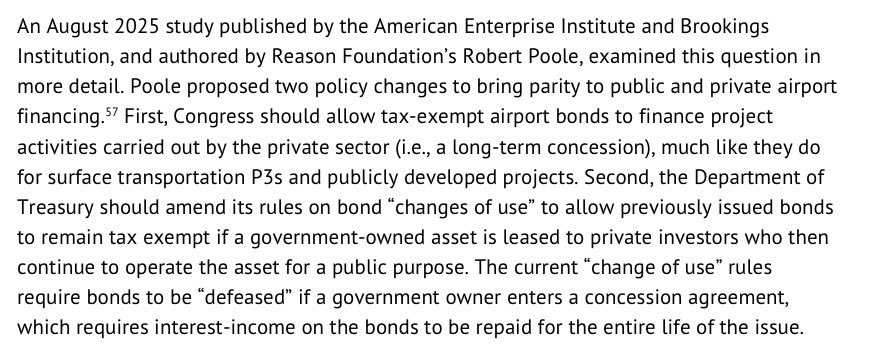
The U.S. is increasingly a global outlier on private investment in and operation of commercial airports.
Why does the U.S. keep its airports trapped in the political sector? Part of it is we’re probably so rich that we perversely tolerate paying Cadillac prices for Kia products. But bad tax code and IRS rules definitely don’t help. These are straightforward fixes.
@bendreyfuss The new JFK Terminal 1 is supposed to open later this year. Ground transportation has been a bigger mess in recent years because of all the construction.
As a response to the 2023 East Palestine derailment, the Railway Safety Act has never made any sense.
Below I explain how each provision of the bill either violates or is unresponsive to the recommendations contained in the NTSB’s final accident report on East Palestine.
The Railway Safety Act was reintroduced in the Senate yesterday. This bill was supposedly written in response to the 2023 East Palestine derailment, but unfortunately either violates or is unresponsive to NTSB findings and recommendations.
Let’s look at 8 core provisions (🧵):
My latest in @ReasonFdn’s monthly Aviation Policy News highlights the newly formed Digital Tower Technology Coalition (@DTCintheNAS), which seeks to advance remote/digital air traffic control towers that are increasingly popular outside the U.S.: https://t.co/YAlHYSwrDe
"The FAA’s latest plan to get the air traffic control workforce on better footing makes some important advances. But it doesn’t address the ultimate source of America’s ATC dysfunction: a bureaucratic agency that regulates itself."
@PostOpinions
https://t.co/1kAHiVdKAv
"Repealing it would take a big step toward saving public transit without reaching back into taxpayer wallets," @ReasonFdn's @marcscribner writes in the Red Tape newsletter. https://t.co/VYa2UI0wLz
If you genuinely want to help public transit succeed, this is crucial:
“Section 13(c), the little-known provision of federal transit law jacks up operating costs by locking in 20th-century labor practices and blocking innovation. Repealing the law would save taxpayers from shelling out more money for systems that desperately need reform, not subsidies.” https://t.co/XZVOdqqefj @ReasonFdn@marcscribner
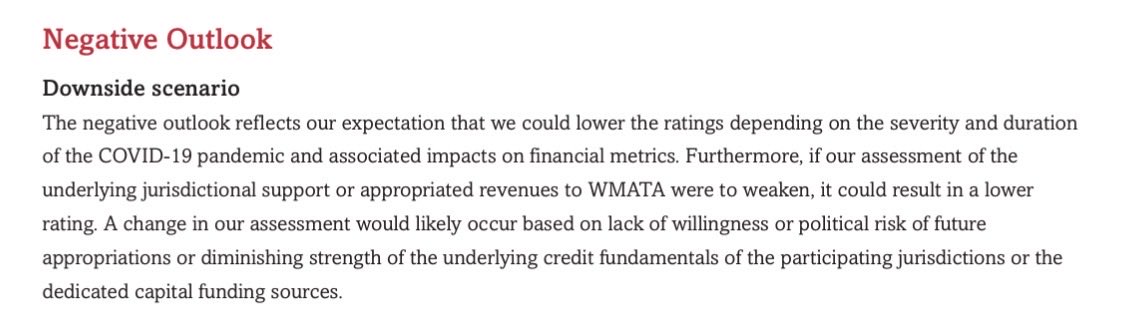
Shifting transit financial support from users to appropriated government subsidies increases risk and has real costs, such as those that manifest in the bond market.
In Washington D.C., taxpayers who don’t take the train or bus are increasingly subsidizing those who do, and it’s not sustainable. @DominicJPino explains why.
🔗 Read more: https://t.co/XnaPxOFX7m
@binarybits@Abi0lvera Streetcars aren’t a great analogy because they ran on schedules and fixed routes. Better are the jitneys that the streetcar industry lobbied cities to outlaw. (Although back then, these modes were mainly used by the middle class; the poor couldn’t afford the fares and walked.)
@Oriana0214@SamOgozalek It looks like we may be only half a decade behind Nav Canada, which deployed Digital Twin-Sector Performance Optimizer nationwide last year. That’s very good by FAA standards.
When California’s high speed rail project was approved they said it would cost ~$30billion, @ReasonFdn estimated closer to $80bn.
When voters approved a $10bn bond to help fund in they said the project would cost $45bn, @ReasonFdn estimated closer $100bn,
Now the state says it will cost between $126bn and $232bn!! When will people give up on this unbelievable boondogle?
https://t.co/n5O8cgmktm
Cars are more connected than ever, but at what cost to privacy and security? Join @BrookingsGov for a webinar on May 5 at 2 p.m. ET for a discussion on the future of this technology.
RSVP here: https://t.co/poDoohQDHZ