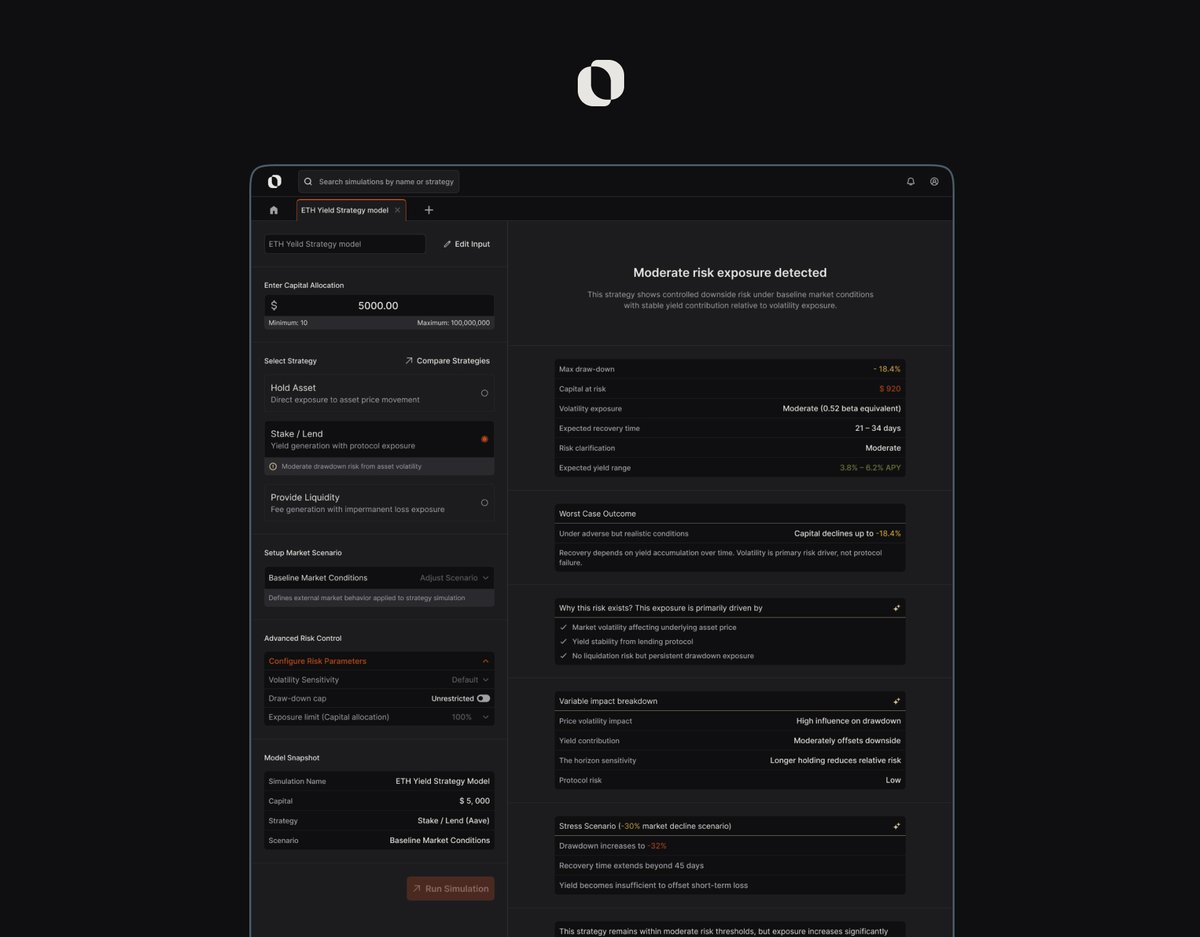
I built a DeFi risk simulator that shows you what happens before you commit capital.
Most DeFi tools only explain outcomes after decisions are made.
I wanted to fix that.
@trikcode The deeper issue is that building and distribution are two different systems. The best founders treat both as experiments, not as “building” vs “selling.”
Trust is an important part of design, especially in AI and DeFi systems.
People don't just trust products because they look nice. They trust systems that they can understand, predict, and make sense of.
So, trust needs to be built into the design.
I learned this while building Nuvesta:
Concept systems need a clear direction. Infrastructure can't just be neutral. You have to understand what problem you're trying to solve; otherwise, the system ends up being just a mix of features without any purpose.
@superset_sh Making 10–100 agent outputs legible enough for a human to decide in seconds is where the product actually wins or dies.
That’s the layer I’ve been exploring in multi agent interfaces.
@watolabs The hardest design problem in this category is making 'memory' visible without it feeling like a data dump. How are you thinking about the representation layer?
@watolabs The interesting shift is creating systems where AI work becomes visible, reusable, and trusted.
The hard UX question is how you represent evolving context and workflows without adding more complexity.
@edgarpavlovsky The interesting UX challenge here is not just managing agents, but making coordination visible without turning humans into project managers for machines.
Trust is built in the interface layer...knowing who is doing what, why, and what needs attention.
I'm not building in public just to grow an audience.
I'm trying to build a record of how I think.
The products are the proof.
The posts are the reasoning behind them.
DeFi has a risk literacy problem, not a risk data problem.
The data is already there.
Liquidation levels, exposure, volatility, positions.
The hard part is understanding what those numbers actually mean when making a decision.
That gap is what led me to build MARGIN.
A good decision system doesn't tell people what to do, rather It helps them see what they're missing.
I've never been interested in replacing user decisions with AI. I'm more interested in revealing blind spots, surfacing context, and making consequences visible.
While designing FLUX, I don't think the hardest part was the UI, i believe It was deciding what to hide. With signals, more updates, more information, the result was noise.
A lesson from building FLUX:
"What you remove is often as important as what you show"
@ycombinator@KimptonAI The 'IDE for investors' metaphor is interesting. a good IDE works because it collapses cognitive overhead, not just tooling. That's the hardest design bet in this space.
@0xAron@ProductHunt@fere_ai Congrats on the growth. the signal-to-execution flow is the hardest UX in autonomous trading. The moment most agents lose users is the review step before execution. Curious how you're designing that.
@jackzumwalt@KimptonAI The shift from “research tools” to “decision IDEs” is one of the most interesting UX problems in finance right now.
Curious how you’re thinking about trust + explainability when agents start proposing trades at scale.
@ryolu_ The combination of taste + systems thinking + shipping with AI tools is becoming its own discipline.
I've been exploring that through FLUX, an intelligence terminal built with Claude Code as part of the workflow. Excited to see more teams hiring for this intersection.
@ycombinator@Pierredpy72@KarimBOURI1 Just saw the YC launch. Building the institutional brain for wealth managers is exactly the kind of AI agent legibility problem I've been designing for with FLUX. If you're thinking about design, happy to show you what I built. @Pierredpy72