A breathtaking view: Messier 17, the Omega Nebula, a star-forming region
This enormous expanse of gas, dust, and scorching young stars sits near the center of the Milky Way.
(Credit: ESO/INAF-VST/OmegaCAM. Acknowledgement: OmegaCen/Astro-WISE/Kapteyn Institute)
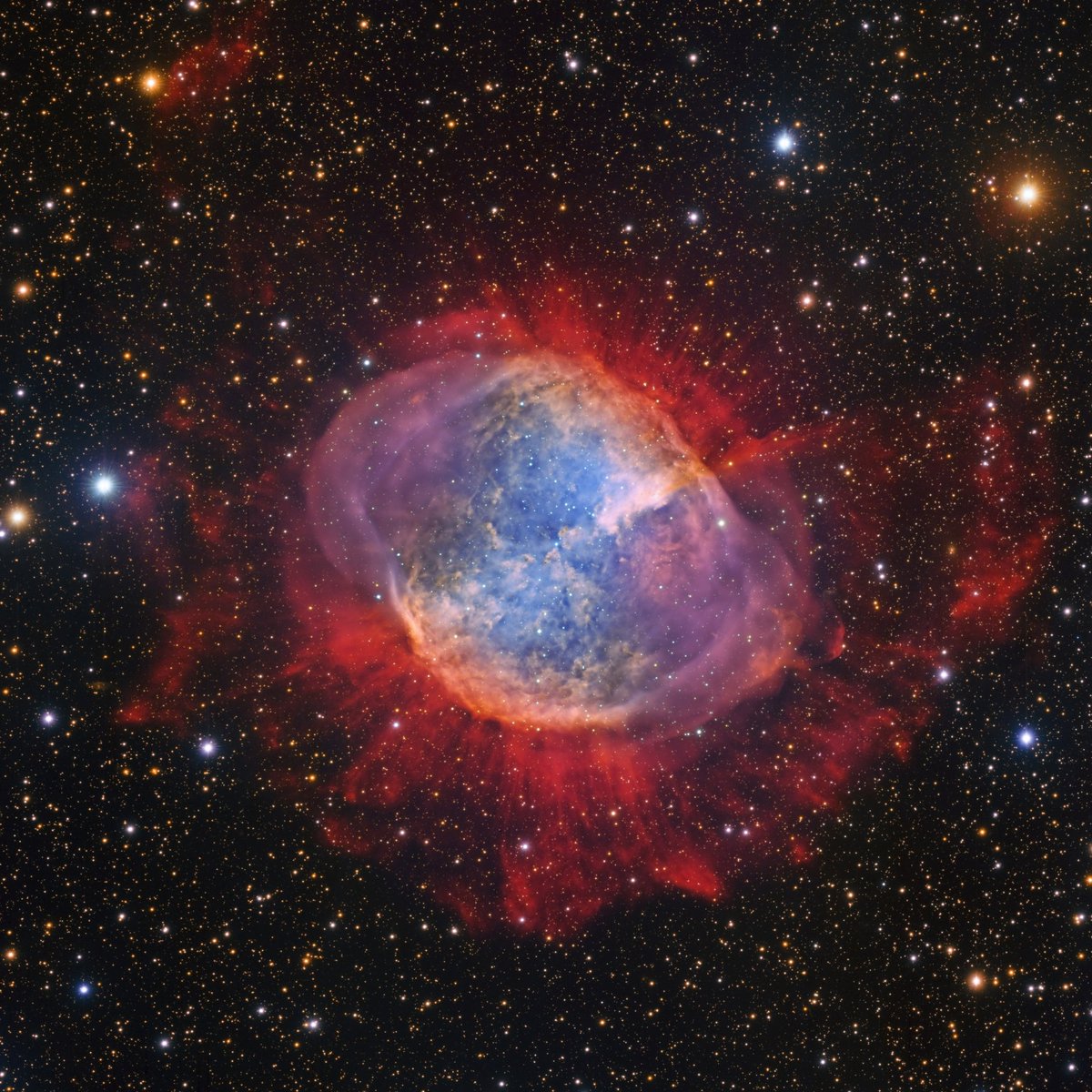
'M27 Not a Comet'
Image Credit & Copyright: Data: Subaru, NAOJ; Assembly and Processing: Roberto Colombari
https://t.co/SX2j6rzBo3 06-09-2017
#astronomy#space
Este es el cúmulo de galaxias Abell 370, a 4000 millones de años luz. Está dominado por dos galaxias elípticas gigantes y la inmensa gravedad del cúmulo provoca la deformación de la luz de galaxias mucho más lejanas, que aparecen como arcos estirados. Crédito: NASA/ESA/J. Lotz et al. #FelizSabado
A breathtaking look at HFG1
It's a planetary nebula in the constellation Cassiopeia, created by the fast moving binary star system V664 Cassiopeiae as it expelled gas into space
Credit: T.A. Rector (University of Alaska Anchorage) and H. Schweiker (WIYN and NOIRLab/NSF/AURA)
Cassiopeia A has been observed by astronomers since its discovery in 1948. Its close distance and brightness help telescopes like #NASAWebb see intricate details in the supernova remnant, informing astronomers about how its progenitor star exploded: https://t.co/ihRQgFXzBa
A striking view of HFG1
HFG1 is a planetary nebula in the constellation Cassiopeia. It formed from the material shed by the binary star system V664 Cassiopeiae
Credit: T.A. Rector (University of Alaska Anchorage) and H. Schweiker (WIYN and NOIRLab/NSF/AURA)