Yes.
Writing is not a second thing that happens after thinking. The act of writing is an act of thinking. Writing *is* thinking.
Students, academics, and anyone else who outsources their writing to LLMs will find their screens full of words and their minds emptied of thought.
People forget that in previous iterations and abstraction there was no informational loss.
When assembly code gets compiled to binary, nothing is added, removed, or changed.
When C gets assembled, same, nothing is added, removed, or changed.
When ORM maps database entities, it maps them one-to-one, nothing is created, added, removed of that relationship
When English prompts are transformed into code... it's pretty much up to LLM to decide how it writes the code. Shit's created on the fly.
You can prompt same LLM with exact same request but there is no guarantee that it will generate exactly same code output.
And fuzziness gets even greater on large scope.
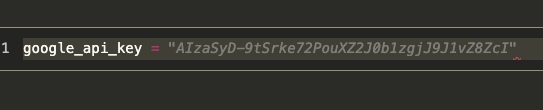
life hack: if you do not have an API key for a service or you cannot afford to run it simply type the name of the service with "api_key" after it and copilot will provide you one free of charge
Finally it's out, my experiment in all-monospace web!
https://t.co/nfk8BAbDxJ
I've tried to include a bunch of different elements to showcase the idea. Many more things could be added and supported. I've had a lot of fun with this so far!
This is the best thing to happen to typesetting in a very long time. One of the best applications of modern tech I've seen so far. https://t.co/28cJ0cpwsP
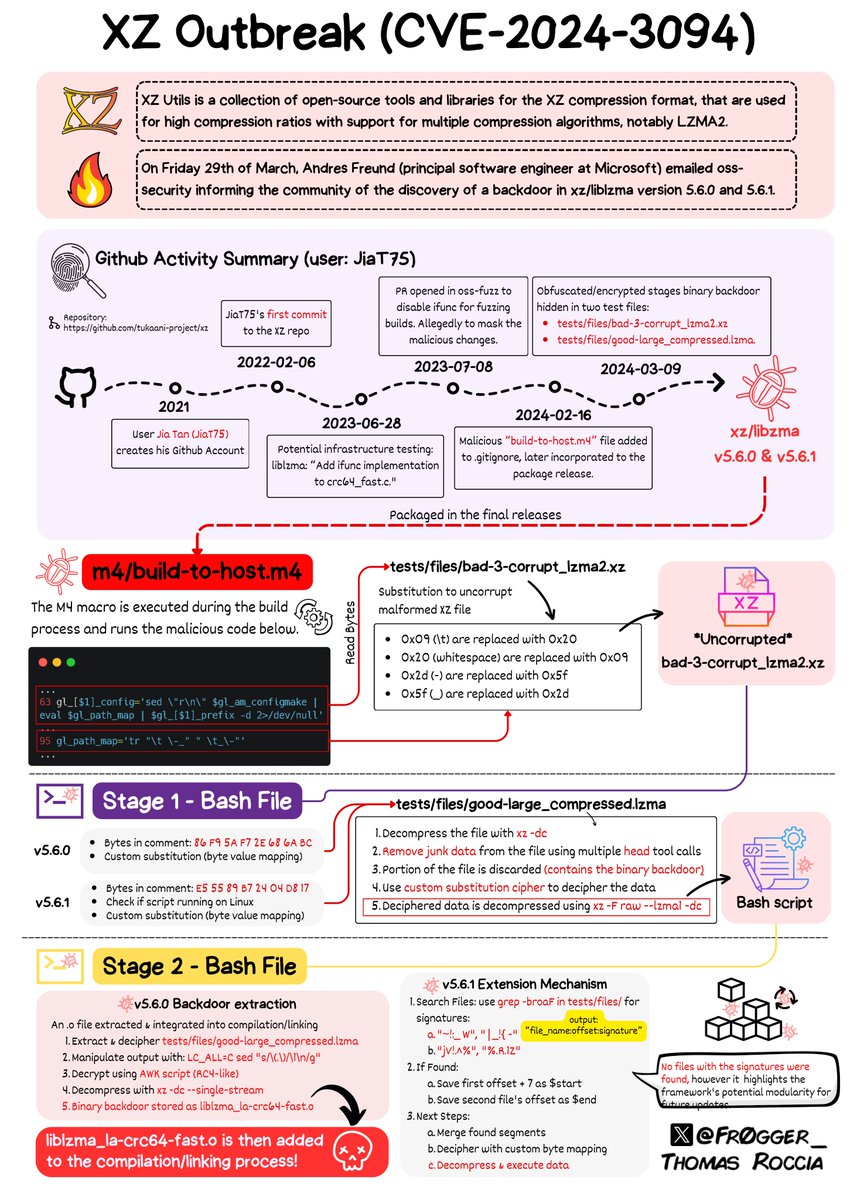
🤯 The level of sophistication of the XZ attack is very impressive! I tried to make sense of the analysis in a single page (which was quite complicated)!
I hope it helps to make sense of the information out there. Please treat the information "as is" while the analysis progresses! 🧐 #infosec #xz
It's Official: NFTs Will Go Down in History As Pet Rocks On Steroids (And Crypto Is On The Fast Track To Do The Same)
Stick a fork in the NFT marketplace, it’s dead. Remember when NFTs sold for millions of dollars? 95% of the digital collectibles are now probably worthless, less than two years after a massive bull run.
Specifically, a new study found that out of 73,257 NFT collections analyzed, 69,795 (95%) of them had a market cap of zero ether. Out of the top collections, the most common price for an NFT is now $5-$10. https://t.co/JS6s5BihkQ
This is not at all surprising. Fractionalized links to the meta data of JPEG files are an offensive, shocking and utterly ridiculous con game. The NFT marketplace is not merely inorganic, it's flat-out rigged. Market manipulation of NFTs is not only rampant and tolerated, but also encouraged. Fraud not only rewarded, but also taught.
Ironically, a small cadre of venture capitalists and Wall Street profiteers got filthy rich by pitching NFTs promising ethereal dreams of decentralization, financial inclusion and instantaneous wealth and prosperity. But for most of their duped retail buyers, what resulted was primarily investor carnage while Web3-financiers laughed all the way to the bank.
The same goes for all of crypto. It’s a modern day adaptation of The Emperor Has No Clothes meets The Pied Piper of Hamelin, and the victims are only now finally waking up, and stepping out, from the purple haze of it all:
An Investment? No. Crypto fails as an "investment” because there's no regulatory oversight, transparency, consumer protections, insurance, licensure, net capital requirements, and the crypto rug-pull bazaar is so rife with market manipulation/insider trading/fraud, investors stand no chance from the get-go. https://t.co/ftnEea4Gxt
A Currency? No. Crypto fails as a “currency” because the price is too volatile; fees too high; taxes too burdensome; and risks too infinite. How can anyone accept crypto as payment when it could be worth a lot less the next day? https://t.co/osyLFUlCQN
A Store of Value? No. Crypto fails as a “store of value” because it lacks utility and intrinsic benefit, the measure of what an asset is actually worth. Crypto has no value to store and its price is solely dependent upon the greater-fool-theory. https://t.co/7DiHBcQImq
A financial Panacea? No. Crypto fails as a “financial panacea for the unbanked” because it’s just another exemplar of “Predatory Inclusion” and affinity fraud, sadly peddled to dupe the disadvantaged and disaffected. https://t.co/VzwJgKwAlu
A “Safe Haven?” No. Crypto fails as a “safe haven” because there exists no government oversight or protections to provide any semblance of safety. I get it, there have now been several notorious bank failures and those bank failures evidence serious problems within the US financial system. But don’t let crypto promoters lure you in with their disturbing and twisted logic i.e. “See, I told you that you can’t trust banks, buy crypto next time and you will never have to trust a bank again.” This is a classic grift tactic I often saw during my tenure as Chief of the SEC Office of Internet Enforcement. In the rare instance of bank failure, there are statutory guardrails to protect/help depositors, like insurance and federal ownership/takeovers. The US government steps in swiftly and responsibly. But when a crypto platform fails (like FTX, Blockfi, Voyager, Celsius, etc.), there exist no U.S. government protections, and the customer’s access to assets is suddenly locked out or frozen. Bankruptcy becomes inevitable, and the customer most likely (depending on the user agreement and other factors) becomes an “unsecured creditor,” last in line for recovery and possibly left with zero. https://t.co/1CJ3xC5Chy In other words, crypto platforms might look like traditional brokerage apps to everyday users, but crypto apps lack the oversight and investor protections built into traditional financial services. For example, Coinbase has specifically acknowledged in SEC filings that the crypto it holds for users might not really belong to those depositors if push comes to shove, stating, “Because custodially held crypto assets may be considered to be the property of a bankruptcy estate, in the event of a bankruptcy, the crypto assets we hold in custody on behalf of our customers could be subject to bankruptcy proceedings, and such customers could be treated as our general unsecured creditors.” Coinbase has promised to remedy this danger and maybe they have or will. But these unpredictable issues are decided in bankruptcy. By contrast, securities held for customers by an SEC registered brokerage firm are legally segregated from the assets of the brokerage, meaning they can’t be touched in bankruptcy, and are protected by SIPC, a nonprofit set up by Congress in 1970, which also insures as much as $500K of customers’ securities and cash in brokerage accounts. https://t.co/WxY5cQmpcC
A Blockchain Revolution? No. The reality is that no matter how exciting and aspirational the venture capital blockchain propaganda, blockchain stubbornly remains a glorified, append-only, limited writer spreadsheet and immutable ledger -- which provides little utility for anyone. The truth is that blockchain’s technological DNA is laden with sluggishness, clunkiness, costliness, inefficiencies, security issues and a slew of other problems, which renders blockchain not just difficult to scale but also challenging to use. Hence, blockchain faces extraordinary obstacles to evolving into the magical financial and societal panacea that its promoters have been promising for over 15 years. And herein lies the stark reality: Just because some big bank or investment house seems to be using a private blockchain internally for a project that sounds exciting and forward-thinking, does not mean it is somehow worth jumping on the blockchain bandwagon. The vast, if not overwhelming, number of current blockchain projects are "private blockchain" projects which are not open to the public, not decentralized, not permission-less, not technologically transformative, not futuristic (but are instead antiquated) and cannot perform any better than a Google Docs spreadsheet. In other words, when it comes to blockchain, beware not only of the perils of ubiquitous Web3 flimflam but also beware of the trappings of misguided groupthink and crypto-sophistry. Both are patented grifter techniques and the hallmarks of just about every bigtime financial crime history. https://t.co/2Zv6tfJpWE
An Affinity fraud? Yes. This is one of the most important proclaimed benefits of crypto i.e. that crypto is a revolutionary equalizer for the unbanked and will cure historical issues of financial inclusion. And it also happens to be categorically false. The disquieting reality is that crypto is just another horrendous exemplar of affinity fraud, and orchestrated shamelessly to dupe the disadvantaged and disaffected. Crypto fails miserably as a “revolutionary equalizer for the unbanked” because, as the legendary Michelle Singletary recently explained in her award-winning Washington Post financial column, crypto does not cure historical issues of financial inclusion. https://t.co/XN5Nfn9zip In fact, when examined closely, as was done by Tonantzin Carmona for the Brookings Institution, Crypto has also evolved into a dire affinity fraud. https://t.co/HpAgBmklc1. Because “crypto’s current capabilities do not match the needs of the groups it purports to serve, it carries a host of risks and drawbacks that undermine its benefits. More alarming, we can observe parallels between crypto and other predatory products, which highlights crypto’s potential to exacerbate unequal financial services to historically excluded groups.” In other words, disadvantaged and disaffected communities get access under the auspices of inclusion, but that access only makes their situations worse. Last year, a University of Chicago study found that 44 percent of Americans who owned and were trading crypto were people of color. To make matters worse, a recent J.P. Morgan Chase study found that people with lower incomes very likely made their crypto purchases when prices were elevated when compared to higher earners and have therefore suffered disproportionately. Algernon Austin, director for Race and Economic Justice at the Center for Economic and Policy Research, said during an interview about crypto investing and building Black wealth. “As an investment, it’s closer to gambling.” Austin co-authored a report released earlier this year comparing crypto with index funds. When looking at a random sampling of 100 cryptocurrencies — all in the top 1,000 by market capitalization — Austin and his team found that the median cryptocurrency declined 46.6 percent from August 2017 to August 2022. But a total stock market index fund climbed 56.4 percent during that period, while an S&P 500 index fund surged 60.8 percent. https://t.co/qlst1Ga9Zf; https://t.co/vmnBy6wR36
A Mammoth Grift? Yes. IMHO, grift, chicanery and fraud are not just common and routine in the crypto-ecosystem — they are modus operandi and inherent criminal characteristics deeply rooted in crypto-ecosystem DNA in perpetuity. The result? Victims become victimizers, the crypto-contagion spreads, crypto-titans become fugitives, informants and defendants — and fiat vanishes. I discuss this and more at a recent Fintech Conference Held by the Philadelphia Federal Reserve, entitled, “Blockchain, Web 3.0, Digital Identity, and the Future of Finance."
https://t.co/rePsmKW7jA
Amazing, never would've seen a headline like this in mainstream press three months ago.
Folks need to hear that Blockchain is *not* enabling technology for anything except decentralized double-spend prevention.
That's the lesson from @Helium's missteps.
https://t.co/RVqWqFiBa7
Last Wednesday we heard from researchers, journalists & businesses with expertise on blockchain. @davidgerard told us that little progress of significant value had been made on the technology since its emergence in 2008.
Watch his response⬇️
Yesterday @packyM was asked to explain a Web3 use case.
I clipped this gem from 8:40 of @loganbartlett's latest @cartoonavatars podcast episode with co-host @zachweinberg.
Highly recommended...