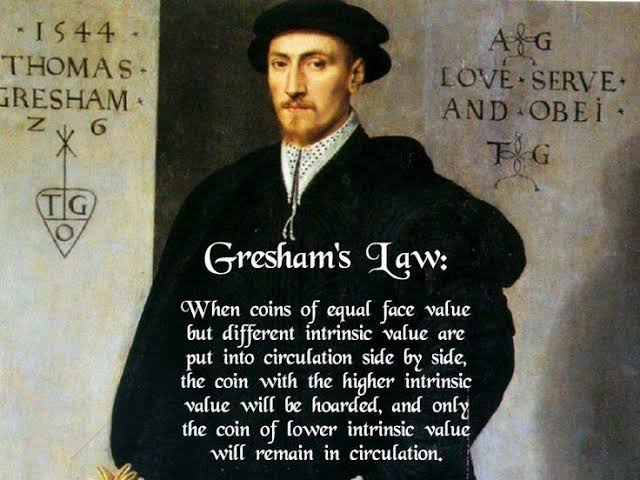
Gresham's Law states that bad money drives out good, and every government that has ever debased its currency has proven this true the hard way.
The mechanism is straightforward. When a sovereign declares that two coins carry equal legal value despite one containing more silver, citizens spend the inferior coin and hoard the superior one. The overvalued bad money circulates. The undervalued good money disappears into mattresses and private vaults. The state creates this distortion through legal tender laws, forcing you to accept both coins at the same face value regardless of actual metal content. Without that legal compulsion, Gresham's Law doesn't operate. Markets simply price the better money higher.
Rome did this with systematic ferocity. The silver denarius, roughly 90% pure under Augustus, fell to under 5% silver by the reign of Gallienus in the 260s AD. Citizens watched the debasement happen and responded rationally: they spent the garbage and saved whatever genuine silver remained.
Gresham's Law is a symptom, not a disease. State monopoly over money is the disease. Remove the legal tender mandate, allow competing currencies, and good money wins on merit. Thomas Gresham identified the phenomenon in 1558 through observation. The cure has been available just as long.
I think that social or cultural change does not always require violence. Competition of ideas provides a marketplace where individuals can choose what is best for them. It is true that in an established hierarchy, people in power will fight to keep it. But when a new idea becomes widely adopted, the established hierarchy loses the ability to control the narrative. Decriminalization of marijuana is an example of a cultural change that has proceeded without violence and has succeeded despite the stubborn opposition of an entrenched hierarchy.
Excellent post.
I wrote a book that is intended to be an easy to understand introduction to the philosophy and history of individual liberty. In chapter 8, I discuss Gramsci, the Frankfurt School, and postmodernism. I would be very interested to hear your opinion of my book.
https://t.co/uVEMGkwdzs
@MisesChair Hi Michael, I wrote a book intended to be an easy-to-understand explanation of the philosophy and history of individual liberty. If you find time to read it, I would be very interested in your opinion. https://t.co/x35koato4v
"The most important thing to remember is that inflation is not an act of God; inflation is not a catastrophe of the elements or a disease that comes like the plague. Inflation is a policy—a deliberate policy." - Ludwig von Mises
Wind and solar may succeed at a smaller, localised scale. But scaling them to power an entire modern civilisation is a fundamentally different challenge.
It was never going to work. They don't provide crucial baseload power, and traditional industrial grids were not built to accommodate their erratic delivery.
Decades of government incentives, feed-in tariffs and tax credits have heavily subsidised their rollout across wealthy Western nations. But it's an exercise resembling hopeless love. These desperate initiatives have ignored the fundamental mismatch between intermittent generation and existing grid architecture.
A complete rebuild of the global grid carries an estimated price tag of $21 trillion — a task made harder by decades of underinvestment in basic transmission infrastructure and heavy-duty storage.
Traditional power grids rely on synchronous generation — massive spinning turbines in coal, gas, nuclear or hydro plants. This physical rotating mass provides natural mechanical inertia, keeping grid frequency locked at a stable 50 or 60 Hz.
In sharp contrast, wind and solar just can't plug in. They rely on inverter-based technology, which gives zero inherent inertia. While engineers try to patch this stability gap with complex synthetic controls and giant spinning flywheels, it adds layer upon layer of extra cost and friction.
Meanwhile, the colossal scale of battery storage required to bridge multi-day lulls in wind and sunlight — the dreaded Dunkelflaute — runs into an immediate brick wall. It creates yawning bottlenecks in copper, lithium and cobalt mining, compounded by soaring production costs.
Crucially, the system can't even build itself. It just hasn't got the muscle. Mining the quartz, smelting the silicon, forging the structural steel and transporting massive turbine blades - all demands high-density, uninterrupted process heat and power. In an ironic twist, this energy is supplied almost exclusively by coal, oil and gas.
The gridlock this creates is almost farcical. Because wind and solar remain weather-dependent, grids must keep fast-ramping gas peakers or idling coal plants on standby. They are burning fuel in the background to step in the instant the wind drops or clouds roll over.
Great business plan.
Great new book by Mark A. Monoscalco
The Forbidden Idea: Hidden Truths About Individual Liberty, Economic Freedom, Political Philosophy, and History https://t.co/J6QoZPiO9r
The Soviet Union, Maoist China, North Korea, and Cuba all tried to replace markets with planning. The results followed a grim pattern: shortages, repression, rationing, stagnant productivity, and political control over work, food, movement, and speech.
If you are troubled by #poverty and #inequality, then your best bet for a solution in our lifetimes is to advocate for radical deregulation of markets. That so many believe the opposite, despite centuries of experience, indicates the sad state of people's economic understanding.
Government is not self-correcting the way a market economy is. A business that destroys value goes bankrupt. A political movement that destroys value gains voters—because the destruction creates the dependency that sustains it. https://t.co/kG2enVqaDj