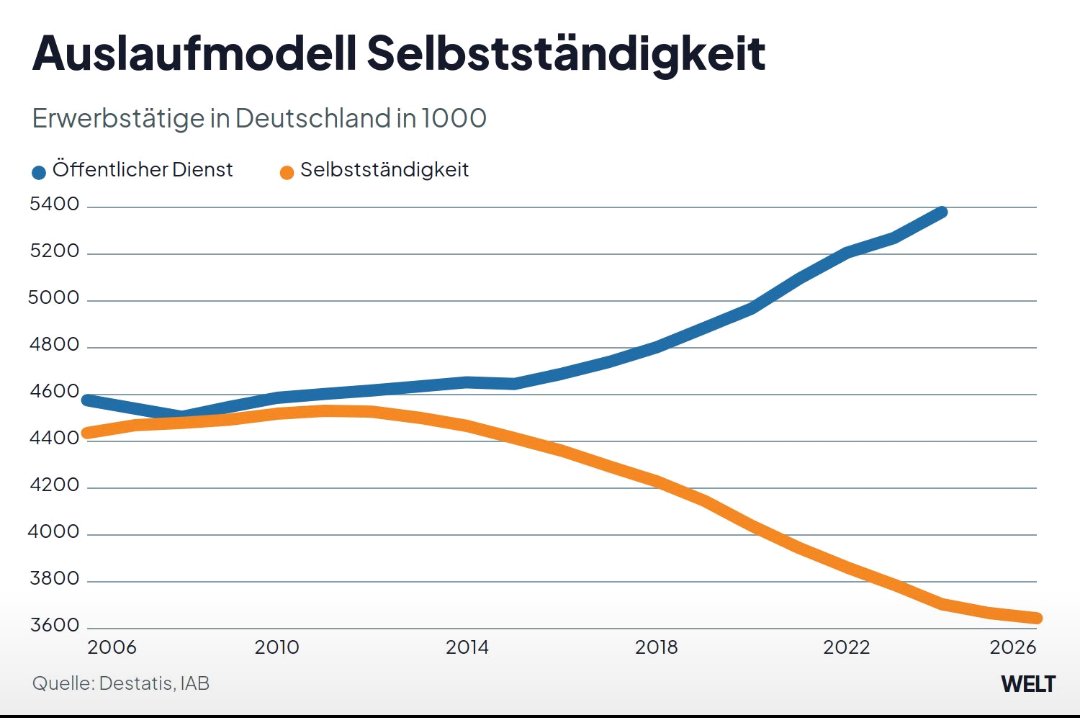
These: Ab einer Staatsquote von über 50 Prozent sind demokratische Systeme nicht mehr reformfähig, da eine kritische Masse der Wahlberechtigten direkt oder indirekt von umverteilten Geldern lebt.
🇪🇺 DATENSCHUTZ ADÉ! EU-Staaten geben europäische Daten fürs KI-Training frei. Ohne Einwilligung.
Am Mittwoch hat der Rat seine Verhandlungsposition zum Digital Omnibus beschlossen, mit deutscher Unterstützung. Kern ist ein neuer Artikel 88a in der DSGVO: Die Verarbeitung personenbezogener Daten im Rahmen von Entwicklung und Betrieb von KI-Systemen kann auf das berechtigte Interesse gestützt werden. Keine Einwilligung nötig, Prüfung im Einzelfall. Dazu eine Ausnahme in Artikel 9, die Restbestände besonderer Datenkategorien in Trainingsdaten toleriert. Das Parlament muss noch zustimmen.
Max Schrems nennt es eine digitale Enteignung der Europäer und das größte Geschenk, das EU-Staaten der US-Tech-Industrie je gemacht hätten.
Profitieren wird, wer bereits riesige Mengen europäischer Daten besitzt. Das sind Google, Meta und Microsoft, nicht der Mittelständler in Schwaben. Wer zwanzig Jahre lang gesammelt hat, darf diesen Bestand jetzt für Training nutzen. Wer bei null anfängt, hat davon nichts.
Dieselbe Woche, dieselbe Union: Haftungsregeln für KI liegen auf Eis, weil man sich nicht einigt. Für das Training mit fremden Daten findet sich eine Mehrheit sofort.
Meine Meinung: Wer glaubt, der Datenschutz in seiner heutigen Form überlebe diese Technologie, ist naiv. Er fällt, so oder so. Die einzige Frage ist, ob er für alle fällt oder nur für die, die schon zwanzig Jahre gesammelt haben.
Europa hat damit sein Verhältnis zur KI auf den Punkt gebracht. Die Modelle bauen andere. Die Rechenzentren stehen anderswo. Beigesteuert werden die Daten der eigenen Bürger. 👍🏼
WTF, $3000 Samsung TV has an always-on mic, automatic content recognition, geo tracking, network mapping, and ships your data to Samsung + 400 partners.
Bro Rooted a brand-new 2025 Samsung TV after noticing absurdly targeted ads.
Firmware was locked down, so zero-days it was.
Got a root shell.
then found: always-on voice service, ACR, geo, full telemetry pipeline, and four separate DRM systems.
This isn’t a bug, It’s the product bro.
Dusting off this tweet from April because this gap in shared understanding of LLM capability is *widening*. It's now less "two groups of people speaking past each other" and more a sharp funnel.
- Napkin math somewhere around 6B people (~75% of the population) have barely come in contact with LLMs at all.
- Around 1-2B (~20%) are casual and infrequent users of free-tier ChatGPT-like products. This group sees derpy chatbots and treats them a bit like a better Google search, a writing aid, or etc. Maybe an agent tries to book you a flight. I have non-tech friends who (reasonably, imo) say they have not much use for it at all. Even many professionals outside of math&code are in this tier. For example, execs and many other functions spend a lot of their time talking to other people, so while they understand what is happening intellectually, it is still second-hand and a bit abstract.
- Now we get to professional use of frontier-grade LLMs in math&code. Somewhere around 20M people (0.2%) see first-hand that large, complex projects that used to take them weeks/months can now be completed by agents with a prompt. Building apps, copying apps, translating apps, decompiling apps from binaries... This has all happened very quickly and recently - less than 1 year ago, I was writing code manually by hand, typing memorized computer code commands into a code editor character by character, occasionally pressing Tab to autocomplete a little chunk of code.
- And finally we get to the ~5,000 people (~0.00006%) with access to frontier-grade systems internally. The external world has seen the preview. It looks like swarms of thousands of agents collaborating over weeks on software mega projects: minting zero days, running cyber attacks and defenses at machine speeds, discovering new science, advancing the frontier of mathematics. Things that would have taken top professionals in the industry years of work. Meanwhile, human review and comprehension are starting to fall behind. For example, people are still involved in the "archeology" of the OpenAI-HF incident from many months ago. Mathematicians may be poring over the 722 manuscripts on frontier mathematics for a while.
The funnel is driven by a combination of factors:
1. The impact scales with ambition, problem size, and horizon. A question with a paragraph answer barely stresses the system. You need a reservoir of big, difficult problems that you really care about. This aspect drives the consumer / professional dimension of the funnel.
2. The jaggedness of the system (which I have written about a lot separately). Capability peaks in domains that are digital, verifiable and economically valuable. This is because LLM capability emerges from reinforcement learning on verifiable rewards on a curated environment mixture driven by revenue potential. This aspect primarily drives the area (e.g. math&code) dimension of the funnel.
3. Access. Free-tier, paid-tier, internal.
So this is the weirdness of the moment. The general public has mostly not interacted with these systems. When they have, it looks like a derpy chatbot. The majority of professionals still see only a modest uplift. And a small sliver of professionals are experiencing the vertigo of the curve going vertical. And it is all happening at the same time.
The year 2038 problem: a potential digital catastrophe
The Year 2038 problem, also known as the "Y2K38" or the "Unix Millennium Bug," is a digital time-related issue that is set to affect various computer systems and software applications in the near future. Unlike the well-known Y2K problem, which revolved around the rollover from December 31, 1999, to January 1, 2000, the Year 2038 problem is centered on the representation of time in many digital systems. In these systems, time is often recorded as the number of seconds that have elapsed since the epoch time of 1 January 1970, stored as a signed 32-bit binary integer. This encoding method, while efficient, has a critical limitation: it cannot accurately represent times beyond 03:14:07 UTC on 19 January 2038.
To understand the Year 2038 problem, we must first grasp the concept of epoch time. Epoch time, also known as Unix time or POSIX time, is a system for tracking time in computing. It represents time as the number of seconds that have elapsed since 00:00:00 UTC on 1 January 1970 (not counting leap seconds), often stored as a signed 32-bit binary integer. This format was widely adopted across various operating systems, programming languages, and applications because of its simplicity and efficiency in computation [1].
The root of the Year 2038 problem lies in the limited range of a 32-bit signed integer. A signed 32-bit integer can represent values from -2,147,483,648 to 2,147,483,647. This means it can represent 2,147,483,648 seconds, which is approximately 68 years. Counting forward from the epoch time of 1 January 1970, we arrive at 19 January 2038, 03:14:07 UTC. Beyond this point, the integer overflows, causing time-related calculations to behave erroneously [2].
The Year 2038 problem has significant implications for a wide range of digital systems that rely on 32-bit epoch time representation. One of the most critical sectors affected is embedded systems, which are pervasive in modern life. These systems can be found in medical devices, industrial control systems, transportation, and more. For example, consider the use of embedded systems in air traffic control. If these systems are not updated to handle the Year 2038 problem, it could lead to catastrophic failures in air traffic management [3].
Moreover, financial institutions and banking systems, which rely heavily on precise timekeeping for transactions and record-keeping, are at risk. Incorrect timestamps could lead to financial discrepancies, regulatory violations, and legal disputes. This poses a threat to the stability and integrity of the global financial system [4].
Mitigating the Year 2038 problem is a complex task that requires a concerted effort from the global tech community. Several approaches have been proposed and implemented to address this issue.
One approach is to transition to a 64-bit epoch time representation, which would provide a much longer time span before the integer overflows. While this is a technically sound solution, it requires significant changes to existing systems, including hardware and software upgrades. Furthermore, it does not entirely eliminate the problem, as it merely postpones it to a much later date [5].
Another approach involves using alternative timekeeping systems that are not subject to the 32-bit limitation. Some systems, such as the Network Time Protocol (NTP), already use a 64-bit timestamp. However, widespread adoption of such alternatives is a formidable challenge, as it requires coordination across the entire technology ecosystem [6].
As we approach 19 January 2038, 03:14:07 UTC, the risk of critical failures in embedded systems, financial institutions, and various other sectors becomes increasingly real. Addressing this problem requires a proactive and collaborative effort from the global tech community. Transitioning to 64-bit epoch time representation and exploring alternative timekeeping systems are potential solutions, but they come with their own challenges. To ensure a smooth transition and prevent potential disruptions, it is crucial for organizations and stakeholders to begin addressing the Year 2038 problem well in advance of the impending deadline [7].
References:
1] Leslie Lamport, "Time, Clocks, and the Ordering of Events in a Distributed System," Communications of the ACM, 1978.
[2] Markus Kuhn, "The Year 2038 Problem," University of Cambridge Computer Laboratory, 2008.
[3] Charles Perrow, "Normal Accidents: Living with High-Risk Technologies," Princeton University Press, 1999.
[4] Janusz Ordover and Russell W. Cooper, "The Bigness Complex: Industry, Labor, and Government in the American Economy," Brookings Institution Press, 1999.
[5] Brian Ford, "Large Address Aware Programming in Windows," Microsoft Corporation, 2013.
[6] David L. Mills, "Internet Time Synchronization: The Network Time Protocol," CRC Press, 2006.
[7] John K. Ousterhout, "System Performance," Pearson, 1990.