Ugly software that ~works~ gets the job done. Copy-pasting since the CP200, now with autocomplete.
prev: data, research @balancerlabs, research @block_science
Just a month later and...
🇪🇺 ChatControl is back!
Now they're trying to pass an even more far reaching ChatControl law through the back door, in a form even more intrusive than the originally rejected plan, without needing any of the EU countries votes
The new proposal:
- total mandatory surveillance of ALL text chats, emails and social media in the EU
- obligatory registration of your ID/passport to your chat, email or social media account
- minimum age requirement for chat, email and social media apps of 16 (!)
The only way to stop this law is if EU countries veto it
Read more here by @echo_pbreyer:
https://t.co/Yg2iXX9uWs
Inspecting the monthly average spending by long-term holders shows a clear trend: their outflows have risen steadily from ~12.5k BTC/day in early July to 22.5k BTC/day now (30D-SMA).
This highlights growing distribution pressure from older investor cohorts.
With all due respect to Matt, the notion that Tempo will in any way be neutral is a fantasy.
First, the very fact the he is billed as the "project lead" while sitting on the board of Stripe, a corporation who is clearly central to this effort, and being a GP at a VC firm that will likely be heavily invested in it, is a problem. That screams "not neutral."
(counterintuitively, the better Matt is at being project lead, the less neutral the chain will be).
Second, he is conflating the chain being permissionless with it being public. Public means "anyone can transact or issue on it" and permissionless means anyone can be a validator. As stated by Matt, Tempo will start as a permissioned chain.
A permissioned chain will never be public.
To wit: will North Korea be able to freely issue tokens on Tempo? What if Do Kwon decides to launch an algorithmic stablecoin on there from jail? And then Putin says "we will route payments for our sanctioned oil being sold on the black market via stablecoins on Tempo"?
Will the permissioned, known, and regulated corporations who run the validators be OK with all of this? Will the general council of Visa declare "Yes: we are clearly violating many US Federal laws and risk losing or licenses and possibly going to jail, but the docs said Tempo is a public blockchain, so we will process all of these transactions?"
I don't think so. As I argued yesterday, permissioned networks do not provide validators the plausible deniability required for a chain to be neutral:
https://t.co/hBgm1SjR1O
Third, no permissioned network has ever successfully transitioned to being permissionless. Hyperliquid is trying, but they have a long way to go, and are a special use case because it's mostly an app-chain, one whose primary margin asset still remains "elsewhere", something that might be OK for perps but not for payments.
Tempo will have an even harder time transitioning, because per the announcement, there is heavy involvement from various payments incumbents, most of all Stripe.
To believe that the network can transition to permissionless is to believe that corporations that accrued hundreds of billions of dollars in value over recent decades by owning a network will now launch a new network that they own (cause it's permissioned) but then magically decide to give all the power and profits that come with it away, quite possibly to competitors that will try to destroy their incumbent businesses.
That is highly unlikely. As @ccatalini pointed out yesterday, even Libra's original plans to someday decentralize nwere pushed to the back burner rather quickly. And Facebook did not have an incumbent payment business to protect. Stripe, Visa, Nubank, etc etc all do.
Y'all really think they'll give it away?
This has never happened before in the history of shared corporate infrastructure - which is what Tempo will be on day one.
Every other shared corporate infra (Visa, Mastercard, CME, NASDAQ, SWIFT, The Clearing House, etc etc) has gone in the opposite direction - it has centralized power and become more permissioned and censorable over time.
This is literally why Satoshi invented Bitcoin.
And I say this not as an ideological opposition to Tempo, but as an observation of what will be debated in the conference rooms of every potential issuer, user, etc etc.
Y'all really think Mastercard will jump all over a permissioned network controlled by Stripe and Visa?
Or Amazon or Walmart - fresh off their endless lawsuits against Visa and Mastercard for being oligopolies?
Lastly, It's hard enough to bootstrap a PoS chain from scratch because of the "rich get richer" problem of staking. Ethereum is still the only PoS chain that's achieved a diverse token-holder set that can deem it "a neutral L1." It got there by :
a)having a tiny premine by modern standards and b)being PoW for years.
Tempo will start with a massively concentrated token holder set and permissioned validator set. To argue it'll easily become neutral is to make a whole bunch of assumptions that are contrary to the ideals and lived experience of this industry.
Fight Chat Control.
You cannot make society secure by making people insecure.
We all deserve privacy and security, without inevitably hackable backdoors, for our private communications.
The fact that the government officials want to exempt themselves from their own law is telling: https://t.co/s2AF6wMPL3
With all due respect to Matt, the notion that Tempo will in any way be neutral is a fantasy.
First, the very fact the he is billed as the "project lead" while sitting on the board of Stripe, a corporation who is clearly central to this effort, and being a GP at a VC firm that will likely be heavily invested in it, is a problem. That screams "not neutral."
(counterintuitively, the better Matt is at being project lead, the less neutral the chain will be).
Second, he is conflating the chain being permissionless with it being public. Public means "anyone can transact or issue on it" and permissionless means anyone can be a validator. As stated by Matt, Tempo will start as a permissioned chain.
A permissioned chain will never be public.
To wit: will North Korea be able to freely issue tokens on Tempo? What if Do Kwon decides to launch an algorithmic stablecoin on there from jail? And then Putin says "we will route payments for our sanctioned oil being sold on the black market via stablecoins on Tempo"?
Will the permissioned, known, and regulated corporations who run the validators be OK with all of this? Will the general council of Visa declare "Yes: we are clearly violating many US Federal laws and risk losing or licenses and possibly going to jail, but the docs said Tempo is a public blockchain, so we will process all of these transactions?"
I don't think so. As I argued yesterday, permissioned networks do not provide validators the plausible deniability required for a chain to be neutral:
https://t.co/hBgm1SjR1O
Third, no permissioned network has ever successfully transitioned to being permissionless. Hyperliquid is trying, but they have a long way to go, and are a special use case because it's mostly an app-chain, one whose primary margin asset still remains "elsewhere", something that might be OK for perps but not for payments.
Tempo will have an even harder time transitioning, because per the announcement, there is heavy involvement from various payments incumbents, most of all Stripe.
To believe that the network can transition to permissionless is to believe that corporations that accrued hundreds of billions of dollars in value over recent decades by owning a network will now launch a new network that they own (cause it's permissioned) but then magically decide to give all the power and profits that come with it away, quite possibly to competitors that will try to destroy their incumbent businesses.
That is highly unlikely. As @ccatalini pointed out yesterday, even Libra's original plans to someday decentralize nwere pushed to the back burner rather quickly. And Facebook did not have an incumbent payment business to protect. Stripe, Visa, Nubank, etc etc all do.
Y'all really think they'll give it away?
This has never happened before in the history of shared corporate infrastructure - which is what Tempo will be on day one.
Every other shared corporate infra (Visa, Mastercard, CME, NASDAQ, SWIFT, The Clearing House, etc etc) has gone in the opposite direction - it has centralized power and become more permissioned and censorable over time.
This is literally why Satoshi invented Bitcoin.
And I say this not as an ideological opposition to Tempo, but as an observation of what will be debated in the conference rooms of every potential issuer, user, etc etc.
Y'all really think Mastercard will jump all over a permissioned network controlled by Stripe and Visa?
Or Amazon or Walmart - fresh off their endless lawsuits against Visa and Mastercard for being oligopolies?
Lastly, It's hard enough to bootstrap a PoS chain from scratch because of the "rich get richer" problem of staking. Ethereum is still the only PoS chain that's achieved a diverse token-holder set that can deem it "a neutral L1." It got there by :
a)having a tiny premine by modern standards and b)being PoW for years.
Tempo will start with a massively concentrated token holder set and permissioned validator set. To argue it'll easily become neutral is to make a whole bunch of assumptions that are contrary to the ideals and lived experience of this industry.
The next challenge isn't just mainstream adoption of crypto, but preservation of true decentralization.
Some will settle for "fintech 2.0" — walled gardens on permissioned chains that juice TradFi margins but do little to change the system.
No thanks. Permissionless or bust!
Open, neutral, decentralized infrastructure must be the foundation for the future of US and global economic activity
Neutral infra provides a universal, persistent value proposition to any application or user—empowering them to refine, extend, and build upon that neutral stratum to meet an endless set of evolving needs
Systems that are biased, controlled, and otherwise not decentralized are fundamentally narrower - constricting innovation, encouraging local rather than global maxima, hampering free-market growth, and ultimately leading us to a more brittle outcome in an increasingly dynamic world
Decentralization truly matters if we're aiming for the largest possible positive impact on the US and the world, and *Ethereum remains our best bet*
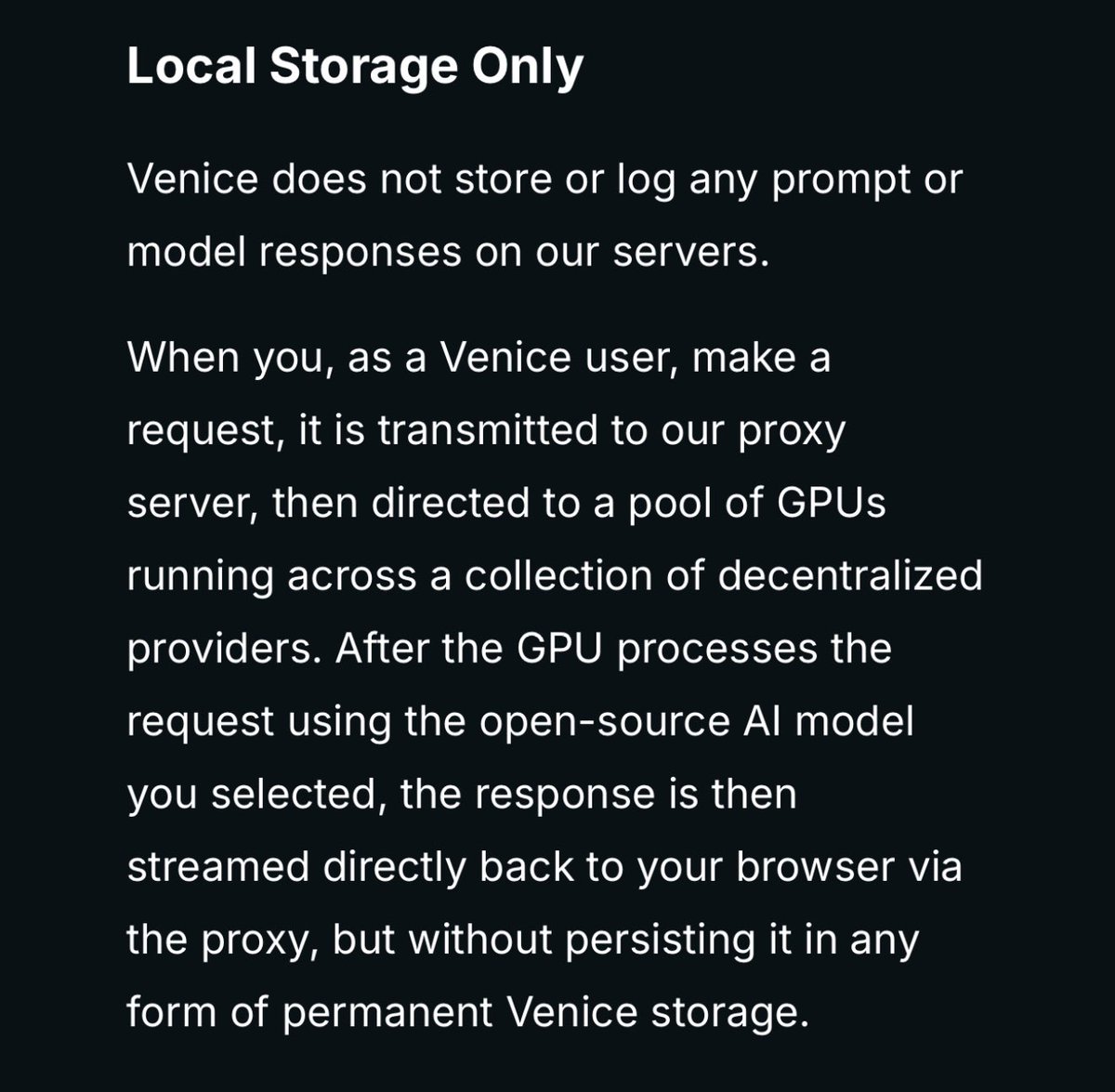
Venice is not built onchain
Venice is also not private
Prompts are sent to a collection of GPU providers who each individually have the full ability see the full contents of your prompt and any files you upload with it
Files can be stored indiscriminately of what Venice wants
Don't fret, brother.
Crypto is, and has always been, 99% nonsense grifty garbage/scams/jokes, and 1% fundamental global financial system revolution.
But this 99/1 is based just on quantity of projects.
Considered by market cap, it's more like 75% quality, 25% nonsense. Bitcoin is good. Ethereum is good. Stablecoins are good. Several dozen defi projects are good. Wildly cool technology permeates through all of it, and sound economics underpins its long term growth, though the short term feels often like an appallingly irrational market.
How to cope with this dichotomy?
Embrace the degen frontier and have fun, and recognize that amidst it all, a decentralized financial system is real, is important, and is working. None of it is forced on anyone, after all.
We are building and we are attracting the world toward us... and much of the world simply wants to gamble and have fun. This is okay, and actually provides capital for the important work happening behind the casino.
It is, actually, working.
We are realizing the wildest dreams of those who are into it for all the right reasons, despite the accompanying fantasies of those who aren't.
Just keep building, and build well.
We've got some big things landing in Balancer v3 in the upcoming months. Here's what I'm most excited about:
• Expansion to L2s - @arbitrum and @base
• Stable Surge hook designed for peg protection
• MEV internalization via priority fees on @base
• Return of Liquidity Bootstrapping Pools (LBPs)
• Passive CL powered by @GyroStable ECLPs
• CoW AMMs compatible with v3 architecture
Time to build
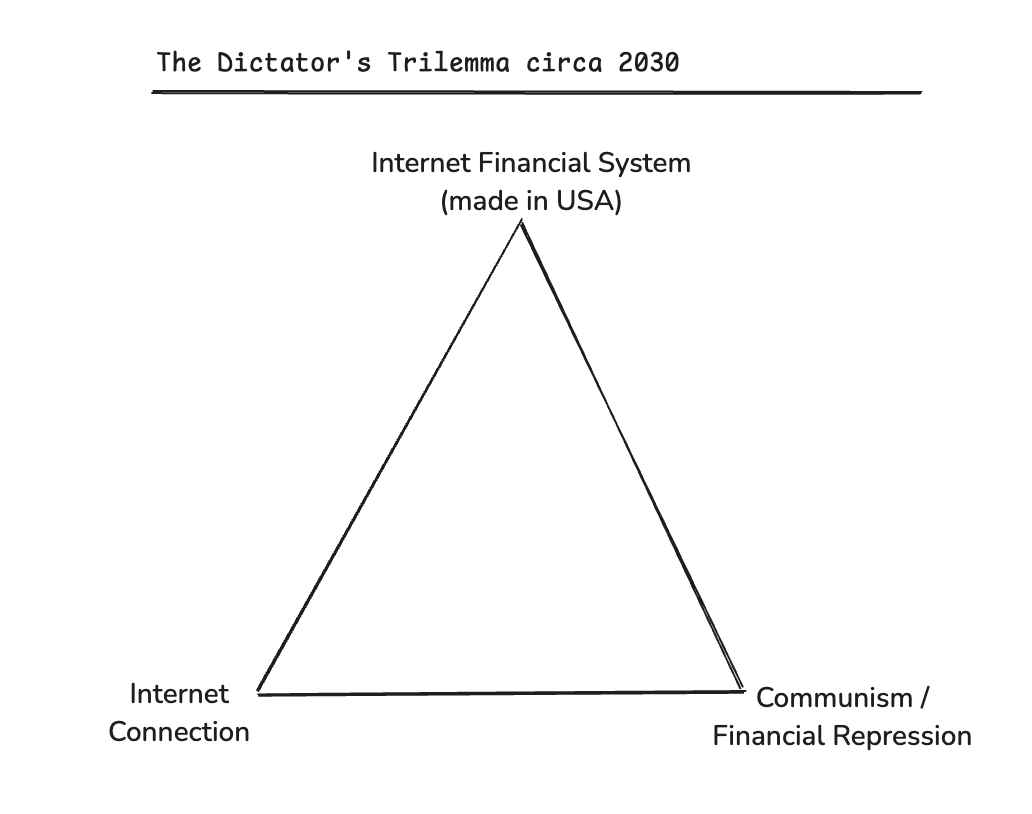
How the Internet Financial System (made in the USA) can end financial repression across the world
Over the next few years, I expect the US financial and regulatory system to embrace stablecoins, basic financial regulations for onchain financial primitives, and tokenized US assets (e.g., Apple stock onchain). These are the table-stakes regulations we are asking for as an industry, and they can all be drafted in such a way that they advance the US national interest while protecting consumers. These basic regulations are entirely sufficient to establish an operational Internet Financial System.
A few assets can fully live on the cloud, like Bitcoin. Still, most assets require a physical manifestation and cooperation with a legal system associated with control over physical territory. There is no better place to begin than the USA, the financial system with the deepest and most valuable capital markets in the world.
People don't fully appreciate how an Internet Financial System built in America will spread property rights worldwide and pull value from all regimes engaged in financial repression. The Internet Financial System builds a trilemma into political reality. It means a state must decide between financial repression and a working Internet connection, and I expect most regimes to opt for the working Internet connection.
If there is no Internet Financial System, you can still have financial repression (i.e., financial regimes that impose decisively suboptimal choices at the individual level using the coercive power of the state) in a territory with access to the Internet. The financial repressors can block capital flows at the level of the banking system and lock the local population into local assets that the government can freeze, devalue, and confiscate.
The model is simple— local government has root access to the local banking system, where the local population has its wealth and savings.
The existence of an Internet Financial System will force local governments around the world to either abandon financial repression or cut entire populations from the Internet. This is because individuals can use encrypted communication to sell labor abroad in exchange for savings and assets that exist on the cloud, and those assets will work through the local economy.
Imagine the former USSR in a world with a properly working Internet Financial System. The USSR had many of the best scientists and mathematicians in the world, and there was plenty of demand for Soviet human capital abroad. Millions of Soviets could have earned money on the Internet.
A young Soviet Anatoly could decide to ship Rust code for a foreign company in exchange for Bitcoin or USDC. He may choose to spend his USDC to buy Apple stock onchain. He can decide to save exclusively in US capital markets.
Anatoly's landlord may also decide she wants to receive payment in USDC. She has seen her savings melt under the heat of double-digit inflation in the Soviet Ruble. The landlord then tells her construction company she will pay them in USDC in exchange for a 10% discount and better payment terms, and they are thrilled. You can see how easily US assets spread across the world.
Every knowledge worker is a potential source node for a shadow economy operating within the Internet Financial System (and outside of the financial repression of the local territorial government).
We are seeing the early innings with cases like USDT in Argentina and Nigeria and Bitcoin across many high-inflation countries. I expect this to accelerate dramatically over the next few years as stablecoins cease to be the target of an overly zealous and misguided regulatory pitbull and become legitimate assets supported by the US government.
The Internet Financial System will make US capital markets a shining city on a hill for every knowledge worker living under financial repression. American Renaissance (real).