Today I will start a new small series: Uropathology for urologists and uro-oncologists. @urotoday@OncoAlert@imedverse
Let us start with my favorite topic: Urothelial Cancer!
You will often hear urothelial cancer is a heterogeneous disease, but why ?
Second approval for Iza-bren by China NMPA in patients with recurrent or metastatic esophageal squamous cell carcinoma (ESCC)
Approval supported by the results from the pivotal PANKU-Esophagus01 trial
https://t.co/kGVcS2xrtj
FGFR3 is a dimmer pretending to be a switch.
Or at least that’s increasingly how I’ve come to think about it.
That mismatch may explain why erdafitinib often works… until it doesn’t.
1/
🔬happy to share our new expert article on FGFR3 testing in advanced UC: practical, consensus-driven guidance on FGFR3 testing in urothelial carcinoma, from patient selection to result reporting.
Why it matters: FGFR3 alterations occur in ~15-20% of MIBC/mUC (up to 80% in low-grade NMIBC). In the THOR trial, erdafitinib improved OS vs chemo in FGFR-altered mUC (12.1 vs 7.8 mo, HR 0.64, p=0.005). Testing at the right time is what actually gets patients access to this.
👥 Who/when: test all LA/mUC patients at diagnosis (EAU/ESMO). No routine reflex testing in UC generally, but consider it at progression or emergence of metastatic disease if clinical info is available. Frailty/ECOG > chronological age when deciding eligibility.
🧫 Sample: metastatic tissue preferred over archival material, older specimens carry different biology and risk false positives. Ischaemia time, fixation window (6-48h, neutral buffered formalin), and tumour cellularity all affect yield.
⚙️ Methodology:
• PCR: fast (3-5d), cheap, validated CDx available (Therascreen FGFR RGQ RT-PCR for erdafitinib), but limited to known hotspots and few fusions
• NGS: broader (mutations, fusions, CNVs), ideally parallel DNASeq (mutations) + RNASeq (fusions), 5-21d TAT, higher cost/infrastructure demand Both acceptable per ESMO ESCAT (FGFR1/2/3 = Tier I)
🧪 Emerging: liquid biopsy (ctDNA) is useful when tissue is unavailable, but concordance with tissue is only ~60% across UC broadly (no FGFR3-specific data yet), 23% alterations tissue-only, 17% plasma-only. AI on H&E slides shows promise but remains a black box without multicentre validation. Neither replaces tissue testing today.
📄 Reporting: state ESCAT tier, distinguish “non-informative” (QC/insufficient tumour content) from true negative, use standard (HUGO) nomenclature, agree templates across the MDT. This is where a lot of real-world testing quality actually gets lost.
Grateful to the whole multidisciplinary panel for this one. 🙏
#BladderCancer #FGFR3 #UroOnc #PrecisionOncology
@y_loriot@niklas_kluemper@b_szabados@Uromigos@tompowles1@DrChoueiri@urotoday@yao_zhu_sh@DrYukselUrun@OncoAlert@shilpaonc@PGrivasMDPhD@drenriquegrande
https://t.co/rPOTA8qha1
🔬happy to share our new expert article on FGFR3 testing in advanced UC: practical, consensus-driven guidance on FGFR3 testing in urothelial carcinoma, from patient selection to result reporting.
Why it matters: FGFR3 alterations occur in ~15-20% of MIBC/mUC (up to 80% in low-grade NMIBC). In the THOR trial, erdafitinib improved OS vs chemo in FGFR-altered mUC (12.1 vs 7.8 mo, HR 0.64, p=0.005). Testing at the right time is what actually gets patients access to this.
👥 Who/when: test all LA/mUC patients at diagnosis (EAU/ESMO). No routine reflex testing in UC generally, but consider it at progression or emergence of metastatic disease if clinical info is available. Frailty/ECOG > chronological age when deciding eligibility.
🧫 Sample: metastatic tissue preferred over archival material, older specimens carry different biology and risk false positives. Ischaemia time, fixation window (6-48h, neutral buffered formalin), and tumour cellularity all affect yield.
⚙️ Methodology:
• PCR: fast (3-5d), cheap, validated CDx available (Therascreen FGFR RGQ RT-PCR for erdafitinib), but limited to known hotspots and few fusions
• NGS: broader (mutations, fusions, CNVs), ideally parallel DNASeq (mutations) + RNASeq (fusions), 5-21d TAT, higher cost/infrastructure demand Both acceptable per ESMO ESCAT (FGFR1/2/3 = Tier I)
🧪 Emerging: liquid biopsy (ctDNA) is useful when tissue is unavailable, but concordance with tissue is only ~60% across UC broadly (no FGFR3-specific data yet), 23% alterations tissue-only, 17% plasma-only. AI on H&E slides shows promise but remains a black box without multicentre validation. Neither replaces tissue testing today.
📄 Reporting: state ESCAT tier, distinguish “non-informative” (QC/insufficient tumour content) from true negative, use standard (HUGO) nomenclature, agree templates across the MDT. This is where a lot of real-world testing quality actually gets lost.
Grateful to the whole multidisciplinary panel for this one. 🙏
#BladderCancer #FGFR3 #UroOnc #PrecisionOncology
@y_loriot@niklas_kluemper@b_szabados@Uromigos@tompowles1@DrChoueiri@urotoday@yao_zhu_sh@DrYukselUrun@OncoAlert@shilpaonc@PGrivasMDPhD@drenriquegrande
https://t.co/rPOTA8qha1
AMP is sharper for sure, but recent data (including a paper from our group in press) indicates a different picture. 10-15% are higher for Nectin-4 (mostly in the sarcomatoid and squamous spectrum) and more than 10% are Nectin-4 low, so there is still space for other targets specifically in the basal squamous spectrum that covers 30% of the whole real-world spectrum (usually not reflected in most clinical trials due to exclusion of non-conventional UC).
FDA approves neoadjuvant + adjuvant EV+pembro for muscle-invasive bladder cancer, now regardless of cisplatin eligibility. The first non-platinum regimen in ~25 years to beat cisplatin-based NAC head to head.
EV-304 / KEYNOTE-B15 (n=808, EV+pembro vs neoadjuvant gem/cis):
📉 EFS HR 0.53. Median EFS not reached.
📉 OS HR 0.65 (95% CI 0.48–0.89). 24-mo OS 86.9% vs 81.3%.
🔬 pCR 55.8% vs 32.5% (Δ 23.4%, 95% CI 16.7–29.8). 64.4% in those who reached cystectomy.
⚠️ Not a free lunch: grade ≥3 TEAEs 75.7% in the EV+pembro arm.
Three things I am watching as a pathologist 🔬
1️⃣ pCR nearly doubled, but regression grading is still not a validated surrogate for survival in MIBC (pCR alone is not sufficient because there are probably major responders with similar outcomes as pCR patients—we know that from many other cancer types). So still a lot of work out there.
2️⃣ ypT0N0 reporting at cystectomy just became a high-stakes number. Sampling protocols and regression assessment need to be rigorous and consistent.
3️⃣ The open question: who, if anyone, still needs cisplatin—or better to say who is resistant to EV. It is a targeted therapy and evidence is becoming bigger and bigger that it isn’t as abundantly expressed as estimated before—and certain UC biologies respond worse? And can we identify patients with resistant tumors before they receive 4 cycles of an ADC that is ineffective for their biology—so that they could instead go on a trial with a more suited ADC?
FDA approves neoadjuvant + adjuvant EV+pembro for muscle-invasive bladder cancer, now regardless of cisplatin eligibility. The first non-platinum regimen in ~25 years to beat cisplatin-based NAC head to head.
EV-304 / KEYNOTE-B15 (n=808, EV+pembro vs neoadjuvant gem/cis):
📉 EFS HR 0.53. Median EFS not reached.
📉 OS HR 0.65 (95% CI 0.48–0.89). 24-mo OS 86.9% vs 81.3%.
🔬 pCR 55.8% vs 32.5% (Δ 23.4%, 95% CI 16.7–29.8). 64.4% in those who reached cystectomy.
⚠️ Not a free lunch: grade ≥3 TEAEs 75.7% in the EV+pembro arm.
Three things I am watching as a pathologist 🔬
1️⃣ pCR nearly doubled, but regression grading is still not a validated surrogate for survival in MIBC (pCR alone is not sufficient because there are probably major responders with similar outcomes as pCR patients—we know that from many other cancer types). So still a lot of work out there.
2️⃣ ypT0N0 reporting at cystectomy just became a high-stakes number. Sampling protocols and regression assessment need to be rigorous and consistent.
3️⃣ The open question: who, if anyone, still needs cisplatin—or better to say who is resistant to EV. It is a targeted therapy and evidence is becoming bigger and bigger that it isn’t as abundantly expressed as estimated before—and certain UC biologies respond worse? And can we identify patients with resistant tumors before they receive 4 cycles of an ADC that is ineffective for their biology—so that they could instead go on a trial with a more suited ADC?
Huge congrats on the final publication of LITESPARK022 - impressive results and improvement for adjuvant therapy.
Are there any plans for future trials with ctDNA-based patient selection? The initial data were not perfect in terms of sensitivity, but technical metrics might change?
@niklas_kluemper@OncoAlert@urotoday@DrChoueiri
🧬 New in The Lancet Oncology: HORIZON-Breast01, a phase 3 interim analysis (very uncommon).
Trastuzumab rezetecan (SHR-A1811), a HER2-directed antibody-drug conjugate with a topoisomerase I inhibitor payload, beat pyrotinib plus capecitabine in HER2-positive metastatic breast cancer after prior trastuzumab and a taxane.
📊 The numbers (4.8 mg/kg, n=142 vs control n=145):
✅ Median PFS 30.6 months vs 8.3 months. HR 0.22 (95% CI 0.15–0.34), p<0.0001.
✅ 12-month PFS 84.7% vs 35.5%.
✅ ORR 81.7% vs 55.9%. Median duration of response 27.8 vs 10.9 months.
✅ OS still immature (median not reached), but 12-month OS 96.3% vs 88.4%, HR 0.31, p=0.0012.
🩸 Safety: mostly haematologic. Grade ≥3 TRAEs 70% vs 63%. Interstitial lung disease in 4 patients (3%), no grade 4 or 5 events, exposure-adjusted rate 2.5% per patient-year. That ILD signal is low for a HER2 ADC and worth watching. 👀
⚠️ Caveats worth stating plainly. Interim analysis, so the PFS estimate may still shift. All 287 patients were enrolled at 50 Chinese sites. No head-to-head against trastuzumab deruxtecan, the current global standard. Funded by Jiangsu Hengrui.
🎯 Bottom line: a potential practice-changing option in this setting, pending mature OS and broader populations.
@OncoAlert@oncodaily@niklas_kluemper@LancetOncology
🔗 https://t.co/GSXkZnIPpz
🧬 Casdatifan (new HIF-2α inhibitor) just showed real durability in heavily pretreated metastatic ccRCC 👇
📊 ARC-20 trial (n=127):
✅ ORR: 31% overall, 35% at 100mg QD (the RP3D)
⏳ Median PFS: 12.2 months — not even reached yet in the 100mg cohort!
🎯 Disease control rate: 81%
🔬 The science checks out too: deeper drops in serum EPO (a HIF-2α biomarker) = better responses (P=0.001) and longer PFS (P=0.006). Higher Tumor HIF-2α expression tracked with outcomes too. Everything’s in line with previous data on that mainly stemming from Kaelin, Ratcliffe and others.
@DrChoueiri: would you envision these markers specifically EPO serum levels as guidance for this treatment ?
⚠️ Safety: manageable — mostly anemia & hypoxia, low discontinuation rates (3%)
🚀 Next up: Phase III PEAK-1 testing casdatifan + cabozantinib
#KidneyCancer #RCC #HIF2 #OncTwitter #ClinicalTrials @DrChoueiri@niklas_kluemper@OncoAlert@urotoday@DrYukselUrun@shilpaonc@Uromigos@oncodaily
https://t.co/HTWRQzDOQc
Do we understand PDAC? These tumors have a particular desmoplastic stroma, are hypovascularized, and exhibit proven high osmotic pressure in their stroma. As indicated by the 0% ORR achieved by T-DXd in 2/3+ PDACs and the lack of additive value from zolbetuximab (also an antibody), this cannot be explained solely by chemoresistance. Anti-PD-1 antibodies were also inactive.
There is no strong evidence for this, but antibodies probably cannot reach PDAC tumor cells. This is underscored by the 0% ORR to T-DXd, while some patients respond to small-molecule chemotherapy.
How can we overcome this? Potentially with next-generation small peptide compounds or direct tumor stroma remodeling.
@LauraBukavinaMD@jcasusce Those are BCG refractory patients scheduled for early/salvage CX, right? If so ctDNA would important to be included (and as said in another post probably also in therapy naive T1) to determine likelihood of muscle invasion.
Yes true, and MET too. But I wonder how this is explained. In pan Destiny02 ORR in 25% pdac patients was 4%, while for other ADCs ORR then ranges between 10(which is in line with poor tdxd findings) versus 40% (for MET eg). What’s your explanation for this discrepancy ? Tdxd is an active drug though right now probably one of the most efficacious ADCs.
Do we understand PDAC? These tumors have a particular desmoplastic stroma, are hypovascularized, and exhibit proven high osmotic pressure in their stroma. As indicated by the 0% ORR achieved by T-DXd in 2/3+ PDACs and the lack of additive value from zolbetuximab (also an antibody), this cannot be explained solely by chemoresistance. Anti-PD-1 antibodies were also inactive.
There is no strong evidence for this, but antibodies probably cannot reach PDAC tumor cells. This is underscored by the 0% ORR to T-DXd, while some patients respond to small-molecule chemotherapy.
How can we overcome this? Potentially with next-generation small peptide compounds or direct tumor stroma remodeling.
Zolbetuximab plus gemcitabine and nab-paclitaxel in CLDN18.2+ metastatic PDAC: phase II GLEAM study
@ESMO-GI
👉Primary endpoint not met, no OS & PFS benefit
👉Toxicity manageable
🧐Not the right drug, but maybe the right target
Wer Personalverantwortung trägt, kennt das Problem von Fehlanreizen und missbräuchlichen Einzelfällen, die @Arnd_Diringer hier anspricht. Unser größeres Problem in Deutschland ist jedoch die multifaktoriell verursachte Erosion von Leistungsbereitschaft, Mut zur Veränderung und struktureller Innovationskraft. Unbegründete Krankheitstage und eine gesunkene Hemmschwelle, diese trotz Arbeitsfähigkeit zu nehmen, tragen dazu bei, erklären die Lage aber nur zu einem kleinen Teil.
Der Anstieg krankheitsbedingter Fehlzeiten ist gut belegt. Ebenso sind die volkswirtschaftlichen Kosten erheblich: Die BAuA schätzt für 2024 insgesamt 881,5 Millionen Arbeitsunfähigkeitstage, daraus resultierend 134 Milliarden Euro Produktionsausfall und 227 Milliarden Euro Ausfall an Bruttowertschöpfung. Ökonomische Analysen gehen zudem davon aus, dass der erhöhte Krankenstand das BIP-Niveau in den Jahren 2022 und 2023 um etwa 0,7 bis 1,1 Prozent gedämpft haben könnte.
Als Arzt halte ich ausdrücklich fest: Ein relevanter Anteil dieser Krankheitstage ist medizinisch berechtigt und für Genesung, Infektionsschutz und langfristige Arbeitsfähigkeit essenziell.
Ein noch größeres Problem ist aber die neue deutsche Tugend der Zerredung. Wenn wir nicht endlich akzeptieren, dass wir in den vergangenen 20 Jahren an vielen kleinen Kreuzungen falsch abgebogen sind, und wenn wir weiterhin jede notwendige Korrekturmaßnahme als Republik der Bedenkenträger zerlegen, wird Deutschlands Krise tiefer werden. Währenddessen schaut unsere Konkurrenz, insbesondere aus China, auf Europas geringe Produktivitätsdynamik und zieht weiter davon.
https://t.co/GMhYsNMSAi
🧬 Casdatifan (new HIF-2α inhibitor) just showed real durability in heavily pretreated metastatic ccRCC 👇
📊 ARC-20 trial (n=127):
✅ ORR: 31% overall, 35% at 100mg QD (the RP3D)
⏳ Median PFS: 12.2 months — not even reached yet in the 100mg cohort!
🎯 Disease control rate: 81%
🔬 The science checks out too: deeper drops in serum EPO (a HIF-2α biomarker) = better responses (P=0.001) and longer PFS (P=0.006). Higher Tumor HIF-2α expression tracked with outcomes too. Everything’s in line with previous data on that mainly stemming from Kaelin, Ratcliffe and others.
@DrChoueiri: would you envision these markers specifically EPO serum levels as guidance for this treatment ?
⚠️ Safety: manageable — mostly anemia & hypoxia, low discontinuation rates (3%)
🚀 Next up: Phase III PEAK-1 testing casdatifan + cabozantinib
#KidneyCancer #RCC #HIF2 #OncTwitter #ClinicalTrials @DrChoueiri@niklas_kluemper@OncoAlert@urotoday@DrYukselUrun@shilpaonc@Uromigos@oncodaily
https://t.co/HTWRQzDOQc
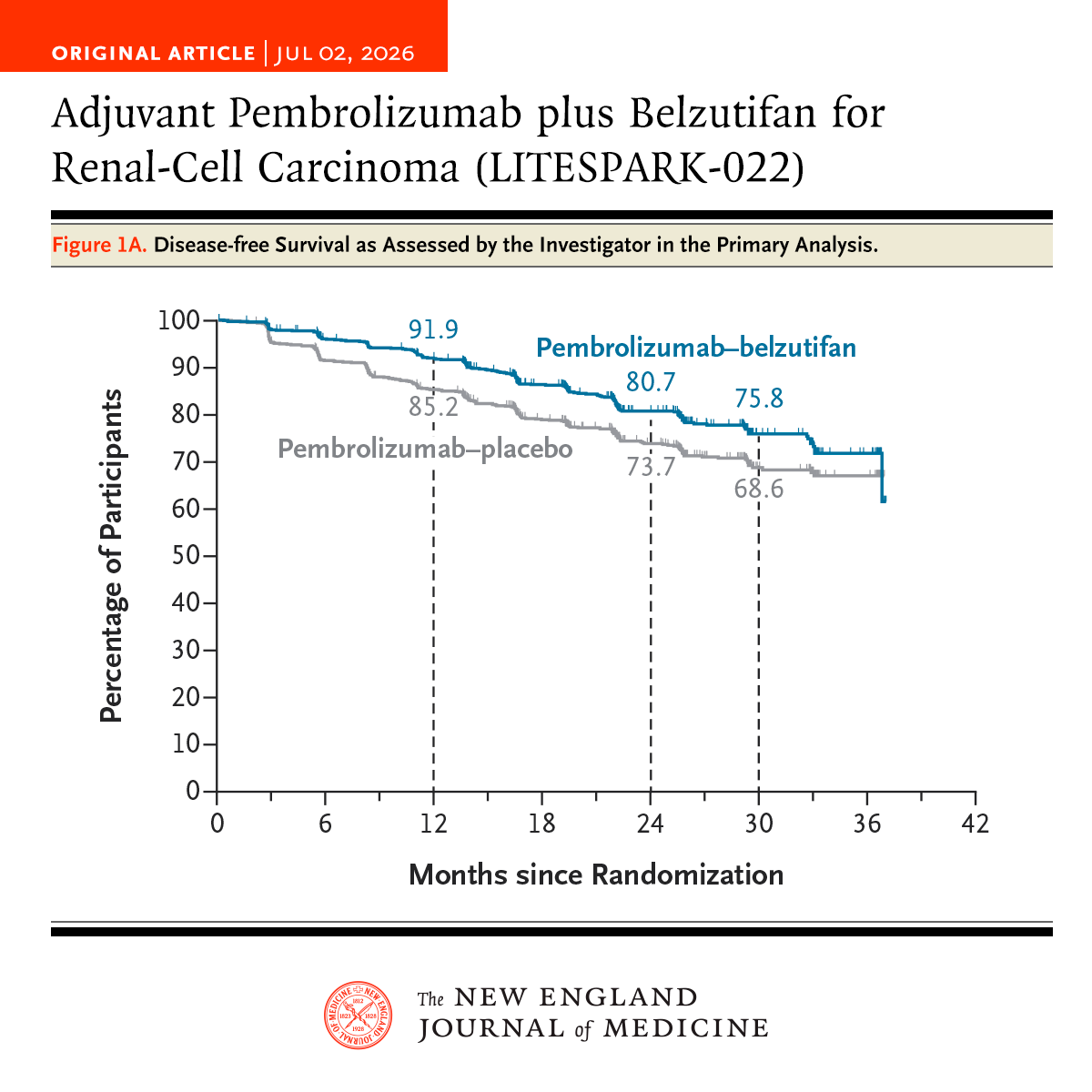
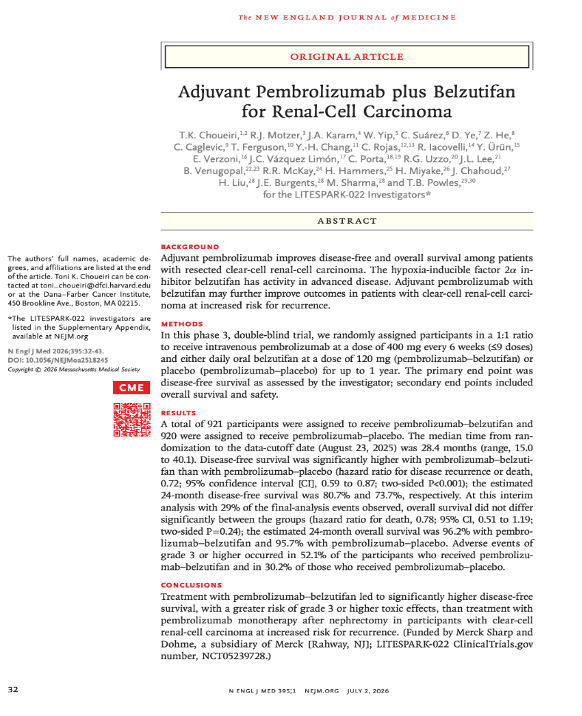
In patients with resected clear-cell renal-cell carcinoma, pembrolizumab plus belzutifan led to higher disease-free survival than pembrolizumab alone but with an increased risk of grade 3 or higher adverse events. Full phase 3 LITESPARK-022 trial results: https://t.co/CF0F3TFyxd
NEJM subscribers can use AI Companion to ask questions about this article and quickly find the details you need.
🧬 New in The Lancet Oncology: HORIZON-Breast01, a phase 3 interim analysis (very uncommon).
Trastuzumab rezetecan (SHR-A1811), a HER2-directed antibody-drug conjugate with a topoisomerase I inhibitor payload, beat pyrotinib plus capecitabine in HER2-positive metastatic breast cancer after prior trastuzumab and a taxane.
📊 The numbers (4.8 mg/kg, n=142 vs control n=145):
✅ Median PFS 30.6 months vs 8.3 months. HR 0.22 (95% CI 0.15–0.34), p<0.0001.
✅ 12-month PFS 84.7% vs 35.5%.
✅ ORR 81.7% vs 55.9%. Median duration of response 27.8 vs 10.9 months.
✅ OS still immature (median not reached), but 12-month OS 96.3% vs 88.4%, HR 0.31, p=0.0012.
🩸 Safety: mostly haematologic. Grade ≥3 TRAEs 70% vs 63%. Interstitial lung disease in 4 patients (3%), no grade 4 or 5 events, exposure-adjusted rate 2.5% per patient-year. That ILD signal is low for a HER2 ADC and worth watching. 👀
⚠️ Caveats worth stating plainly. Interim analysis, so the PFS estimate may still shift. All 287 patients were enrolled at 50 Chinese sites. No head-to-head against trastuzumab deruxtecan, the current global standard. Funded by Jiangsu Hengrui.
🎯 Bottom line: a potential practice-changing option in this setting, pending mature OS and broader populations.
@OncoAlert@oncodaily@niklas_kluemper@LancetOncology
🔗 https://t.co/GSXkZnIPpz
Huge congrats on the final publication of LITESPARK022 - impressive results and improvement for adjuvant therapy.
Are there any plans for future trials with ctDNA-based patient selection? The initial data were not perfect in terms of sensitivity, but technical metrics might change?
@niklas_kluemper@OncoAlert@urotoday@DrChoueiri
🚨 Results from #LITESPARK022 (#LS022) are out in @NEJM!
1/This phase III trial evaluated whether adding the HIF-2α inhibitor Belzutifan (BEL) to adjuvant pembrolizumab (PEMBRO) could improve outcomes for patients with resected clear-cell RCC at increased risk for recurrence.
https://t.co/1BLAercj3p
@oncoalert@asco@myESMO