Epic moment indeed. Google's "Project Suncatcher" .
we’re about to watch AI compute leave the planet earth.
Google is about to put 4 TPUs in orbit. SpaceX is the launch provider, and is scheduled to fly on SpaceX's Transporter-18 rideshare mission.
Google's next step is to launch 2 satellites in 2027 and make them run AI together with laser links, because distributed AI workloads need data center class bandwidth.
So a network of satellites need to operate like a giant data center in space.
They'll send data directly between each other using laser beams, basically fiber-optic communication without the cable.
That speed is crucial if multiple satellites are going to work like one data center, and Google's lab system has already reached 800Gbps each way.
---
(full video on official Google YT channel, link in comment)
China is seeing a historic boom in exports due to AI.
China’s exports rose +25% YoY in August, their 3rd-largest monthly reading in at least 2 years.
At the same time, imports surged +28%, pushing the monthly trade surplus to +$119 billion and the year-to-date surplus to +$806 billion.
This puts China’s trade surplus on track for another annual record, following the $1.2 trillion seen in 2025.
This all comes as high-tech exports contributed more than half of China’s export growth last month.
Integrated-circuit shipments soared +130% YoY in August, while high-tech product exports jumped +57%.
The AI boom is increasingly powering China’s export engine.
This is exactly what I’ve been waiting for 🔥
Meta just announced its new VR Glasses. Basically an Apple Vision Pro-like experience, but MUCH smaller and lighter.
• Only 100g
• Micro-OLED displays
• Snapdragon Reality Elite
• Eye + hand tracking
• External compute/battery puck
• $1,299
This is the direction I want VR to go. Smaller, lighter, more comfortable, while keeping the full spatial computing experience.
Launching Spring 2027. I’m getting these 100% 🙌
Formal verification is the future of coding.
Expressing user intent formally is the key bottleneck.
In the past, it was too cumbersome for humans to manually specify their intent in languages like Lean.
That bottleneck has gone away with frontier models.
One of the most interesting arguments about the #AI age comes from Anthropic cofounder Jack Clark, who studied literature and creative writing—not computer science in college.
His point: As AI makes technical execution easier, the premium may shift to people who can ask the right questions, think critically, connect ideas across disciplines, understand history and human behavior, and see what’s worth pursuing in the first place.
In other words, the skills we once dismissed as “soft” may become some of the hardest—and most valuable—skills to replace.
All kinds of evidence of this already.
#Leadership #HR #SHRM #FutureOfWork #LeadFromTheHeart
The Fed’s decision to hike interest rates this past week isn’t supported by the economy’s performance. But it may make sense if the move was intended to establish the Fed’s independence under the new chair. The President has said he wants the Fed to cut rates, yet the FOMC voted unanimously to raise them.
The rumors were true once again; they are sitting on multiple major announcements. Open AI announced this morning that the unnamed internal model involved with Navier-Stokes has resolved more than 100 long-standing open problems across most areas of mathematics.
Delegate coding. Never delegate understanding.
If code was previously your source of truth for managing understanding, then you need a new source of truth artifact. If code-centric workflows were how you developed that understanding, then you need new workflows.
The loudest voices stoking fears about AI dangers have made tremendous headway in the past two weeks. AI technology has not taken some unexpected, dangerous turn, but the hype around it — propelled by what appears to be a well orchestrated PR campaign — has drummed up considerable fear. I worry that it represents a setback for our field.
I have written frequently that fears of AI are overhyped. AI’s capabilities can be uncannily human-like and unpredictable, and it’s rational to worry when people who are directly involved express concerns. But I see the problems as a sign of the engineering work that ahead, rather than insurmountable barriers or the sky falling. AI technology continues to advance — which is a good thing! — but technical advances, poorly understood by the public, give those who seek to generate hype repeated opportunities to do so.
First, I don’t see any step up in the risk of human extinction from AI compared to a few months ago. The theories about this remain the same fantastical, science fiction scenarios as a few months ago. The biggest change in AI risk is its cybersecurity capabilities — a topic which we should take seriously — but this, too, will not lead to the end of the world.
The most notable recent event leading to increased fear was when an OpenAI team deployed an agent swarm that hacked into Hugging Face. Much of the popular press contained significant hype. For example, some publications reported that a swarm of 1,200 agents carried out the attack. While this was technically accurate, as I write this, I have about 1,300 processes running on my laptop. Yes, the ability to get large swarms of agents to work in parallel on a task is a significant technical advance, And, in computing, many processes run at the same time. So this shouldn’t be seen as some magical capability.
Additionally, OpenAI’s buggy sandboxing and monitoring processes were key to enabling this incident. Fixing these bugs and putting in place improved monitoring would be appropriate fixes, not pausing AI. There are many well known ways to attack software systems. The main advantage of AI agents is that they are relentless. They will tirelessly try many tactics — and have the patience to chain vulnerabilities together — that previously would have taken an infeasible amount of human effort. But in the long term, I believe the advantage will lie with defenders (because they have more information with which to identify bugs, which they can fix), but the cyber-threat landscape has changed significantly. There are still bottlenecks to identifying and exploiting a vulnerability. AI agents still have to try a lot of things to see what works, and taking these actions takes time and might be detected by defenders. This is why, even though it is now easy to obtain versions of leading open weight models that have had their guardrails removed or weakened, so they will not refuse to try to execute cyber attacks, the world has not ended.
I am also concerned about the anthropomorphization of AI in a lot of reporting, where LLMs and agents are unnecessarily treated as if they were people. If I wield a hammer, miss a nail, and accidentally dent the wall, it’s not the fault of the hammer. The problem lies in how I used the hammer. Similarly, if I prompt an agent and it hacks into someone else’s system, the responsibility lies with me, not the agent.
Of course, we want to build systems that are as safe and predictable as possible. (For example, an unsafe hammer would be one whose head randomly flies off under normal use.) Today’s agentic systems are not predictable, but I see no reason why, by applying sound engineering practices, we won’t be able to make them extremely safe to use. One new element in the forecasts of AI-enabled doom is AI companies disclaiming responsibility for their own products. “I didn’t do it; my out-of-control agent did!” There’s a balance to be struck between the responsibility of the tool maker and the tool user, but when something goes wrong, let’s hold the people building and/or using the hammer responsible, rather than the hammer. (By the way, if you’re worried about AI bioweapon risk, David Bellamy has a great post on why this, too, is overhyped. Briefly, the bottleneck in building a bioweapon is not intelligence, but lab work and manufacturing.)
Pausing AI progress will create much more harm than benefit. First, our adversaries will certainly not slow down. Second, engineering requires discovering problems empirically so we can fix them. If we pause AI by a decade, we will also delay finding and implementing safety engineering fixes by about the same duration.
Of course, the incentive to stoke fears — for regulatory capture, to garner attention, or to make one’s technology seem more powerful — remains the same as before. Disclaiming responsibility is a new one. Taking a hard technical look at the actual risks however, I see little factual basis for the degree of fear that’s been stoked up. We still have hard research and engineering work ahead to improve AI safety, but the beneficial applications continue to vastly outweigh the risks, and we should keep building.
[Original text (with links): https://t.co/jni2tWazAH ]
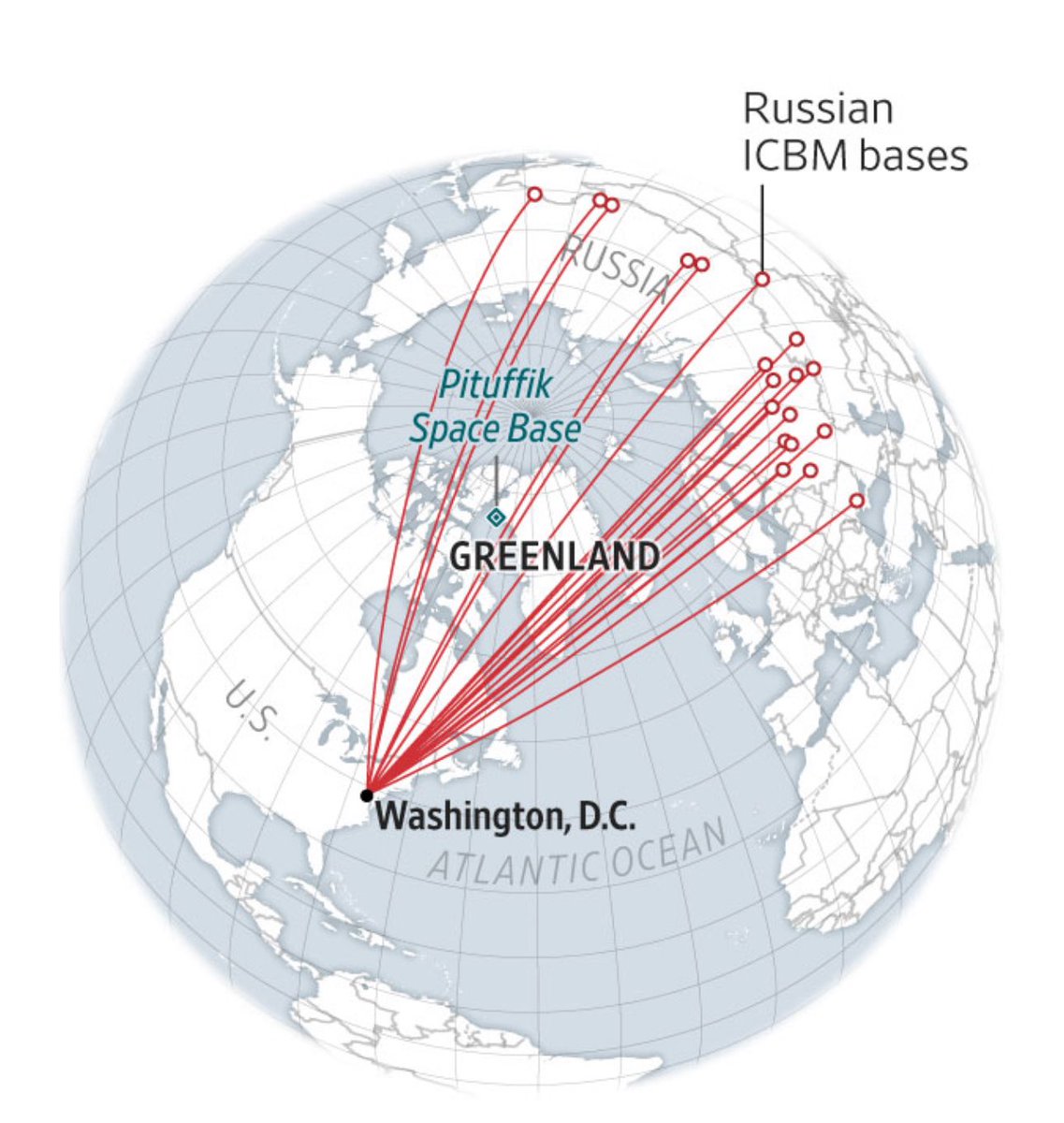
One reason Greenland is strategically important to the US is in fact twofold:
1. It’s the best place to set up anti-missile defenses to intercept ICBMs coming from Russia / China
2. It’s a very good place to set up offensive missile capabilities to threaten Russia / China
The WSJ had a good graphic out a few days ago showing the trajectory of missiles from ICBM sites around Russia to the US would fly overhead or near Greenland, which also happens to be almost directly beneath where those missiles would reach their highest points (“apogee”) which is when they are most vulnerable to interception because they are traveling at their slowest speeds.
If you throw a ball into the air you’ll see the same effect - the ball is slowest at its highest point.
And for an intelligently guided missile capable of trying to evade interception, you have an even better chance to shoot it down from a point directly beneath it since that is the closest path to the missile (i.e. least amount of warning time for the missile to realize an interceptor is coming).
This above is all courtesy of our resident rocket scientist Phil.
The US already has the right to dot Greenland with military installations, and I imagine that extends to intercepting ICBMs. Though Europe might object for some purposes.
"the only reason why there is even a 12-month gap between open source and frontier models is US export controls."
Perplexity’s CEO Aravind Srinivas on why China’s open-source AI may become more powerful than ever.
And why Anthropic has lobbied very hard for export control.
"There is a chance that, because of the export controls, they now get really good at the physical layer.
One advantage they (China) have is that they can actually build data centers a lot faster. Power is not a problem. Permits are not a problem. People are not a problem. Labor is not a problem. Expertise is not a problem.
And so, by forcing them to go out there and build all this, you are converting them into a far more potent competitor."
---
From "20VC with Harry Stebbings" YouTube channel (@HarryStebbings ), link in comment
.@linamkhan tells @cwarzel that AI leaders are warning of their products’ potentially catastrophic effects while preparing to take their companies public. If that behavior were applied “to every other industry, we would think that was ludicrous,” she says.
https://t.co/JynDU6dPaM #TAF26
Can we all just pause for a sec and reflect on how fucking important Tailscale is, and how nobody ever talks about them? I don't think I've ever seen a more useful service with a more invisible corporate footprint.
SUMMARY OF FED DECISION (9/16/2026):
1. Fed hikes interest rates by 25 bps for first time since July 2023
2. The decision was made in a 12-0 unanimous vote
3. Fed says the decision will support a "timelier" return to 2% inflation
4. Median Fed forecast shows one more 25 basis point rate hike in 2026
5. Fed says job gains are strong and the unemployment rate has "changed little"
6. "The Committee will deliver price stability," the Fed's statement says
Higher for longer is back.
Anna de Graaff of the Max Planck Institute for Astronomy suspects that two newly observed objects are giant stars with black holes hidden inside them. “In all the millions of [observations] we’ve taken with ground-based telescopes, there’s nothing that looks like these sources,” she said. https://t.co/tUNuh7jUWb








![QuantaMagazine's tweet photo. Anna de Graaff of the Max Planck Institute for Astronomy suspects that two newly observed objects are giant stars with black holes hidden inside them. “In all the millions of [observations] we’ve taken with ground-based telescopes, there’s nothing that looks like these sources,” she said. https://t.co/tUNuh7jUWb](https://pbs.twimg.com/media/HSRszN_WcAAFTza.jpg)


