NCI has released its first publicly available tissue microarray (TMA) panel from the NCI Patient-Derived Models Repository (NCI-PDMR), giving researchers a new resource to study #PancreaticCancer biomarkers using matched patient-derived models. https://t.co/xIYgAOUTAS
Excited to share TERRA, a tissue world model 🧬
Over ~1.5 years we ran a large data-generation + modelling effort to build a world model for human tissues, pretrained on 112M cells from spatial transcriptomics (mostly Xenium 5000-plex + public data).
It's built on one of the largest human spatial transcriptomics corpora assembled to date, spanning 20 tissues across development, health and 26 disease conditions, ~two-thirds newly generated in-house.
Why a "world model" for tissue? Images have universal representations (ViT/DINOv3), so do proteins (ESM, @alexrives) and pathology (UNI, @AI4Pathology). We've worked hard to build something similar for human tissue: one model that captures its multi-scale logic, genes → cells → their native microenvironments.
Like the JEPA approach @ylecun has championed, TERRA learns by prediction in embedding space, but for human tissue. How it works: it tokenises each cell together with its nearest neighbours into one sequence while keeping every gene's identity, then masks part of a neighbourhood and predicts the representation of the hidden part, not raw noisy counts. From one backbone it reads out three scales, gene embeddings (what a gene is doing in a cell and its niche), cell embeddings (cell type and state) and neighbourhood embeddings (the niche), and because it keeps gene-level resolution it can knock a gene out in silico and predict the response. Applied entirely zero-shot, TERRA maps and perturbs human tissue across unseen organs, diseases and technologies, outperforming existing spatial approaches.
Three take-homes:
1️⃣ One model, any tissue. A single pretrained backbone provides tissue representations zero-shot, handling genes, cells and niches across organs and platforms, off the shelf.
2️⃣ New biology, development to clinic. We built a new spatial atlas of the developing human pancreas and found an islet-associated capillary state that looks like a precursor of mature islet vasculature. In kidney, TERRA's in silico knockouts predicted the tissue-injury programme from cancer immunotherapy (checkpoint blockade), confirmed in treated kidneys, detected in blood, and linked to declining kidney function.
3️⃣ A grammar of tissue architecture. By coupling each cell's state to its niche, TERRA defines recurring cross-organ "archetypes" of macrophage neighbourhoods, including a tumour-boundary niche that tracks poor survival in kidney cancer.
TERRA is already in use: it powered our recent skin atlas of hidden immune-memory niches (https://t.co/LeWxOKkgMt), with more studies coming soon.
This was an amazing collaboration between clinicians, machine-learning scientists and cell biologists 🙏 Led by @SebastianBirk_, @ValiSanian@AmirhVahidi, Samuel Ogden, @daniyal_jafree, @Adib_m_, @CarloLeonardi7 and Arpit Merchant, with Lassi Paavolainen, Menna Clatworthy, @bayraktar_lab, @Muzz_Haniffa, Tom Mitchell and @bakhti_mostafa. Huge thanks too to everyone who shared data and helped along the way.
What excites me most is seeing how the community builds on this. The model, code and tutorials are all public, so anyone can run TERRA on their own tissues, extend it, or build new models on top. Huge thanks to the whole team across @sangerinstitute and our many collaborators.
📄 Paper: https://t.co/AOOIcwuTnq
💻 Code: https://t.co/ZBwTmd6SNI
🤗 Model: https://t.co/gyQA79lVfW
#SpatialTranscriptomics #SpatialGenomics #FoundationModels #AI4Science #MachineLearning #ComputationalBiology #SingleCell #WorldModels
Dual-payload antibody-drug conjugates move into first oncology clinical trials https://t.co/EEk3J6SsIh
Find out why a rapidly growing number of companies are betting that two different warheads on ADCs for cancer could be better than one in this news story in the August issue
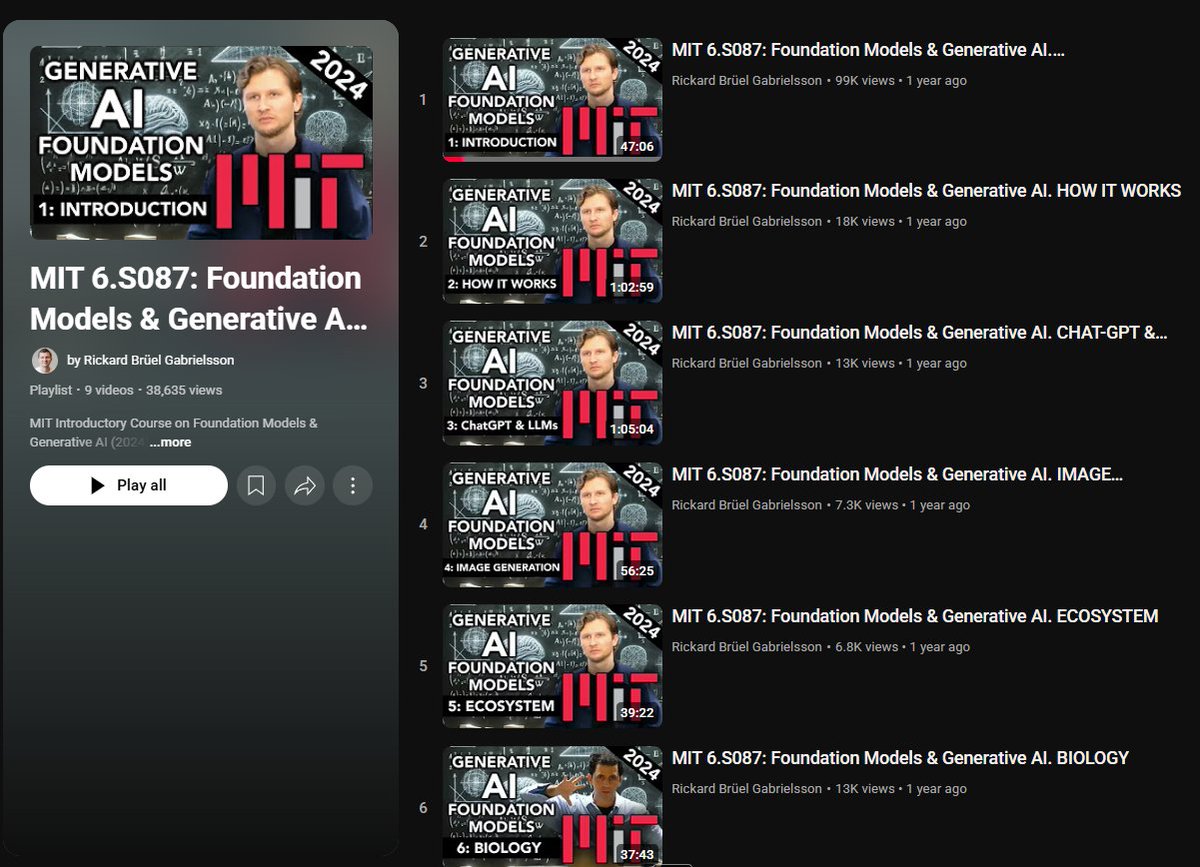
MIT packed 7 hours of lectures with everything you need to know about Gen AI completely free. Link in comment.
Here’s what it covers:
→ ChatGPT
→ Stable Diffusion and DALL·E
→ Neural Networks
→ Supervised Learning
→ Representation and Unsupervised Learning
→ Reinforcement Learning
→ Generative AI
→ Self-Supervised Learning
→ Foundation Models
→ GANs (Adversarial)
→ Contrastive Learning
→ Autoencoders
→ Denoising and Diffusion
Unsupervised analysis of single-cell RNA-sequencing data across cell types and individuals predicts disease severity https://t.co/6RcEM0l2RR
https://t.co/8LB9OoyJwv
The AI4Science workshop @NeurIPSConf is hosting a dataset proposal competition with a $10K USD prize pool!
Submit a 2 page proposal for a dataset you'd like to create and why.
Thanks to @AdaFang_ & the organizers for making this happen!
More info and link below👇
✅ Published in @Nature today, the paper describing the initial whole-genome sequencing analysis of 500,000 UK Biobank participants.
https://t.co/QmyovKXEy1
The authors report that all seven tested deep learning models failed to outperform simple baselines in predicting transcriptome changes after single or double perturbations.
I will duck for cover.
Hot off the press in@ImmunityCP! 🔥 Proud to share our new perspective — a collaborative effort with fantastic colleagues — proposing a unified framework to classify neutrophil subpopulations. #ThePowerOfMany
👉https://t.co/cSK5cHssDM
H&Enium, Applying Foundation Models to Computational Pathology and Spatial Transcriptomics to Learn an Aligned Latent Space https://t.co/SGuWne1ECW
Build a Large Language Model from scratch!
This repository contains the code for developing, pretraining, and finetuning a GPT-like large language model.
100% Free & Open Source
Using RNA sequencing from 480K single cells, researchers mapped 10K disease genes to key cell types, guiding new drug targets and advancing precision medicine. https://t.co/lsxktjRM1x
Compare multiple statistical models effortlessly with ggstats, a versatile extension package for ggplot2 that simplifies data visualization tasks. The ggcoef_compare() function allows you to compare the coefficients of several models side by side, providing an intuitive way to analyze and present differences between them.
Why use ggcoef_compare()?
✔️ Clear comparisons: Visualize the coefficients of multiple models in a single, cohesive plot to identify patterns and differences at a glance.
✔️ Customizable outputs: Adjust the appearance of the plot to meet your presentation or analysis needs.
✔️ Easy to use: Integrates seamlessly with ggplot2, making it straightforward to add model comparison capabilities to your workflow.
The example visualization showcasing this functionality originates from the ggstats documentation and demonstrates how it can enhance your model comparison tasks: https://t.co/AITQvg3t7G
Explore more ways to elevate your data visualization skills in R and learn about ggplot2 extensions in my online course, "Data Visualization in R Using ggplot2 & Friends!"
Learn more: https://t.co/ztlEzoEDWv
#ggplot2 #VisualAnalytics #database #programmer #datasciencetraining #RStats #Rpackage #DataAnalytics