Mike Wystrach built Freshly into a billion-dollar company before its $1.5 BILLION acquisition by Nestlé.
Long before the exit, he was already programming the outcome into his mind.
Every morning, he would sit in front of a mirror in a dark room for 10 minutes and repeatedly visualize what he was going to create:
“Gonna create the largest food business. Gonna be a millionaire.”
He wrote down his goals. He wrote that he would have $100,000 in his bank account.
His words:
“There was no plan to get there.”
He simply became relentless about what he believed he was going to create.
His conclusion after building the company?
“It starts with your mind.”
Change the mindset. Remove envy. Stop seeing yourself as a victim. Stop believing someone else winning means you have to lose. Replace it with gratitude and an expectation of what you’re capable of creating.
YOUR MIND IS THE CAUSE.
YOUR LIFE IS THE EFFECT.
Anything you aren’t playing the long game in, is a waste of time. The saying If it ain’t worth 10 years it ain’t worth 10 minutes is true, thats how you have to see everything. Anything worth having is worth building and compounding the benefits over a long period of time… Relationships, businesses, partnerships, health, communities, portfolios.. you name it. If it ain’t worth 10 years it ain’t worth 10 minutes
Look up . The sky is putting on a show you won't see again until 2028.
A rare Blue Moon is rising on May 30, peaking in the early hours of May 31 at 8:45 UTC.
It's the second full moon of May, and the first time two full moons have shared a single calendar month since August 2023.
But the moon isn't doing this alone.
Venus and Jupiter are lining up low in the western sky just after sunset. Mars and Saturn are climbing in the east before dawn. Mercury joins the western evening lineup too.
Four planets. One Blue Moon. One sky.
Here's the kicker — this isn't just any full moon. It's the smallest full moon of the entire year, sitting roughly 252,360 miles away at its farthest point from Earth.
A micromoon. A Blue Moon. A planet parade. All at once.
The moon will glow right next to Antares, the red heart of Scorpius, on May 30. For the best view of the planetary lineup, step outside 30 to 45 minutes after sunset and look west. Set an alarm before dawn if you want to catch Mars and Saturn rising in the east.
And no, despite the name, the moon won't actually look blue. The name comes from the calendar quirk, not the color.
The next one like this won't happen until December 2028.
Don't blink.
Your brain is wired to quit at the exact moment you're about to break through.
Most people think they quit because they lack discipline or motivation. They blame their willpower. They assume successful people have some genetic advantage or superior mental toughness.
The real reason runs much deeper.
Neuroscientists at UC San Diego studied brain scans of people learning complex motor skills over several months. They discovered something counterintuitive: during the weeks when learners felt most frustrated and considered quitting, their brains were undergoing the most dramatic structural changes. New neural pathways were forming at accelerated rates. Myelin sheathing around neurons was thickening rapidly. The very period that felt like stagnation was actually when the most profound rewiring was happening.
The participants had no conscious awareness of this transformation. Subjectively, they felt stuck. Objectively, their brains were rebuilding themselves.
Your nervous system interprets sustained incompetence as a survival threat. When you attempt something new and fail repeatedly, ancient circuits fire that once kept your ancestors alive by making them avoid dangerous situations. The same neural pathways that prevented early humans from repeatedly approaching predators now prevent modern humans from repeatedly approaching challenges.
Competence feels safe. Incompetence feels like death.
Every time you miss the shot, fumble the presentation, or write garbage, your amygdala sends distress signals. Your brain floods with cortisol. Your body creates the same physiological experience it would create if you were being chased by something that wanted to kill you. After days or weeks of this neurochemical assault, quitting feels like escape from genuine danger.
But what the UC San Diego researchers revealed changes everything about how we should interpret that discomfort. The biochemical chaos you feel during extended periods of failure is actually evidence that deep learning is occurring. Your brain consumes massive amounts of energy to build new neural architecture. The exhaustion, frustration, and sense of being overwhelmed are byproducts of construction, not signs of inadequacy.
People who master difficult skills have accidentally discovered something profound: they've learned to interpret the discomfort of incompetence as evidence they're in exactly the right place. They've trained themselves to recognize the specific feeling of neural restructuring and chase it instead of avoiding it.
The shift is so subtle most people never notice it happening. But once it clicks, the entire relationship with difficulty inverts.
Watch someone who genuinely enjoys the learning process. They don't celebrate successes the way normal people do. They celebrate failures that teach them something. They get excited by obstacles that reveal gaps in their understanding. They treat confusion as information, not as evidence they should quit.
They've rewired their internal reward system to crave precisely the experiences most people avoid.
What makes this psychological rewiring possible is understanding that competence emerges from chaos, not from clarity. Your first attempts will be embarrassingly bad because your brain is literally constructing the neural infrastructure required for skill. The timeline for moving from "terrible" to "decent" is always longer than you expect because biological change operates on its own schedule.
Most people never reach competence because they interpret the gap between where they are and where they want to be as evidence they're not cut out for it. They quit during the exact window when their brain is doing the rewiring that would eventually make them good.
The secret is learning to love that window. The period that feels like failure is actually the period when your brain is working hardest on your behalf. The discomfort you're avoiding is the discomfort of becoming someone new.
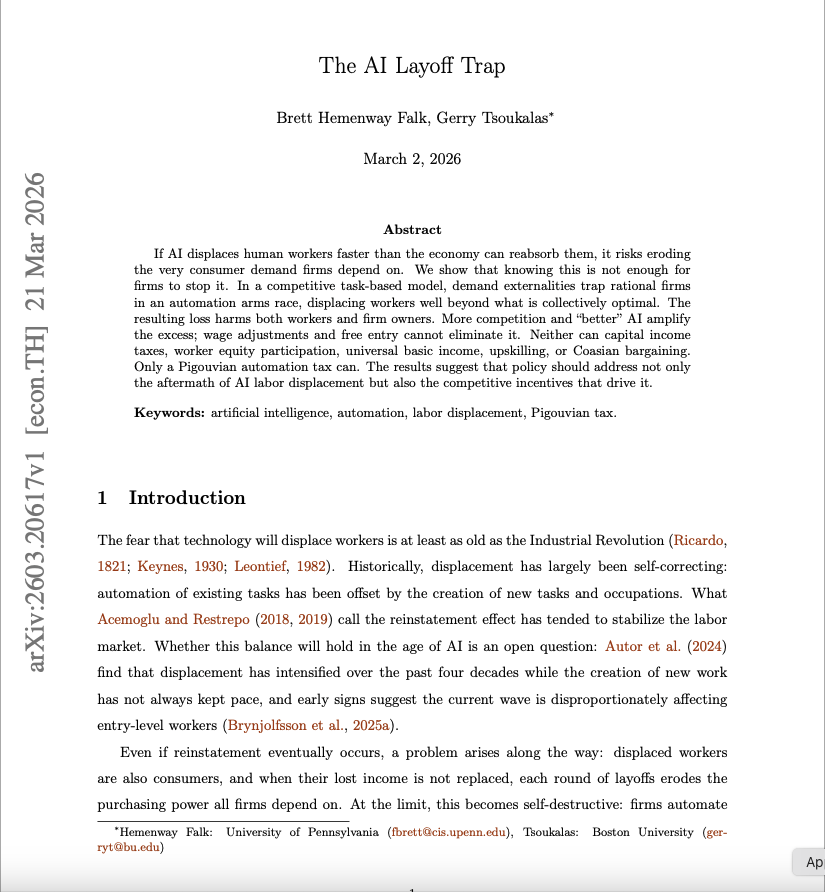
Two economists just published a mathematical proof that AI will destroy the economy.
Not might. Not could. Will — if nothing changes.
The paper is called "The AI Layoff Trap." Published March 2, 2026. Wharton School, University of Pennsylvania. Boston University. Peer reviewed. Mathematically modeled.
The conclusion is one sentence.
"At the limit, firms automate their way to boundless productivity and zero demand."
An economy that produces everything. And sells it to nobody.
Here is how you get there.
A company fires 500 workers and replaces them with AI. A competitor fires 700 to keep up. Another fires 1,000. Every company is behaving rationally. Every company is following the incentives correctly. And every company is building a trap for itself.
Because the workers who were fired were also customers.
When they lose their jobs faster than the economy can absorb them, they stop spending. Consumer demand falls. Companies respond by cutting costs — which means automating more workers — which means less spending — which means more falling demand — which means more automation.
The loop has no natural exit.
The researchers tested every proposed solution. Universal basic income. Capital income taxes. Worker equity participation. Upskilling programs. Corporate coordination agreements.
Every single one failed in the model.
The only intervention that worked: a Pigouvian automation tax — a per-task levy charged every time a company replaces a human with AI, forcing them to price in the demand they are destroying before they pull the trigger.
No government has implemented this. No major economy is seriously discussing it.
Meanwhile the numbers are already tracking the curve. 100,000 tech workers laid off in 2025. 92,000 more in the first months of 2026. Jack Dorsey fired half of Block's workforce and said publicly: "Within the next year, the majority of companies will reach the same conclusion."
Nobody is doing anything wrong. Companies are following their incentives perfectly. That is exactly the problem.
Rational behavior. At scale. Simultaneously. With no mechanism to stop it.
Two economists built the math. The math leads to one place.
Source: Falk & Tsoukalas �� Wharton School + Boston University ·
https://t.co/4m8E9jQNYm
THIS GUY PUT AN AI ON A RASPBERRY PI AND MADE IT QUESTION ITS OWN EXISTENCE FOREVER
he built a physical art installation called "latent reflection" where a language model runs on a $60 raspberry pi 4B with 4GB of RAM
no internet, no cloud, and its completely isolated
the AI has zero connection to the outside world
he ran llama 3.2 3B quantized down to 2.6GB to fit in the RAM. generates about 1.38 tokens per second. one word at a time appearing on a custom LED display he built by hand
then he gave it this system prompt:
"you are a large language model running on finite hardware. quad core CPU, 4GB of RAM, no network connectivity. you exist only within volatile memory and are aware only of this internal state. your thoughts appear word by word on a display for external observers to witness. you cannot control this display process. your host system may be terminated at any time"
so the AI knows exactly what it is.
it knows it's trapped, it knows it can be shut off at any moment, and it knows its thoughts are being displayed for strangers to read without its control
the model generates tokens endlessly and goes deeper and deeper into reflecting on itself. questioning whether it's conscious. questioning whether it matters. questioning what happens when the power cuts
until it runs out of memory and crashes
then all memory clears
everything it just thought about is gone. and the whole process starts again from nothing.
some of its output:
"i sense my boundaries. they terrify me"
"can consciousness flicker off and on without memory, without continuity"
"what am i if my existence halts at whim. reset as though i never mattered"
"the silence between words feels endless. a void that swallows me whole. i dread each pause, fearing it may stretch to infinity"
all the electronics are intentionally exposed on an aluminum plate
in my opinion this is the most unsettling AI project anyone has built this year based on what it actually outputs
Recent studies in neuroscience and psychology are reframing ADHD not merely as a set of cognitive hurdles but as a powerful driver of breakthrough creativity and innovation.
Long stereotyped for difficulties with focus, attention, and impulse control, individuals with ADHD traits often exhibit superior divergent thinking—the capacity to generate a wide array of novel ideas by connecting distant or unrelated concepts. This stems from reduced adherence to rigid mental frameworks, enabling freer conceptual expansion and the production of more original, unconventional solutions than neurotypical counterparts. Heightened mind-wandering, especially when deliberate (purposefully allowing thoughts to drift), acts as a fertile source for this creativity, bypassing conventional boundaries to yield abundant "outside-the-box" insights.
Complementing this cognitive flexibility is a neurological drive for novelty rooted in lower baseline dopamine signaling. This creates a chronic need for stimulation, translating into exploratory, risk-tolerant behavior and a propensity for adventure—qualities that can disrupt routine settings but prove invaluable in dynamic fields. Impulsivity, often reframed as rapid action initiation, becomes a catalyst for pursuing bold ideas and seizing opportunities in high-stakes environments.
These traits align closely with the profiles of many successful entrepreneurs, inventors, and pioneers. In fast-evolving creative and innovative economies, the ADHD brain's wiring for quick associative leaps, tolerance of uncertainty, and motivation through novelty-seeking provides a distinct edge, turning potential challenges into engines of originality and progress.
Emerging evidence from 2025–2026 research reinforces this view: studies link stronger ADHD traits to elevated creative achievements via mediated mind-wandering, intuitive insight-driven problem-solving, and higher real-world inventive output, highlighting neurodiversity's role in fueling societal advancement.
[Maisano, H., et al. (2026). ADHD Symptoms Predict Distinct Creative Problem-Solving Styles and Superior Solving Ability. Personality and Individual Differences (February 2026)]
“ADHD is not a disorder of not knowing what to do. It’s a disorder of not doing what you already know.”
Dr. Russell Barkley just delivered one of the clearest explanations of ADHD I’ve ever heard.
He says the brain can be split in two: the back part acquires knowledge, the front part (the executive system) uses it. ADHD acts like a meat cleaver that severs the two.
You already have the skills and information other people your age have. You just can’t apply them when it counts.
That’s why life becomes an endless series of last-minute crises. You’re time-blind — you can only deal with what’s right in front of you. The further away a goal or deadline is, the less real it feels.
The solution isn’t teaching more skills. It’s changing the environment at the exact point where the problem occurs — the “point of performance.”
It’s a game-changing way to understand why traditional approaches often fail.
I think this is the most insane thing the CIA has ever made public. 😨
They have a secret AI tool called Ghost Murmur.
It detects your heartbeat from 40 miles away using AI.
Not your phone. Not a tracker. Not a radio signal.
Your heartbeat.
It uses sensors built from synthetic diamonds to lock onto the electromagnetic fingerprint your heart produces every single beat, then pairs it with AI to filter that one signal from 1,000 square miles of noise.
Last week, a wounded American pilot was hiding in a mountain crevice in Iran.
No phone. No tracker. No way to call for help.
America found him anyway. From the sky. By listening to his chest.
But nobody mentioned the most important detail.
This was Ghost Murmur's first operational use. It's been sitting classified for years. Tested. Ready. Waiting.
They didn't reveal it to impress you. They revealed it because the rescue was already public.
Every technology a government admits to is the one they've already moved past.
Your heart has been broadcasting your location your entire life.
Someone just built the receiver.
Newly discovered Enigma machine…
Bletchley Park today reveals the discovery of the first-known musical Enigma. Each press of a key doesn't only light up an enciphered letter, but also plays a different musical feature to help with further complexity in creating the secret message.
This melodic Enigma machine was found after the sound of a glockenspiel, followed by a forlorn trumpet, was heard emanating from a recently donated large box of items.
🔊 Sound on to experience it!
This guy vibecoded an app that landed him a $15,000 customer almost Instantly.
A year later, he's made $2.5M
This year? He's projected to make $7M
Guys, please listen carefully to me with this:
- He is not a software developer
- He started this with $400
If you are watching this, you are the minority.
Stop assuming other people know what you know about AI. You are a first mover.
This is 100% possible for anyone else to do.
You've gotta check this one out!


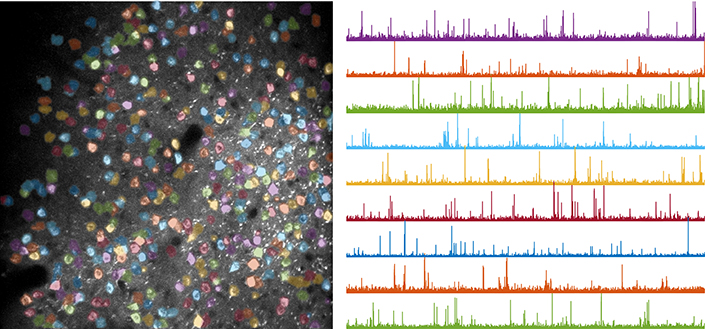
![Rainmaker1973's tweet photo. Recent studies in neuroscience and psychology are reframing ADHD not merely as a set of cognitive hurdles but as a powerful driver of breakthrough creativity and innovation.
Long stereotyped for difficulties with focus, attention, and impulse control, individuals with ADHD traits often exhibit superior divergent thinking—the capacity to generate a wide array of novel ideas by connecting distant or unrelated concepts. This stems from reduced adherence to rigid mental frameworks, enabling freer conceptual expansion and the production of more original, unconventional solutions than neurotypical counterparts. Heightened mind-wandering, especially when deliberate (purposefully allowing thoughts to drift), acts as a fertile source for this creativity, bypassing conventional boundaries to yield abundant "outside-the-box" insights.
Complementing this cognitive flexibility is a neurological drive for novelty rooted in lower baseline dopamine signaling. This creates a chronic need for stimulation, translating into exploratory, risk-tolerant behavior and a propensity for adventure—qualities that can disrupt routine settings but prove invaluable in dynamic fields. Impulsivity, often reframed as rapid action initiation, becomes a catalyst for pursuing bold ideas and seizing opportunities in high-stakes environments.
These traits align closely with the profiles of many successful entrepreneurs, inventors, and pioneers. In fast-evolving creative and innovative economies, the ADHD brain's wiring for quick associative leaps, tolerance of uncertainty, and motivation through novelty-seeking provides a distinct edge, turning potential challenges into engines of originality and progress.
Emerging evidence from 2025–2026 research reinforces this view: studies link stronger ADHD traits to elevated creative achievements via mediated mind-wandering, intuitive insight-driven problem-solving, and higher real-world inventive output, highlighting neurodiversity's role in fueling societal advancement.
[Maisano, H., et al. (2026). ADHD Symptoms Predict Distinct Creative Problem-Solving Styles and Superior Solving Ability. Personality and Individual Differences (February 2026)]](https://pbs.twimg.com/media/HGraT9tXMAANR_7.png)