Working on poverty and inequality @WorldBank. PhD, @SussexUni. Interested in Political Economy, Inequality, Migration and Development.
Views are my own.
Engaging conversation today during the @WorldBank’s #Africa Inspirational Breakfast Series, where we presented the @WBG_Poverty Poverty and Shared Prosperity Report.
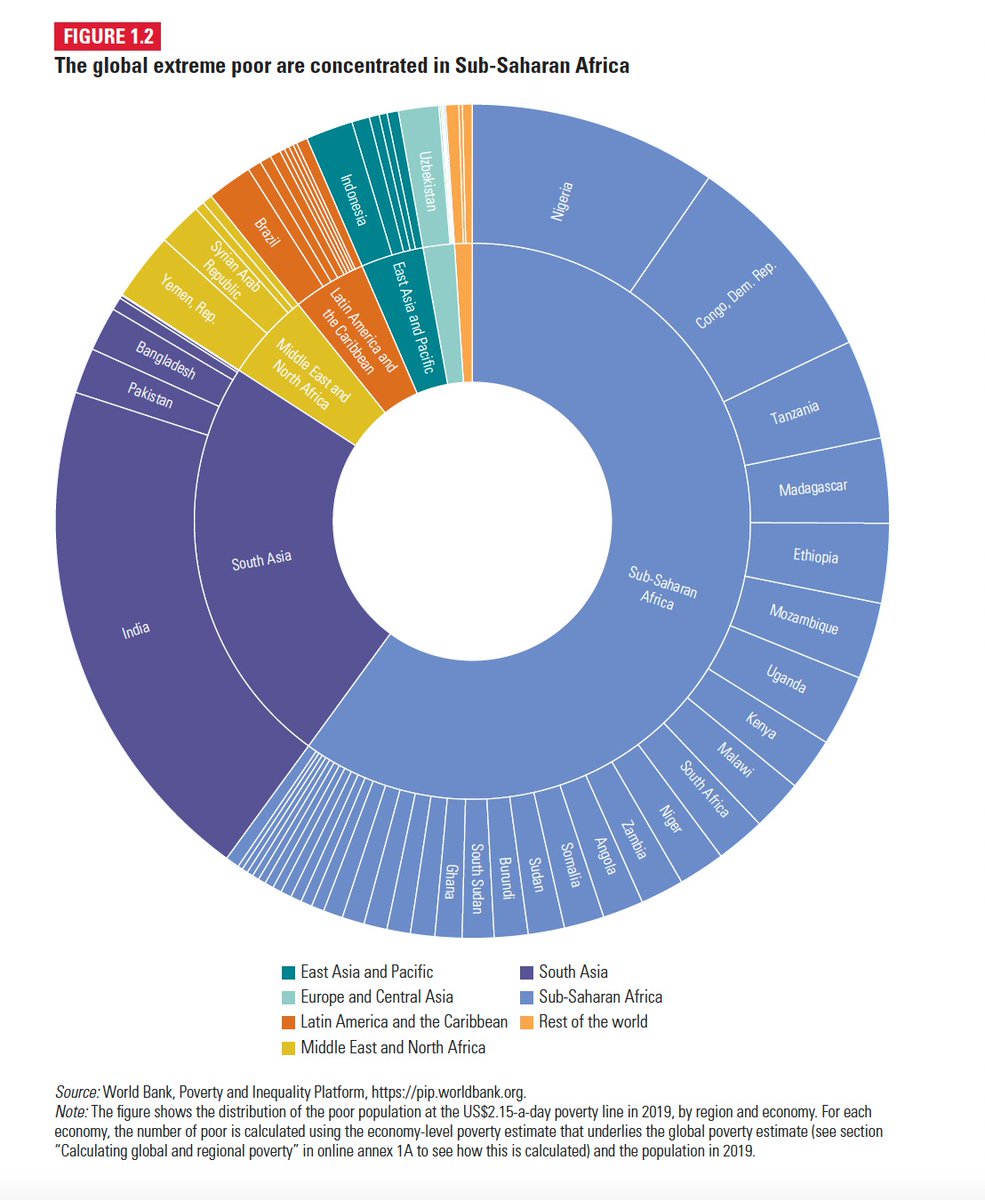
Ending #poverty will require increased efforts in Sub-Saharan Africa, where 60% of the global extreme poor live.
There is a clear crisis in development — poverty is going up & median incomes are going down.
Read my foreword from the @WorldBank’s new 2022 Poverty & Shared Prosperity Report (PSPR) here: https://t.co/8yE4vLp1bn
What happened to global inequality in 2020?
In a just-released paper (https://t.co/4KQIXlr3j7) with Daniel G. Mahler, @ChristophLakner, and I look at what happened to global inequality and poverty due to the COVID pandemic in 2020.
Three things to note:
Shocks related to the COVID pandemic and the war in Ukraine mean the world is unlikely to meet a longstanding goal of ending extreme poverty by 2030, the World Bank said in a new report https://t.co/PKblLsQUOS
The Covid-19 pandemic and Russia’s invasion of Ukraine have reversed three decades of progress in reducing poverty, according to the World Bank https://t.co/fIjPHv9GAJ
New GLOBAL POVERTY projections from the World Bank are officially out today:
- 9.3% global poverty in 2020, up from 8.4% in 2019, meaning 70m new poor.
- Poverty reduction likely stalling again in 2022.
https://t.co/ywoj9SCKYU
1/
NEW! Poverty and Shared Prosperity 2022 offers the first comprehensive look at the global landscape of poverty in the aftermath of #COVID19 and the war in Ukraine and shows the potential of fiscal policy reforms in giving inclusive growth a hand: https://t.co/t24dytT5w5
#PSPR
Today the @WorldBank published its latest Poverty and Shared Prosperity Report. The global goal of ending extreme poverty by 2030 is likely to be missed: by then, about 600 million people will remain in abject poverty. A major course correction is needed. https://t.co/bWuG6FAfv5
The @WorldBank’s latest Poverty and Shared Prosperity Report (#PSPR) provides the first comprehensive look at global poverty in the aftermath of an extraordinary series of shocks to the global economy. https://t.co/ghcBLmdYGq 1/11
Politics matters - but good sense of what is going on as well. Not least in Nigeria where poverty is high but hard to ascertain trends.
I like this attempt, finding poverty is sticky, inversely following of oil prices, so up since 2016.
https://t.co/IHFvUUbRVf @jonathanwlain
By investing in data, Nigeria can build trust, accountability, and transparency, taking substantial strides forward along its pathway to poverty reduction. https://t.co/uStSjVwtrO via @WorldBankAfrica
Update of @worldbank’s global #poverty numbers: Small revisions to published estimates. 2019 numbers for some regions.
Blog: https://t.co/ol0CY43Ucn
Details: https://t.co/AyfITcsivp
Data: https://t.co/18Wk4azLXa
https://t.co/FbiCQEUE3P
@worldbankdata@WBG_Poverty
Mentre attendiamo l'insediamento di #Draghi, oggi vede alla luce il progettino su cui ho lavorato per quattro anni. Un dataset di poco meno di 5mila righe che racconta la storia dei governi italiani da De Gasperi fino a Conte https://t.co/l4FZZYg1HX
Rapid Response Phone #Surveys (RRPS) make it easier to gather near real-time #data from households and businesses even in remote locations. Learn how the @WorldBank is using RRPS and other rapid monitoring tools to help communities in need during #COVID19: https://t.co/78x4pvCgtK
Within Nigeria, the distribution of monetary and multidimensional poverty is spatially unequal, so poverty reduction strategies need to be carefully targeted. https://t.co/PCNrThpTOw via @worldbank
Great work by @jonathanwlain&@TaraVishwanath
Conflict, climate shocks, and COVID-19 need to be carefully considered to successfully reduce poverty in Nigeria, mirroring similar challenges to global poverty reduction in the coming decade. https://t.co/wxLO3DbZtp
Countries with the largest number of poor in the region: Nigeria (79 million), the Democratic Republic of Congo (60 million), Tanzania (28 million), Ethiopia (26 million), and Madagascar (20 million). With Nigeria accounting for 20% of the poor.
Last blog for this year, looking in more detail at poverty in Sub-Saharan Africa and following last week's post analyzing regional trends: https://t.co/5pUGGBzfyh