@EvenRouault @condaforge@GdalOrg We recently switched over the julia builds as well. Surprisingly painless, and we could remove all patches! https://t.co/O3P2BJSdcL
@justb4 @MicheleTobias Python is often good enough, though I like being able to use the same language for when it's not. For GDAL etc. bindings automation was key with limited maintainer time.
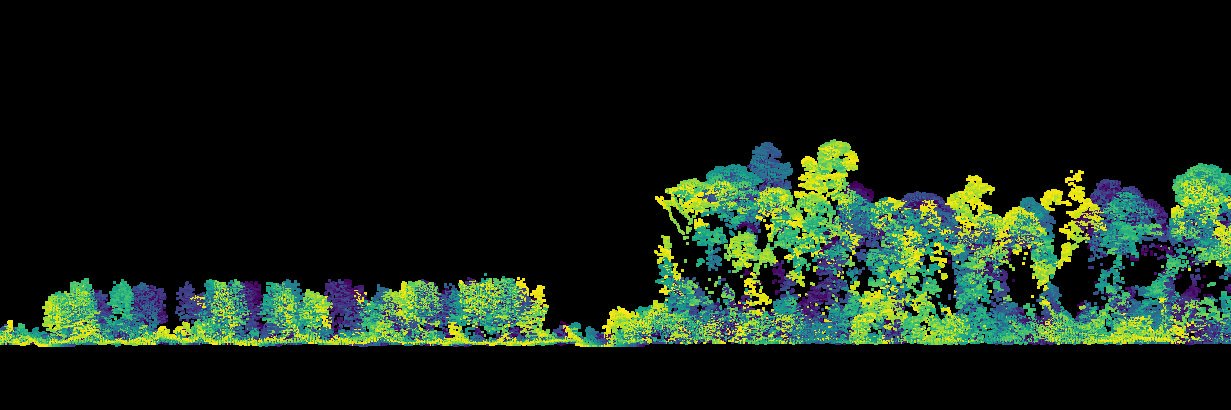
@KelMarkert@MicheleTobias Thanks! The ecosystem is still maturing, but key functionality and wrappers are there. What I like about it is that if you need custom processing, it's generally easy to implement and runs fast. I started using it for point cloud processing, but now also do hydrological modeling.
🔥OpenGeoHub Summer School 2022 -- 28 August 2022 – 03 September 2022🔥
A whole week of #opensource spatial data analysis using #rstats, #python, and #julialang!
Register before May 28th -- https://t.co/5V3fLsTJNg.
#rspatial#gischat
@map_andrew By default it looks for GDAL colour metadata. But for false colour you can first load the bands you want into arrays r, g, b. And then do AG.imview(RGB, r, g, b).
@rabernat Interesting! I just found https://t.co/W91hUCACLJ, which links to Huite's xarray proposal from last year as inspiration. Huite has also been working on https://t.co/mjSxJTQfjs in the meantime, though I don't think it's been widely announced yet.
@fkratzert @EGU_HESS The challenge page shows 124 registrants, of which 53 submitted a solution. But it could be unrelated. Sometimes it just take a while for a paper to catch the attention.
@fkratzert @EGU_HESS Just a guess, but it seems to coincide with https://t.co/BFMdtJhTbR, and I can imagine this paper would be key to winning some money.
@DaniRabaiotti Yeah that's fair. It's definitely not as well documented and supported as R Spatial. If speed is an issue, it could be interesting, as you are free to roll your own loops without performance penalty. That's why I used it for point cloud processing for instance.
Posted a blog article comparing #Python and #julialang processing speeds for #hydrology modeling/calibration
Spoiler: Julia blows Python out of the water 🌊 (pun intended)
https://t.co/Z1gWBEIAkK
As a #Python developer, I really applaud this effort to combat fragmentation. As a #JuliaLang developer, I'm so happy that due to the language design, there is no such fragmentation.
Today is release day! We're announcing a new initiative to tackle the fragmentation in Python array/tensor and dataframe libraries: https://t.co/IMBSaTm4El. Major challenge, with hopefully major benefits for the whole ecosystem.
Gave a presentation today @JuliaConOrg on how we can do interop between @OSGeo GDAL/GEOS/PROJ wrappers with pure #JuliaLanguage#geospatial projects. Hope it will help in establishing a solid JuliaGeo ecosystem! https://t.co/BafjqRe6PF
@fkratzert @HydroProcesses Oh wow. For what it's worth, I think it's a great piece. Used it as a conversation starter in discussion with a big group of hydrologists at @deltares this week.
@henrifdrake @rabernat@JuliaLanguage I'd say most of the parts are there (Dagger.jl, Lazy.jl, NamedDims.jl, various IO packages), though so far nobody put them together in #JuliaLang quite as nicely as xarray.