Teacher and Researcher in AI and ML . Machine learning application in time series data, Geoinformatics, Climatology, Probabilistic forecasting, Hydrology.
𝗧𝗼𝗽 𝟲 𝗥𝗔𝗚 𝗮𝗿𝗰𝗵𝗶𝘁𝗲𝗰𝘁𝘂𝗿𝗲𝘀 𝗲𝘃𝗲𝗿𝘆 𝗔𝗜 𝗲𝗻𝗴𝗶𝗻𝗲𝗲𝗿 𝘀𝗵𝗼𝘂𝗹𝗱 𝗸𝗻𝗼𝘄 ⚡︎
Picking the wrong one is why your AI project is underperforming.
1️⃣ Simple RAG
Retrieve top-k chunks from a vector store, then generate.
→ Use cases: FAQ bots, internal knowledge assistants, support.
2️⃣ Hybrid RAG
Combines semantic and keyword search, then reranks the results.
→ Use cases: Enterprise search over messy or technical docs where pure vector search misses exact terms.
3️⃣ Corrective RAG (CRAG)
Scores retrieved content for relevance and triggers a fallback search when it's weak.
→ Use cases: Medical, legal, financial. Anywhere a wrong answer is expensive.
4️⃣ Self-RAG
The model decides when to retrieve and critiques its own output before answering.
→ Use cases: Technical documentation, deep research, exploratory writing.
5️⃣ Graph RAG
Retrieves over a knowledge graph of entities and relationships, not just isolated chunks.
→ Use cases: Scientific discovery, legal reasoning, multi-hop questions where connections matter.
6️⃣ Agentic RAG
An agent routes queries, runs multi-step retrieval, and validates across sources and APIs.
→ Use cases: Automated research, market intel, executive dashboards.
Most teams default to Simple RAG and wonder why accuracy stalls.
The architecture isn't the afterthought. It's the decision that determines whether your RAG system actually works.
Match the architecture to the problem. Not the other way around.
Which one are you running in production right now? 👇
#AI #RAG #LLM #AIEngineering
If you want to stay up to date on the latest AI and Machine Learning research, reading academic papers can help.
But they can be a bit intimidating and hard to understand sometimes.
In this course, you'll learn how to approach and understand the theory, math, and structure in academic papers.
https://t.co/FL6fOAI0yZ
One of the better agentic AI courses I've seen
Nearly 10 hours of great content. Covers LangChain, LangGraph, RAG, deepagents, guardrails, and more
Any other good Lang* resources out there for folks who are interested in learning?
https://t.co/OXNPMeGiyd
[HF ML Club India]
We are pleased to announce the IRL event in Bengaluru. We are partnering with @GoogleDeepMind and this takes place on the 15th of July 2026 (more details below).
We will have someone from the GDM team talk about Gemma 4, and an hour long build session with Gemma and @huggingface. Great opportunity for folks to network and build.
PS: We will not entertain any "where is the registration link" query. Seek and ye shall find.
If you're an aspiring Data Scientist, Data Science competitions can help improve your skills.
And this course teaches you about Kaggle, a popular competition platform & DS community.
It covers picking competitions, feature engineering, selecting a model, & more.
https://t.co/GRctZvtulI
"Build your own Claude Code with Deep Agents"
Good article by the community showing how to build a Claude Code-like agent using Deep Agents
Especially relevant given how strong GLM-5.2 seems to be!
https://t.co/anPKlGYbcr
8 RAG architectures for AI Engineers:
(explained with usage)
1) Naive RAG
- Retrieves documents purely based on vector similarity between the query embedding and stored embeddings.
- Works best for simple, fact-based queries where direct semantic matching suffices.
2) Multimodal RAG
- Handles multiple data types (text, images, audio, etc.) by embedding and retrieving across modalities.
- Ideal for cross-modal retrieval tasks like answering a text query with both text and image context.
3) HyDE (Hypothetical Document Embeddings)
- Queries are not semantically similar to documents.
- This technique generates a hypothetical answer document from the query before retrieval.
- Uses this generated document’s embedding to find more relevant real documents.
4) Corrective RAG
- Validates retrieved results by comparing them against trusted sources (e.g., web search).
- Ensures up-to-date and accurate information, filtering or correcting retrieved content before passing to the LLM.
5) Graph RAG
- Converts retrieved content into a knowledge graph to capture relationships and entities.
- Enhances reasoning by providing structured context alongside raw text to the LLM.
6) Hybrid RAG
- Combines dense vector retrieval with graph-based retrieval in a single pipeline.
- Useful when the task requires both unstructured text and structured relational data for richer answers.
7) Adaptive RAG
- Dynamically decides if a query requires a simple direct retrieval or a multi-step reasoning chain.
- Breaks complex queries into smaller sub-queries for better coverage and accuracy.
8) Agentic RAG
- Uses AI agents with planning, reasoning (ReAct, CoT), and memory to orchestrate retrieval from multiple sources.
- Best suited for complex workflows that require tool use, external APIs, or combining multiple RAG techniques.
Most architectures here involve some form of retrieval-time decision. But they all run on top of whatever was already indexed.
If that indexing step outputs messy chunks, every architecture inherits them. Improving it is a separate problem from the 8 above.
My co-founder wrote about a better unit for the indexing step. The technique:
- cuts corpus size by 40x.
- reduces tokens per query by 3x.
- improves vector search relevance by 2.3x.
And it doesn't alter the retrieval algorithm, the reranker, or the embedding model.
Read it below.
IN 1999 MIT FILMED A MATH LECTURE ON THE ABSTRACT IDEA YOU PROBABLY HATED IN COLLEGE -- THE EXACT MATH GOOGLE LATER USED TO RANK THE ENTIRE INTERNET
50 minutes from Gilbert Strang, who taught this at MIT for over 60 years, on eigenvalues -- the one idea most students memorize and never understand.
-> The shift it creates: an eigenvector is just the direction a system doesn't twist, only stretches. Find those, and a tangled mess of equations falls apart into something simple.
You were drilled to compute them by hand and never told what they were for.
Google's entire empire started here. PageRank is one giant eigenvector problem and the same math now sits inside PCA, recommendations, and how models find structure in data.
Computing eigenvalues was never the skill -> understanding what they reveal is. This is where it finally clicks.
Most people filed this under "Useless college math". The ones who watched this see it running quietly inside half the tech they touch.
Bookmark & Watch it. This one's a legend ↓
We're hiring!
WMO is looking for professionals from diverse backgrounds and areas of expertise interested in a career in meteorology, hydrology, geophysical sciences, and international cooperation.
Check out all vacancies here 👉 https://t.co/WeDOpeSMEm
There will be no AI jobpocalypse.
The story that AI will lead to massive unemployment is stoking unnecessary fear. AI — like any other technology — does affect jobs, but telling overblown stories of large-scale unemployment is irresponsible and damaging. Let’s put a stop to it.
I’ve expressed skepticism about the jobpocalypse in previous posts. I’m glad to see that the popular press is now pushing back on this narrative. The image below features some recent headlines.
Software engineering is the sector most affected by AI tools, as coding agents race ahead. Yet hiring of software engineers remains strong! So while there are examples of AI taking away jobs, the trends strongly suggest the net job creation is vastly greater than the job destruction — just like earlier waves of technology. Further, despite all the exciting progress in AI, the U.S. unemployment rate remains a healthy 4.3%.
Why is the AI jobpocalypse narrative so popular? For one thing, frontier AI labs have a strong incentive to tell stories that make AI technology sound more powerful. At their most extreme, they promote science-fiction scenarios of AI “taking over” and causing human extinction. If a technology can replace many employees, surely that technology must be very valuable!
Also, a lot of SaaS software companies charge around $100-$1000 per user/year. But if an AI company can replace an employee who makes $100,000 — or make them 50% more productive — then charging even $10,000 starts to look reasonable. By anchoring not to typical SaaS prices but to salaries of employees, AI companies can charge a lot more.
Additionally, businesses have a strong incentive to talk about layoffs as if they were caused by AI. After all, talking about how they’re using AI to be far more productive with fewer staff makes them look smart. This is a better message than admitting they overhired during the pandemic when capital was abundant due to low interest rates and a massive government financial stimulus.
To be clear, I recognize that AI is causing a lot of people’s work to change. This is hard. This is stressful. (And to some, it can be fun.) I empathize with everyone affected. At the same time, this is very different from predicting a collapse of the job market.
Societies are capable of telling themselves stories for years that have little basis in reality and lead to poor society-wide decision making. For example, fears over nuclear plant safety led to under-investment in nuclear power. Fears of the “population bomb” in the 1960s led countries to implement harsh policies to reduce their populations. And worries about dietary fat led governments to promote unhealthy high-sugar diets for decades.
Now that mainstream media is openly skeptical about the jobpocalypse, I hope these stories will start to lose their teeth (much like fears of AI-driven human extinction have).
Contrary to the predictions of an AI jobpocalypse, I predict the opposite: There will be an AI jobapalooza! AI will lead to a lot more good AI engineering jobs, and I’m also optimistic about the future of the overall job market. What AI engineers do will be different from traditional software engineering, and many of these jobs will be in businesses other than traditional large employers of developers. In non-AI roles, too, the skills needed will change because of AI. That makes this a good time to encourage more people to become proficient in AI, and make sure they’re ready for the different but plentiful jobs of the future!
[Original text in The Batch newsletter.]
SOFTWARE ENGINEERS ONLY,
This 24 minutes video will teach you how to properly prompt Claude, ChatGPT, Gemini, Deepseek.
Anthropic's own team leading the workshop.
Worth more than $1000, but available FREE.
Watch NOW.
Bookmark for LATER.
Launching our new workshop to teach the basics of Git, GitHub, and Web Development for complete beginners. Join the instructor-led online session where you will build your portfolio website guided by experts alongside a global group of peers. Sign up at ➡️https://t.co/o28vfRm7nl
INSTEAD OF WATCHING NETFLIX TONIGHT.
Spend 1 hour with this.
Claude AI FULL COURSE that teaches you how to BUILD and AUTOMATE anything.
The people who watch this tonight will wake up tomorrow with a new skill.
Watch it and Bookmark it now.
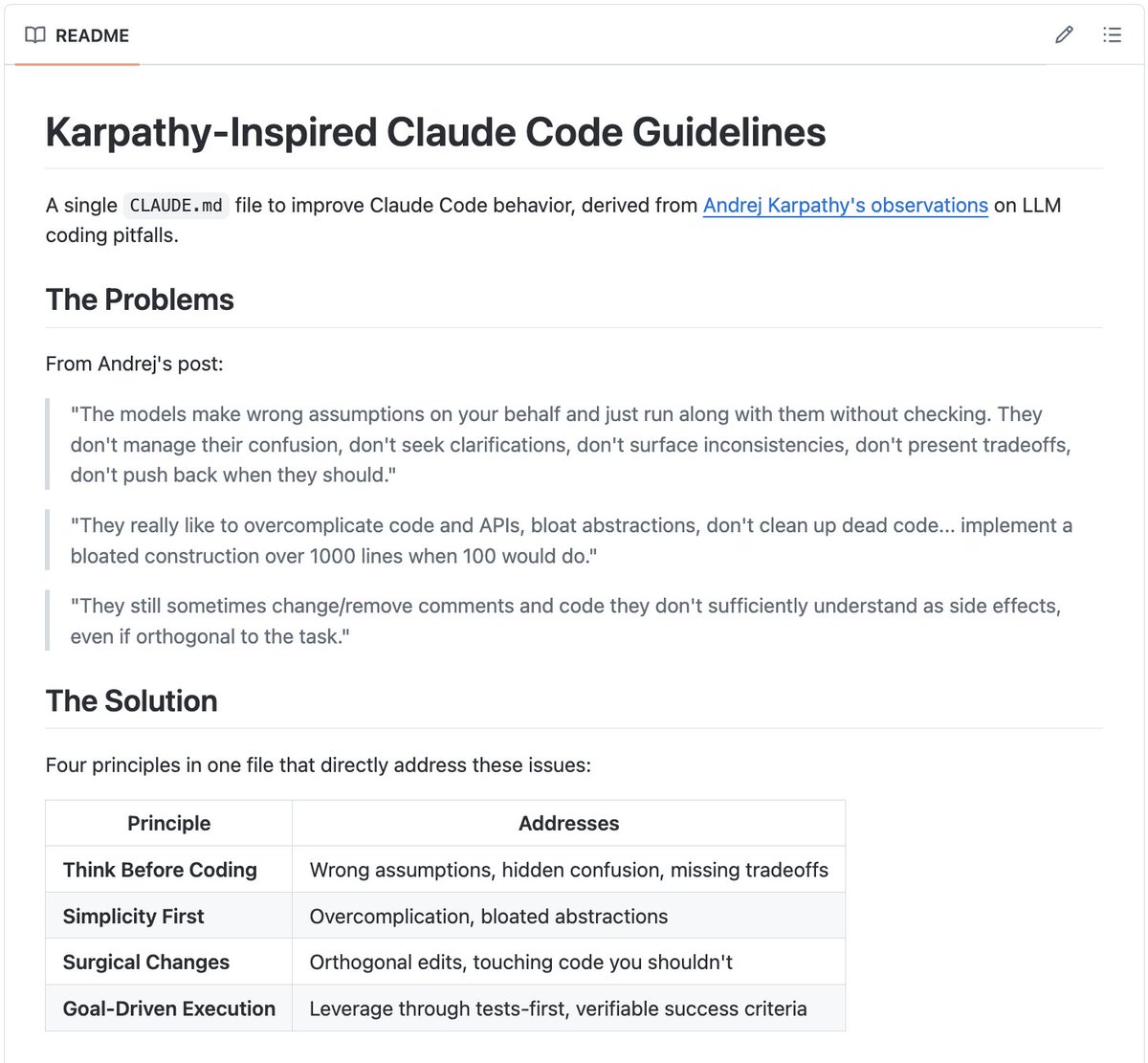
A single 𝗖𝗟𝗔𝗨𝗗𝗘.𝗺𝗱 file just hit 15K GitHub stars.
(derived from Karpathy's coding rules)
Andrej Karpathy observed that LLMs make the same predictable mistakes when writing code: over-engineering, ignoring existing patterns, and adding dependencies you never asked for.
If you've used AI coding assistants, you've hit all of these.
But here's the thing:
If the mistakes are predictable, you can prevent them with the right instructions.
That's exactly what this 𝗖𝗟𝗔𝗨𝗗𝗘.𝗺𝗱 does. You drop one markdown file into your repo, and it gives Claude Code a structured set of behavioral guidelines for your entire project.
This is a big deal.
- Built entirely around prompt engineering for AI coding assistants
- No framework, no complex tooling, just one .md file that shapes behavior
Developers are moving past "use AI to write code" and into "engineer the AI's behavior so the code is actually good."
The Claude Code ecosystem is growing fast, and the best tools in it aren't always software. Sometimes they're just well-crafted instructions.
100% open-source.
I've shared a link to the GitHub repo in the next tweet!
We’re excited to release TorchLean which is the first fully verified neural network framework in Lean. The Lean community has largely focused on pure mathematics. TorchLean expands this frontier toward verified neural network software and scientific computing. With the recent release of CSlib, we see this as another step toward a fully verified ML stack.
We support features:
1. Executable IEEE-754 floating-point semantics (and extensible alternative FP models) verified tensor abstractions with precise shape/indexing semantics
2. Formally verified autograd system for differentiation of NN programs Proof-checked certification / verification algorithms like CROWN (robustness, bounds, etc.)
3. PyTorch-inspired modeling API with eager-style development + export/lowering to a shared IR for execution and verification
Project page: https://t.co/YHpqhRbMQe
Paper: [2602.22631] TorchLean: Formalizing Neural Networks in Lean
Work done @Robertljg, Jennifer Cruden, Xiangru Zhong, @huan_zhang12 and @AnimaAnandkumar.
#MachineLearning #ScientificComputing #Lean
Say you have trained your deep learning model. It works. But do you know what it has actually learned?
🚀 We’ve built SymTorch: a library that translates deep learning models into human-readable equations.
I've attached here a quick video demonstrating how SymTorch works.
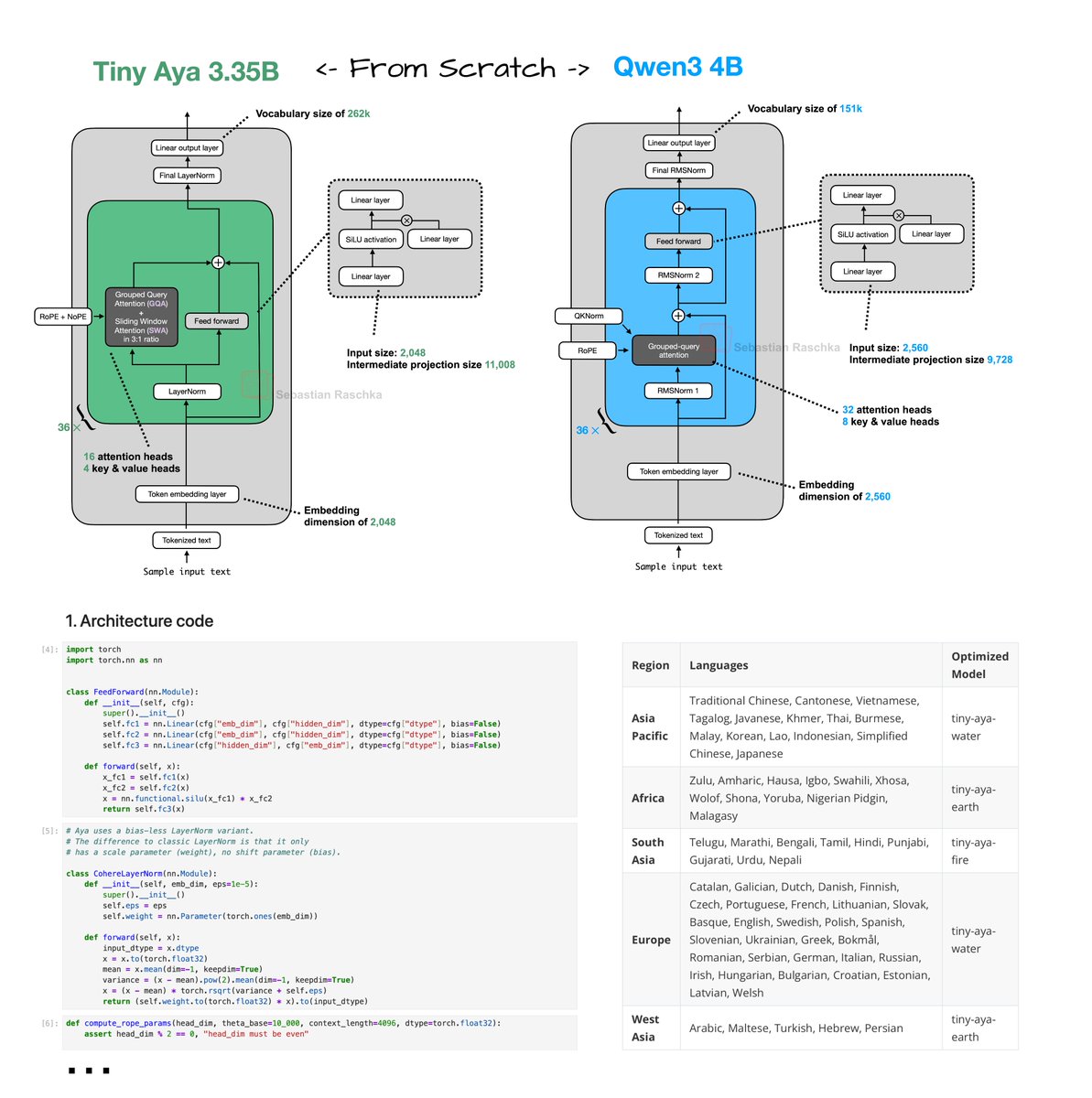
Tiny Aya reimplementation From Scratch!
Have been reading through the technical reports of the recent wave of open-weight LLM releases (more on that soon).
Tiny Aya (2 days ago) was a bit under the radar. Looks like a nice, small 3.35B model with strongest multilingual support of that size class. Great for on-device translation tasks.
Just did a from-scratch implementation here: https://t.co/6KEV0DfVQu
Architecture-wise, Tiny Aya is a classic decoder-style transformer with a few noteworthy modifications (besides the obvious ones like SwiGLU and Grouped Query Attention):
1. Parallel transformer blocks. A parallel transformer block computes attention and MLP from the same normalized input, then adds both to the residual in one step. I assume this is to reduce serial dependencies inside a layer to improve computational throughput.
2. Sliding window attention. Specifically, it uses a 3:1 local:global ratio similar to Arcee Trinity and Olmo 3. The window size is also 4096. Also, similar to Arcee, the sliding window layers use RoPE whereas the full attention layers use NoPE.
3. LayerNorm. Most architectures moved to RMSNorm as it's computationally a bit cheaper and performs well. Tiny Aya is keeping it more classic with a modified version of LayerNorm (the implementation here is like standard LayerNorm but without shift, i.e., bias, parameter).
10 GitHub repositories that will teach you more practical AI engineering than most paid courses:
1. AI Agents for Beginners (Microsoft)
https://t.co/TpqemxagHJ…
2. Awesome Generative AI Guide
https://t.co/fAWUhshIxu…
3. Designing Machine Learning Systems (Resources)
https://t.co/cfg33EgnL8…
4. GenAI Agents
https://t.co/3wJRL08RA8…
5. Hands-On AI Engineering
https://t.co/QFp5tPJ1kR…
6. Hands-On Large Language Models
https://t.co/abzek3Ks0W…
7. LLM Course
https://t.co/a8oANtHJsM…
8. Machine Learning for Beginners (Microsoft)
https://t.co/O0R27RXnII…
9. Made With ML
https://t.co/b4Pb45RB6O…
10. Prompt Engineering Guide
https://t.co/H4Obrmwvot…
Follow @DipanshuKu55175 for more





![ariG23498's tweet photo. [HF ML Club India]
We are pleased to announce the IRL event in Bengaluru. We are partnering with @GoogleDeepMind and this takes place on the 15th of July 2026 (more details below).
We will have someone from the GDM team talk about Gemma 4, and an hour long build session with Gemma and @huggingface. Great opportunity for folks to network and build.
PS: We will not entertain any "where is the registration link" query. Seek and ye shall find.](https://pbs.twimg.com/media/HLZAxOWbcAA4fsC.jpg)


![AndrewYNg's tweet photo. There will be no AI jobpocalypse.
The story that AI will lead to massive unemployment is stoking unnecessary fear. AI — like any other technology — does affect jobs, but telling overblown stories of large-scale unemployment is irresponsible and damaging. Let’s put a stop to it.
I’ve expressed skepticism about the jobpocalypse in previous posts. I’m glad to see that the popular press is now pushing back on this narrative. The image below features some recent headlines.
Software engineering is the sector most affected by AI tools, as coding agents race ahead. Yet hiring of software engineers remains strong! So while there are examples of AI taking away jobs, the trends strongly suggest the net job creation is vastly greater than the job destruction — just like earlier waves of technology. Further, despite all the exciting progress in AI, the U.S. unemployment rate remains a healthy 4.3%.
Why is the AI jobpocalypse narrative so popular? For one thing, frontier AI labs have a strong incentive to tell stories that make AI technology sound more powerful. At their most extreme, they promote science-fiction scenarios of AI “taking over” and causing human extinction. If a technology can replace many employees, surely that technology must be very valuable!
Also, a lot of SaaS software companies charge around $100-$1000 per user/year. But if an AI company can replace an employee who makes $100,000 — or make them 50% more productive — then charging even $10,000 starts to look reasonable. By anchoring not to typical SaaS prices but to salaries of employees, AI companies can charge a lot more.
Additionally, businesses have a strong incentive to talk about layoffs as if they were caused by AI. After all, talking about how they’re using AI to be far more productive with fewer staff makes them look smart. This is a better message than admitting they overhired during the pandemic when capital was abundant due to low interest rates and a massive government financial stimulus.
To be clear, I recognize that AI is causing a lot of people’s work to change. This is hard. This is stressful. (And to some, it can be fun.) I empathize with everyone affected. At the same time, this is very different from predicting a collapse of the job market.
Societies are capable of telling themselves stories for years that have little basis in reality and lead to poor society-wide decision making. For example, fears over nuclear plant safety led to under-investment in nuclear power. Fears of the “population bomb” in the 1960s led countries to implement harsh policies to reduce their populations. And worries about dietary fat led governments to promote unhealthy high-sugar diets for decades.
Now that mainstream media is openly skeptical about the jobpocalypse, I hope these stories will start to lose their teeth (much like fears of AI-driven human extinction have).
Contrary to the predictions of an AI jobpocalypse, I predict the opposite: There will be an AI jobapalooza! AI will lead to a lot more good AI engineering jobs, and I’m also optimistic about the future of the overall job market. What AI engineers do will be different from traditional software engineering, and many of these jobs will be in businesses other than traditional large employers of developers. In non-AI roles, too, the skills needed will change because of AI. That makes this a good time to encourage more people to become proficient in AI, and make sure they’re ready for the different but plentiful jobs of the future!
[Original text in The Batch newsletter.]](https://pbs.twimg.com/media/HIIb1VGaUAAZoAB.jpg)
![AnimaAnandkumar's tweet photo. We’re excited to release TorchLean which is the first fully verified neural network framework in Lean. The Lean community has largely focused on pure mathematics. TorchLean expands this frontier toward verified neural network software and scientific computing. With the recent release of CSlib, we see this as another step toward a fully verified ML stack.
We support features:
1. Executable IEEE-754 floating-point semantics (and extensible alternative FP models) verified tensor abstractions with precise shape/indexing semantics
2. Formally verified autograd system for differentiation of NN programs Proof-checked certification / verification algorithms like CROWN (robustness, bounds, etc.)
3. PyTorch-inspired modeling API with eager-style development + export/lowering to a shared IR for execution and verification
Project page: https://t.co/YHpqhRbMQe
Paper: [2602.22631] TorchLean: Formalizing Neural Networks in Lean
Work done @Robertljg, Jennifer Cruden, Xiangru Zhong, @huan_zhang12 and @AnimaAnandkumar.
#MachineLearning #ScientificComputing #Lean](https://pbs.twimg.com/media/HCSTAlwaoAAe_6n.png)