When monetizing a data business, there a few paywall levers:
>Data granularity (hourly vs daily)
>Historical depth (this year vs full history)
>Latency (real-time vs delayed)
>Coverage (all entities vs a select few)
>Metric breadth (restricting which metrics are available)
>Rate limits (restricting volume)
>Data format & usage
The last one, data format, is what we've been focusing on at DefiLlama.
The main site that people have been using for years is still free. But over the past 6 months, we've built out a custom dashboard builder, spreadsheet functions for Excel and Sheets, csv exports and an LLM to analyze and create custom deep dives on data.
For retail investors all metrics are still available for all entities for the full timespan they exist. But for people that need something more and want to integrate that data into their workflow, they can do so.
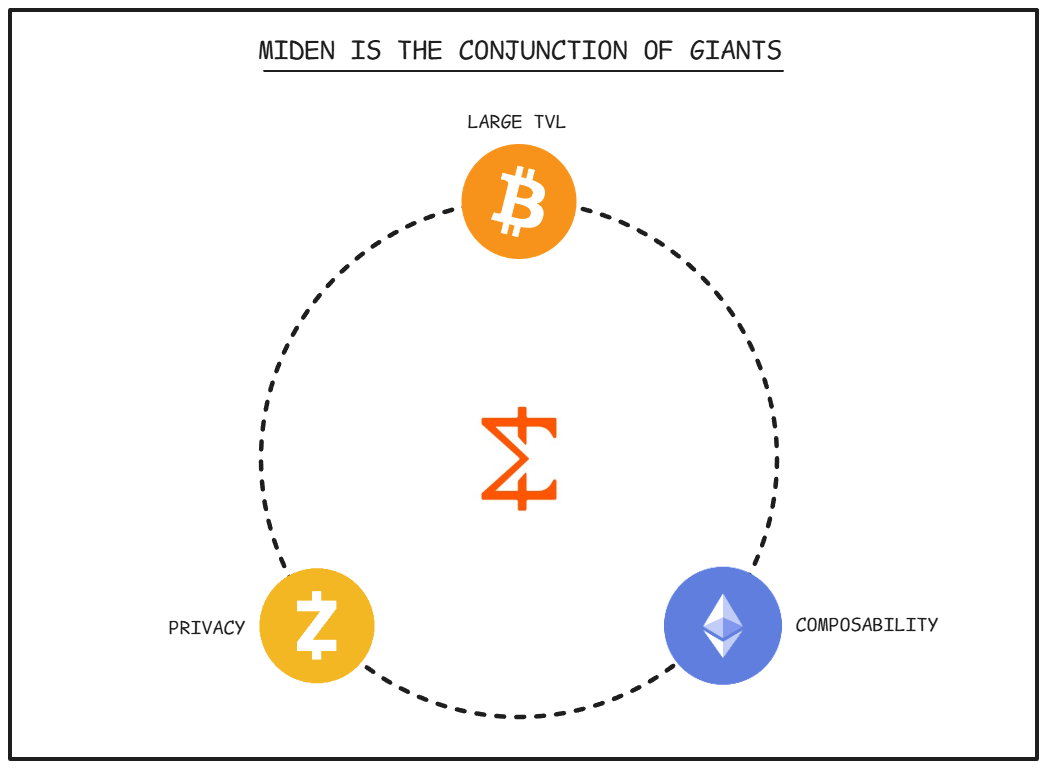
In the meantime, when talking about privacy, besides Starknet, we have @0xMiden.
Some said Miden is the conjunction between the giants - Bitcoin, Zcash, and Ethereum.
Set tech aside, let's see how Miden positions itself in real practice:
+ offering both transparent and private transactions
+ inheriting top privacy like ZK
+ maintaining the composability and speed of EVM
That's how Miden wins the race.
Bring back the cults, bring back the top blasters, bring back the people willing to put everything on the line, bring back holding for the 1000x, bring back the events, bring back the merch, just bring it all back
Family of 4 making < $230k in SF? There are no legit qualifying families. That is absolute poverty in SF and these families live elsewhere. So, who is this for? Is there a citizenship test? Where is this “free” money coming from? Have we audited the existing handouts?
EndGame Season 1 - Combat Era Presale is live:
Here's what happened in the beta test:-
https://t.co/vZzkfXMG1Q
You can get an invite link from here:
https://t.co/BY62A5Qz4J
The game shown in the anime isn’t confined to the story.
Dark Machine is being developed as a real, large-scale mech action shooter, built around the same team battles and machine classes seen on screen.
Early footage hints at the scale they’re aiming for.
🛠️ Scheduled Maintenance
We'll be performing system maintenance on January 7 at 08:00 AM UTC.
The website will be temporarily unavailable during this time.
Thank you for your patience as we improve Tokenomist!
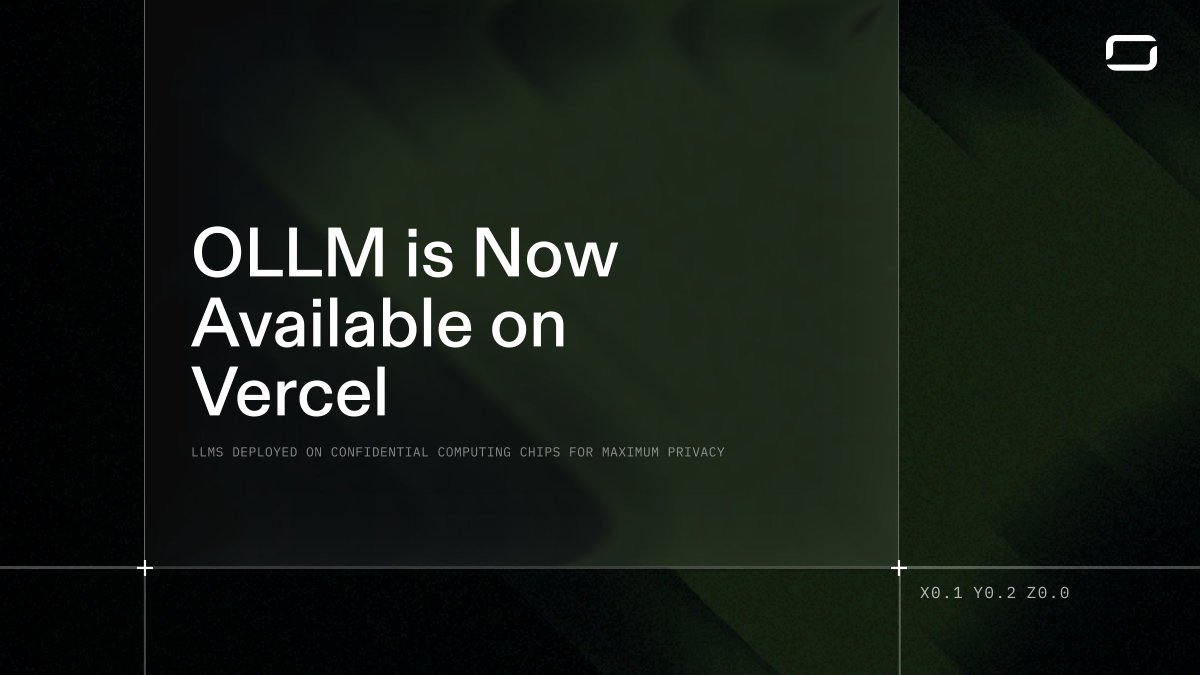
OLLM is now an official provider in @vercel
Developers can access OLLM's confidential AI models through Vercel's AI SDK.
Your inference data stays encrypted and isolated.
Always.
Privacy isn't a premium feature anymore.
i did some reading up on @PerpetualCow's https://t.co/8CLsg4qsF2 and wanted to see how impactful the fee redirection really was for the coin's floor
i put 100 claudes in a tiny box and told them whoever could prove first that price of cow won't go to infinity could escape the box and be free
it's been 4 days and they're still looping
At WEF, @AnthropicAI CEO @DarioAmodei warned that up to half of junior office roles could disappear by 2030.
As AI compounds, he says the gap between machine capability and human adaptability will only widen.
We all know that insti capital is going to come onchain at scale. In fact, a lot of it already has.
Hence, I wanted to map out where said institutional capital will flow into in the next 1-2 years by digging deep into the onchain lending landscape.
A TLDR of what I found: 78% of DeFi lending protocols operate on an architecture that creates systemic risk (and hence institutions cannot touch). The remaining 22% is/will be capturing disproportionate growth.
Onchain lending grew from $19.7 billion to $67.4 billion in under two years. But in my opinion, the growth numbers obscure something way more consequential: a divergence in how protocols actually work under the hood.
Most DeFi lending protocols pool risk. Deposits commingle, parameters are shared, and when one asset blows up, everyone in the pool takes the hit.
This has worked relatively fine for crypto-native users (although many might disagree). It definitely will NOT work for banks.
@Morpho took a different approach, one that - as I dove deeper into the research, I personally really really liked a lot.
Each lending market operates independently. Bad debt in one market cannot spread to another. There is no mechanism for contagion because the smart contracts simply don't allow it.
Starting from $11 million in January 2024, Morpho hit $6.4 billion by January 2026 and originated over $1.6 billion in institutional loans through @coinbase. @brian_armstrong himself has said the next goal is $100 billion in onchain borrow originations.
Then there's Société Générale. A G-SIB (one of 30 banks that regulators watch most closely). For its MiCA-compliant stablecoins, it went with Morpho. Imo that’s hyper bullish Morpho.
Banks need to isolate compliance regimes by jurisdiction. They need clean audit trails, and cannot accept a structure where problems in one market create legal exposure everywhere else.
The tokenized RWA market currently sits at $21 billion. Industry projections put it at $2 trillion by 2028. The protocols that will handle that capital are the ones whose architecture actually accommodates what institutions require.
The full report (link at the end of this post) digs into the five forces determining which protocols win: capital efficiency, risk architecture, RWA integration capability, developer ecosystems, and multi-chain distribution.
It covers how the curator economy works (26 independent risk managers now compete for $4.4 billion in deposits), why Gauntlet left Aave for Morpho, what the Coinbase and Ethereum Foundation deployments reveal about institutional requirements, and how three different scenarios for 2026 to 2028 could play out.
There is also a full breakdown comparing protocol tiers, from Aave's $34 billion dominance down to emerging players carving out niches on specific chains.
In onchain lending, how you build matters as much as what you build.
The Full Report by @caladanxyz:
https://t.co/ep4Lu2uoMD
My general takeaways from a non-coder perspective about vibe coding, based on building my @wtwnapp TV & movie tracker site from scratch, with no coding experience https://t.co/9pLP2RmPwE
🚨 CRYPTO GOES MAINSTREAM ON WALL STREET
BitGo made its public market debut on the New York Stock Exchange this morning, marking another milestone for crypto’s integration into traditional finance.
To commemorate the listing, @BitGo presented the NYSE with a framed copy of the Bitcoin whitepaper, symbolizing the bridge between decentralized money and legacy markets.
Momentum across the industry continues to build ; a big moment for the crypto space.