Hello educators! Just sharing the video I made on digital escape room. I used this in class for a quiz review, but you can utilize for other activities or subject areas. https://t.co/NcdjV1b4PX
The law of reflection states that the angle of incidence always equals the angle of reflection:
when light hits a surface, it bounces off at the same angle it arrived, measured from an imaginary line perpendicular to the surface (the normal).
Hooke's Law is a principle in physics that describe the force required to stretch or compress an elastic object, such as a spring. The law states that force (F) is directly proportional to the distance (X) of stretch or compression from its resting position.
Paradox: If you see a baby located 90 light-years from Earth, right now it would be a 90-year-old, but you see it in your present, as a baby.
While the light takes time to reach you, the baby grows and ages.
When you look at the universe, you are always looking at the past.
To think that we aren't just going "to the Moon," but rather traveling to meet it at an exact point in space... changes everything.
It all comes down to orbital mechanics: arriving at the precise location, at the precise moment.
One tiny error... and it simply doesn't happen
Professor Brian Cox explains using a simple light clock, time is not absolute. Because the speed of light remains constant, a light beam in a moving clock traces a longer, diagonal path from an outside observer's perspective, proving that moving clocks run slower and time literally bends to the speed of the observer.
This reveals a mind-bending reality: if you journeyed through space at 99.94% the speed of light for ten years, you would return to an Earth that had aged 29 years; making you a literal time traveler into the future.
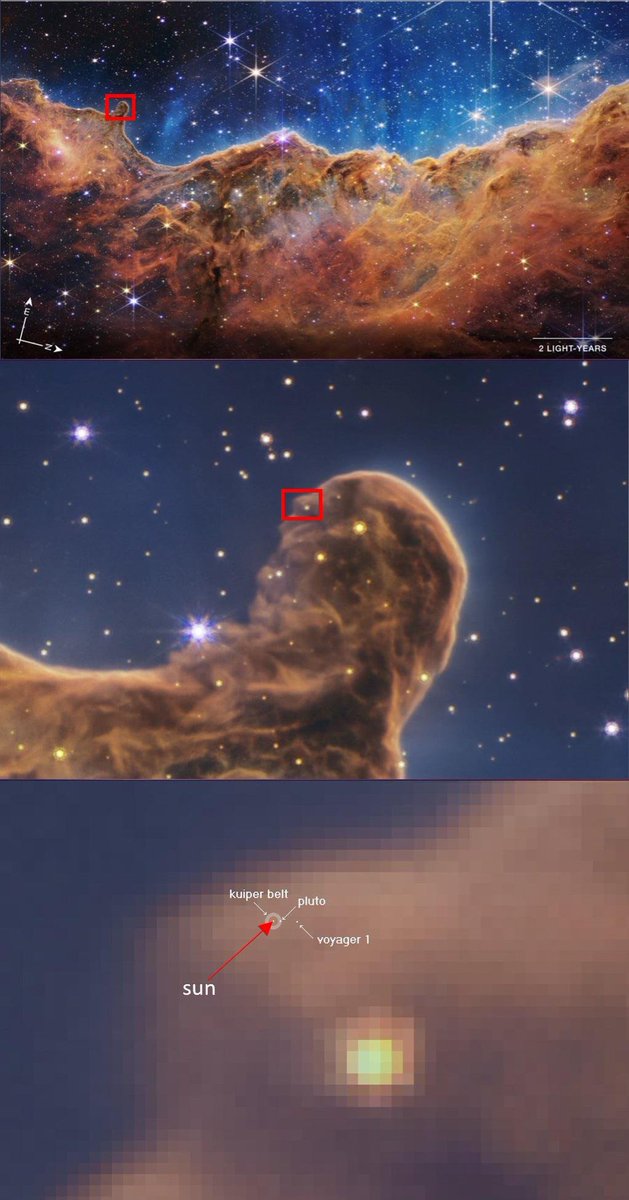
SPACE is BIG. 🤯
Voyager 1 has been flying away from Earth for 47 years at 35,000 mph. In the bottom frame, it hasn't even left the pixel. The Carina Nebula is 7,500 pixels away from that dot.