Calm, kind, and quietly confident.
I enjoy meaningful connections, warm energy, and conversations that feel natural.
Living in Miami, open to meeting like-minded people who value sincerity and a good sense of life
🏛️ Our Florida Society of Anesthesiologists physicians are on Capitol Hill for The American Society of Anesthesiologists (ASA) #LEGCON26! @ASALifeline@ASAGrassroots
The Arizona Attorney General’s Office is suing nine health insurance providers, accusing them of colluding with an AI-driven technology platform to drive down payments to healthcare providers while inflating out-of-pocket costs for some patients.
https://t.co/L12LBpnMXd
There is a plethora of good news in the newly issued CMS No Surprises Act (NSA) Independent Dispute Resolution (IDR) Operations final rule, but none better than CMS reducing its non-refundable administrative fee from $115 to $15 per party per dispute.
Mark and I discuss this highlight and more in our latest podcast.
CMS used its regulatory authority to announce yesterday June 2, 2026 that the new fee would be effective for disputes filed on June 11, 2026, instead of the standard 60 days after publication of the rule in the Federal Register.
Once again, the physician and supporting advocacy community should take another victory lap.
https://t.co/4Utrzpm2eX
The cooling-off period is our next stop because the final rule made real progress on it and also left the most important questions unanswered.
First, the progress. The Departments shortened the cooling-off period for batched disputes from 90 to 30 business days, which is a meaningful reduction. They also committed to publishing clarifying guidance on how the cooling-off period applies under the finalized batching provisions, and they acknowledged directly in the rule that stacking could lock physicians out of arbitration for years.
Congress designed the cooling-off period as a contracting incentive. After an IDR determination establishes what a fair payment looks like, the parties should use that information to negotiate an in-network contract rather than return to arbitration for the same service. While that is a very reasonable idea, in practice, no meaningful in-network contracting is happening during the cooling-off period. What is happening instead is that insurers are using ambiguity in the statute as a prospective payment denial tool.
The mechanism is straightforward. An insurer receives a claim. It decides on its own that the claim falls within a cooling-off period from a prior IDR determination. It refuses to pay. The physician disagrees. The IDRE disagrees. Two of the three parties agree the cooling-off period does not apply. The insurer still does not pay. The physician cannot challenge that through IDR, because the claim is already adjudicated. After the Fifth Circuit's June 2025 decision in Guardian Flight (and multiple others), the physician cannot sue to collect. Their only option is a CMS complaint with no guaranteed timeline and no penalty on the insurer. The insurer's unilateral assertion, even when wrong, is self-executing.
The reason this works as a trap is that the statute never defined who constitutes the same parties for purposes of triggering the cooling-off period. Is it the insurer, meaning a determination against UnitedHealthcare triggers cooling-off for every employer plan UHC administers as TPA? Or is it the specific employer plan, meaning a determination against Employer A's self-insured United plan does not affect Employer B's self-insured United plan, even though they share the same TPA? Insurers read same parties as broadly as possible while physicians and IDREs read it narrowly. There is no mechanism to resolve the disagreement because the insurer holds the money and refuses to pay while the physician is prevented from resubmitting the same claim. It is a circular trap that the insurer wins by default.
As I stated clearly at the Ways and Means panel on May 18, the cooling-off period is being used as a weapon to not pay.
So, for review, a physician submits a claim. The IDRE reviews it and determines it is eligible. Arbitration proceeds. The physician wins. The payer then looks at the award and decides, based on its own interpretation of the cooling-off period, that the claim was actually ineligible because it was filed a day or several days early. Not that the patient was wrong. Not that the physician was wrong. Not that the IDRE made an error on the merits. Just that in the payer's unilateral view, the timing fell inside a cooling-off window the payer defined for itself. So the payer does not pay. That award, won on the merits through the process Congress created, is gone. There is no mechanism to resubmit. There is no mechanism to appeal. The payer holds all the money and has appointed itself judge and jury.
The final rule removed the option to resubmit inappropriately batched disputes. That provision was intended to reduce gamesmanship, but in the context I just described, it eliminates the only potential corrective pathway for a physician whose claim was handled correctly in every material respect and then declared ineligible retroactively by the party that owes the money.
I was at a panel on May 18 where a representative from Elevance Health said, with apparent conviction, that everyone must follow the law. That is the right standard. I agree with it completely. But the same industry is currently running significant advertising in Washington describing IDREs as the fox in the henhouse, arguing that the arbitrator and the attorney representing the physician are corrupt actors tilting the process unfairly. What that framing obscures is that the insurer is simultaneously acting as judge and jury on its own payment obligations, with no oversight, no appeal mechanism, and no penalty for getting it wrong or acting in bad faith. If the IDRE is the fox, what do we call a party that unilaterally decides which of its own legal obligations it intends to honor?
The NSA imposed automatic civil monetary penalties of up to $10,000 per occurrence on physicians for balance billing violations, enforceable without a complaint being filed. That same exposure applies to failing to provide a Good Faith Estimate, violating the notice and consent process, or failing to display required patient notices. For insurers, the penalty for failing to pay a binding IDR award is zero. The penalty for miscalculating the QPA is zero. The penalty for bad faith conduct during open negotiation is zero. Senator Marshall's legislation, S.2420, describes H.R. 4710 explicitly as providing parity between penalties imposed against parties who are not compliant with the law. That language is an acknowledgment from Congress itself that no such parity currently exists.
A physician in a cooling-off dispute has no private right of action. After Guardian Flight, there is no lawsuit to file. There is no appeal process. There is no mechanism to compel payment short of a CMS complaint with no guaranteed timeline and no penalty on the other side. The physician is structurally a claimant and nothing more, while the insurer holds the money, interprets the rules, asserts its own compliance, and faces no consequence for getting any of it wrong.
Physicians lack the plan-level data to make accurate eligibility determinations at the point of submission. They lack any appeal mechanism when an insurer asserts cooling-off after the fact. They lack enforcement tools when an arbitration award goes unpaid. And they face unilateral civil monetary penalties for procedural violations while the counterparty faces none. The real insurer win rate across all NSA-eligible claims is over 95%, documented using the insurance industry's own survey data. And yet the narrative being advanced in Washington is that physicians are the bad actors ruining the system.
Tomorrow I will talk about where we go from here, including where I think genuine consensus with insurers is possible and what Congress needs to do where it is not.
@IndeMedAction
After a long and productive day, there's something comforting about walking through the door, changing into something cozy, and enjoying a quiet evening.
Life may be busy, but I've learned to appreciate these simple moments. Grateful for today and looking forward to tomorrow. ❤️
Dr. Mikel Daniels here. Private practice survival depends on fair medical economics. At WeTreatFeet Podiatry, we are advocating for Medicare reforms that prioritize patient care over bureaucracy. Let's protect independent healthcare. #Medicare#MedicalEconomics#WeTreatFeet
Dr. Mikel Daniels here. Private practice is at a crossroads. Medicare cuts and complex medical economics shouldn’t dictate patient care. At WeTreatFeet Podiatry, we’re advocating for a system that values doctors and patients alike. Join the fight. #Healthcare#Medicare#Podiatry
https://t.co/LH7PSFwdSK
I only count 5 for profits among the 64.
And how many of these vertically integrate, block physician owned hospitals, buy up competition, take advantage of lack of site neutrality, and utilize 340B to INCREASE the cost of care while simultaneously receiving more in tax benefits than in what they provide in community services?
Independent community benefit analysis can be found here:
https://t.co/KUuTq54uhh
Time to level the playing field?
@LoisKolkhorst@electcharles@TomOliverson@RepJamesFrank@mcuban@DrDiGiorgio@DutchRojas
Make your voice heard on physician-led hospitals! This is straightforward to do, please consider taking a few minutes to engage. @DrBruggeman@TSAOG_Ortho@TXOrthoAssn https://t.co/SzEF2iLu6T https://t.co/5gIoK9U6ct
Last week the tri-Departments of HHS, Labor, and Treasury published the final IDR Operations rule, CMS-9897-F. We have been waiting on this rule for a long time, and I want to spend this week walking through what they got right, what still needs work, and where the upcoming guidance and congressional action need to go.
Any discussion needs to start with the fact that The No Surprises Act is the patient shield. It was designed to take patients out of the middle of a dispute between a physician and an insurance company over what constitutes fair payment, and it is doing exactly that. While it was not designed to as a system cost savings, a 2025 BMJ study found that patients in NSA-protected states saw an 18% reduction in out-of-pocket costs, averaging $567 in annual savings per patient, with no statistically significant increase in premiums. More than 10 million surprise bills were prevented in the first nine months of 2023 alone. Any serious conversation about reforming the dispute resolution administration has to start there, because the shield must be protected.
The machinery underneath that protection is a different matter. CMS projected roughly 17,000 IDR disputes per year based on flawed data. The system received 489,000 in its first 14 months and is now processing over 2.6 million annually. The backlog reached 590,000 unresolved cases. Median decision time stretched to 80 business days against a 33-day statutory target. In 2024, 59.6% of IDR awards were not paid within the required 30-day window, up from 24% the year before.
The Departments addressed several of those failures directly in this rule and deserve credit for doing so. The administrative fee drops from $115 to $15 per party, effective within days of Federal Register publication. A mandatory payer registry gets established. Payers must now formally respond during open negotiation. The batching cap rises to 50 line items. Extensions are available for extenuating circumstances. The cooling-off period for batched disputes is shortened from 90 to 30 business days. These are real wins that reflect years of advocacy by independent physicians and patient advocates.
This week I will go through each of those in detail, and then identify what the rule left open. The Departments have committed to issuing clarifying guidance on several key questions, and hopefully this series will help to guide advocates and the Departments as to how the guidance should be shaped.
@IndeMedAction
In every serious policy conversation about the NSA, insurers and insurer supported think tanks claim that IDR volume proves the process is being abused. That argument is built on a foundation of bad data.
The federal government projected 17,000 annual IDR disputes. The system is now processing over 2.6 million. That gap is routinely cited as evidence that physicians are gaming the system. I said at a Ways and Means Committee panel on May 18 that the 17,000 number is not a number we can anchor on, and @PatrickVelliky has done a great job explaining this in Health Affairs Forefront and his Substack.
The Departments based their estimate entirely on New York's IDR experience, scaling New York's roughly 1,000 annual disputes to the national insured population to arrive at 17,000. The problem is that New York's law structurally eliminated emergency medicine disputes by tying out-of-network emergency payments to usual and customary rates rather than sending them to arbitration. Emergency medicine accounts for more than half of all federal IDR disputes. Using New York as the baseline created the system around a model that excluded the largest category of claims from the beginning.
Texas was the right baseline and the data was publicly available. Texas had an analogous arbitration structure with no emergency medicine carve-out. In its first year, the Texas Department of Insurance received nearly 49,000 disputes from approximately 5.8 million Texans in state-regulated plans. Apply that rate to the 183 million nationally insured and you get roughly 1.55 million estimated annual federal disputes, not 17,000. The volume crisis was baked in before the law took effect and doesn’t reflect gaming.
Let’s look at what the volume actually represents. The October 2025 AHIP/BCBSA survey, the insurance industry's own data, found approximately 19.7 million commercial claims were NSA-eligible in 2025. Of those, only 1.23 million were submitted to IDR, a rate of 6.2%. After removing ineligible disputes and cases where the insurer prevailed, additional IDR payments were required in just 4.4% of NSA-eligible claims. The real insurer win rate across all NSA-eligible claims is over 95%. The insurance industry is telling Congress it is losing a process it wins 95% of the time.
The 85% provider win rate in IDR applies only to the 6% of claims that actually reach arbitration. These are cases providers specifically chose to dispute because they were confident the underpayment was real and documentable. Patrick provided a great example. A district attorney with a 50% conviction rate would be investigated for wrongful prosecution. A high win rate in a self-selected pool of documented underpayments is exactly what a functioning backstop looks like.
One more piece of context on the awards themselves. An independent December 2025 analysis of Q4 2024 CMS data across Aetna, BCBS, Cigna, and UHC found that in 60.6% of dispute cases, the actual median in-network contracted rate exceeded the reported QPA, and where it did, the actual in-network rate was 290.5% higher than the QPA. When providers win at what gets called three or four times QPA, they are frequently winning at or below what the same insurer pays its own contracted network physicians for the same service. The QPA is the benchmark, but the QPA is not the market rate.
The final rule does not address QPA methodology but does continue to ensure that eligible cases get through
@IndeMedAction
Our journal’s very first “It’s Up for Debate” - the merits vs risks of employing formalized shock teams to vet and manage the patient with Cardiogenic Shock! What other debates should we consider?
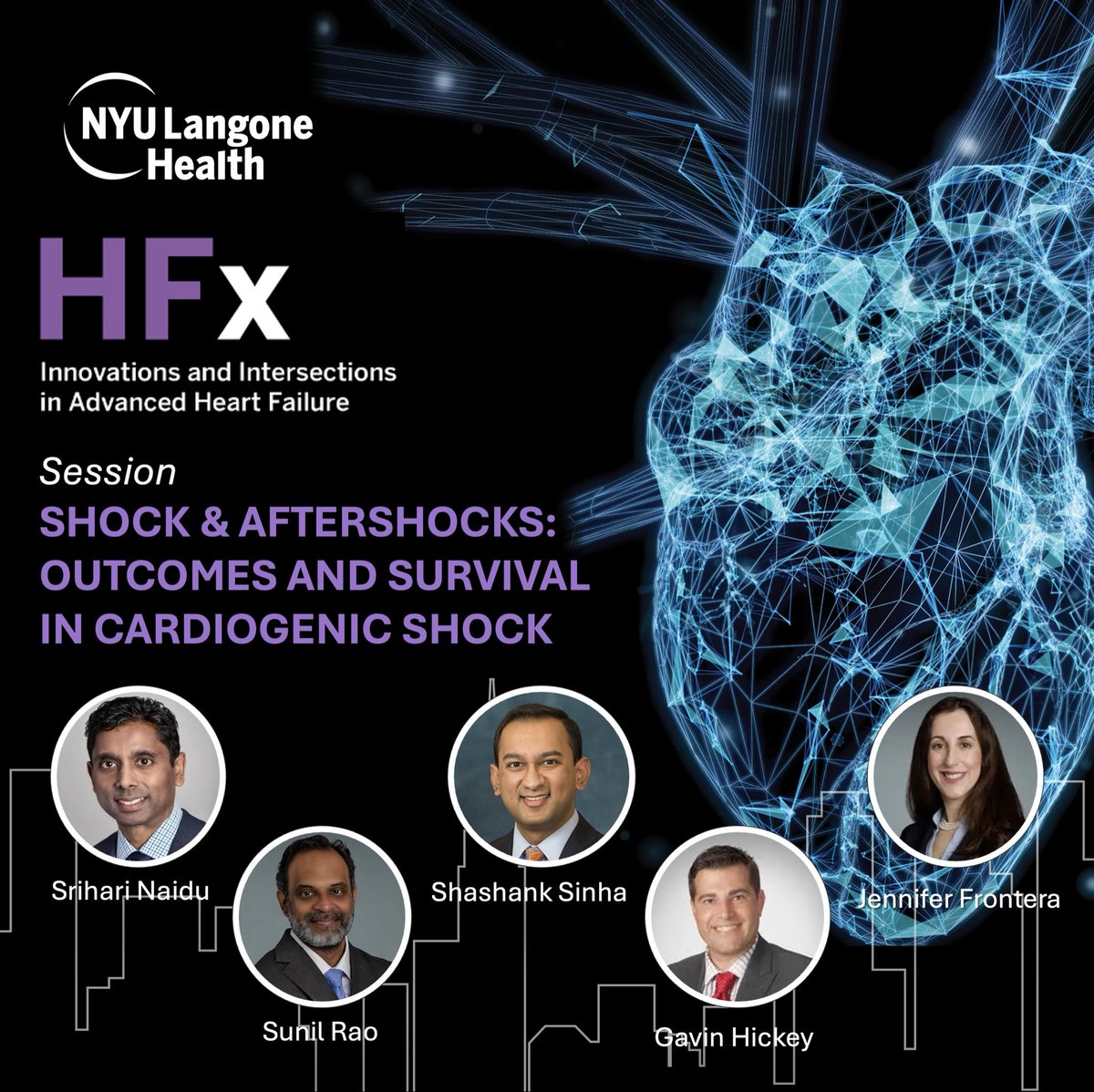
We celebrate survival in #cardiogenicshock. But survival to what? Patients may leave the hospital and never truly make it home.
At #HFx we address some big issues:
❤️🩹 The quiet morbidity after “successful” shock care
🧠 What are the neurological consequences and how can we support meaningful recovery? ⛓️💥How can we pull a fragmented system for survivors together?
🫀 Friday 5/6/26 🔥 @nyugrossman Register: https://t.co/billoxeDrX
#CardiogenicShock #HeartFailure #CriticalCare #Cardiology #MedEd
⏰ Happening Tomorrow!
Join us for Transformative Advances in Interventional Cardiology — an inspiring evening highlighting the innovation and breakthroughs that continue to shape the future of the field.
Hear from legendary interventional cardiologist @BillONeillMD, joined by special guest moderator Dr. Mir Babar Basir, as they explore the evolution of clinical research and its lasting impact on patient care.
🗓 Thursday, May 14
⏰ 6:00 PM
📍 Big Rock Italian Chophouse
An evening designed to educate, connect, and inspire the next generation of clinicians.
RSVP https://t.co/s8s6jQVbHE
#Cardiology #InterventionalCardiology #MedicalEducation #Innovation @MedicalZoll
Dear @IAmAmnaNawaz. On @MSNBC, shocked you think it unimportant who bombed Gaza hospital (an atrocity). You just blame Israel. Sorry: it’s critically important. Looking like terrorist attempt to scuttle Biden’s mission. On @NewsHour, now hard to trust your reporting.
1/3 Conozco al Dr. @josephahill hace más de una década. Hemos colaborado en investigaciones para mejorar la salud de las personas. Más que un referente mundial de @UTSWNews, es un colega con quien comparto la pasión por la excelencia científica.