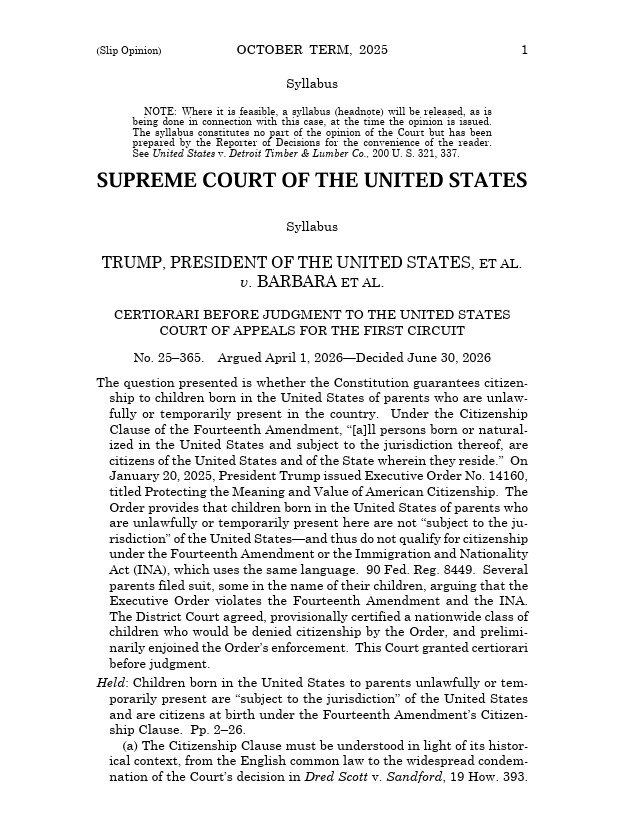
The Court never previously held that the 14th amendment requires birthright citizenship for the offspring of foreign birth tourists or illegal aliens.
True, it was generally assumed that birthright citizenship was mandated, and that was what I was taught back in the day.
But the scholarship in recent years has demonstrated that was not the understanding of the society that ratified the amendment. You shouldn’t have to pass a constitutional amendment; the Court has a responsibility to get constitutional questions right and to correct erroneous interpretations.
To settle the debate over birthright citizenship and the 14th Amendment once & for all, I'm hereby posting the vast majority of the Senate's ratifying debate from May 30, 1866. (Thanks for ChatGPT for spending the last few hours helping me transcribe dozens of screenshots from the original congressional record.)
The transcript runs around 22 pages & it's possible there are some typos, but I'll summarize it briefly: The amendment's author, Sen. Jacob M. Howard, said his purpose in crafting the birthright citizenship clause was to create a standard policy across the United States, premised largely on some states' resistance to enabling newly freed blacks to become fully active members of the body politic.
Noting the provision's specific application to freed blacks, Delaware's Sen. Willard Saulsbury said: "I do not presume that any one will pretend to disguise the fact that the object of this first section is simply to declare that negroes shall be citizens of the United States. There can be no other object in it, I presume, than a further extension of the legislative kindness and beneficence of Congress toward that class of people."
Sen. Howard emphasized from the beginning that birthright citizenship would not apply to anyone born in the United States whose parents were not entirely under American jurisdiction:
"[E]very person born within the limits of the United States, and subject to their jurisdiction, is by virtue of natural law and national law a citizen of the United States. This will not, of course, include persons born in the United States who are foreigners, aliens, who belong to the families of ambassadors or foreign ministers accredited to the government of the United States, but will include every other class of person."
Note here that he's listing various classes of people the provision would not apply to — foreigners, aliens, children of ambassadors or foreign ministers; the word "or" clearly indicates he's listing various groups, not grouping them all into the ambassador category, as some have falsely claimed online.
Maryland Sen. Reverdy Johnson likewise emphasized the provision would not apply to children whose parents were still subject to another country.
"Now, all this amendment provides is, that all persons born in the United States and not subject to some foreign Power—for that, no doubt, is the meaning of the committee who have brought the matter before us—shall be considered as citizens of the United States ... If there are to be citizens of the United States entitled everywhere to the character of citizens of the United States, there should be some certain definition of what citizenship is, what has created the character of citizen as between himself and the United States, and the amendment says citizenship may depend upon birth, and I know of no better way to give rise to citizenship than the fact of birth within the territory of the United States, born of parents who at the time were subject to the authority of the United States"
After this assurance, the debate moved to Gypsies and Chinese people in California, and concern they may game the system to overtake the domestic population. These groups were singled out as examples of peoples not automatically entitled to citizenship merely for being born within the territorial United States, and modern progressives are officially trigger warned upon reading this section.
The debate then moved to Indians, and once again there you'll see agreement that Indians that owed allegiance to a tribe would not be American citizens simply by virtue of being born in U.S. soil. However, the senators did say "civilized" Indians — i.e., those trying to become Americans — could.
Sen. Howard: "Indians born within the limits of the United States, and who maintain their tribal relations, are not, in the sense of this amendment, born subject to the jurisdiction of the United States. They are regarded, and always have been in our legislation and jurisprudence, as being quasi foreign nations."
Illinois' Senator Lyman Trumbull concurred:
"I have already replied to the suggestion as to the Indians being subject to our jurisdiction. They are not subject to our jurisdiction in the sense of owing allegiance solely to the United States; and the Senator from Maryland, if he will look into our statutes, will search in vain for any means of trying these wild Indians. A person can only be tried for a criminal offense in pursuance of laws, and he must be tried in a district which must have been fixed by law before the crime was committed. We have had in this country, and have today, a large region of country within the territorial limits of the United States, unorganized, over which we do not pretend to exercise any civil or criminal jurisdiction, where wild tribes of Indians roam at pleasure, subject to their own laws and regulations, and we do not pretend to interfere with them. They would not be embraced by this provision. For these reasons I think this language is better than the language employed by the civil rights bill [which had recently been passed]."
Sen. Howard repeatedly emphasized the importance of birthright citizenship only applying when BOTH parents were fully under American jurisdiction, not owing loyalty to any other country/tribe/etc.:
"If there are to be citizens of the United States entitled everywhere to the character of citizens of the United States, there should be some certain definition of what citizenship is, what has created the character of citizen as between himself and the United States, and the amendment says that citizenship may depend upon birth, and I know of no better way to give rise to citizenship than the fact of birth within the territory of the United States, born of parents who at the time were subject to the authority of the United States.
"I am, however, by no means prepared to say, as I think I have intimated before, that being born within the United States, independent of any new constitutional provision on the subject, creates the relation of citizen to the United States."
Oregon's Senator George Henry Williams echoed this key point that the provision applies to children whose parents are under the jurisdiction of the United States and the United States only:
"In one sense, all persons born within the geographical limits of the United States are subject to the jurisdiction of the United States, but they are not subject to the jurisdiction of the United States in every sense. Take the child of an ambassador. In one sense, that child born in the United States is subject to the jurisdiction of the United States, because if that child commits the crime of murder, or commits any other crime against the laws of the country, to a certain extent he is subject to the jurisdiction of the United States, but not in every respect; and so with these Indians. All persons living within a judicial district may be said, in one sense, to be subject to the jurisdiction of the court in that district, but they are not in every sense subject to the jurisdiction of the court until they are brought, by proper process, within the reach of the power of the court. I understand the words here, "subject to the jurisdiction of the United States," to mean fully and completely subject to the jurisdiction of the United States."
Read through the whole debate. You won't find anyone arguing that this birthright citizenship provision would apply to anyone born within the territorial United States automatically. Before I paste the text, here's a link to the original source: https://t.co/25JjfmW3IY
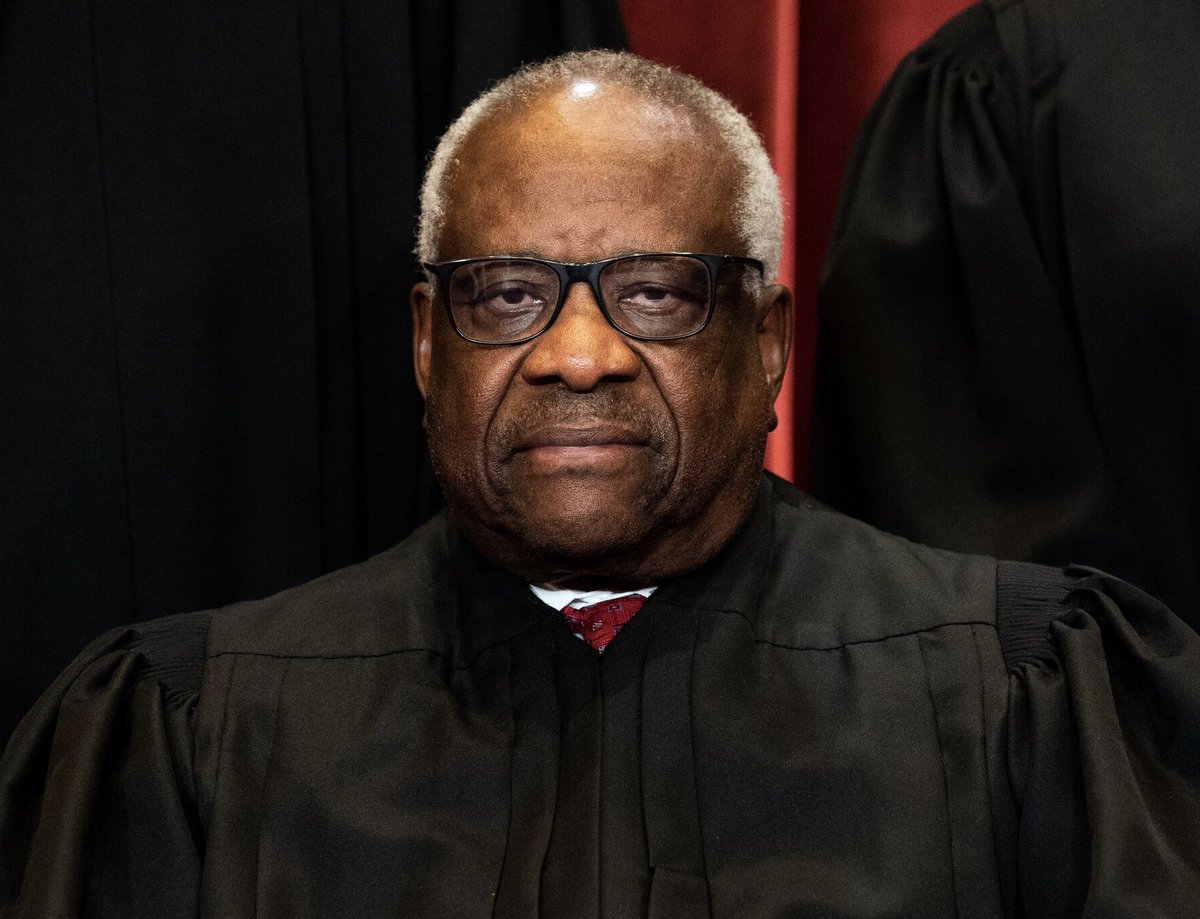
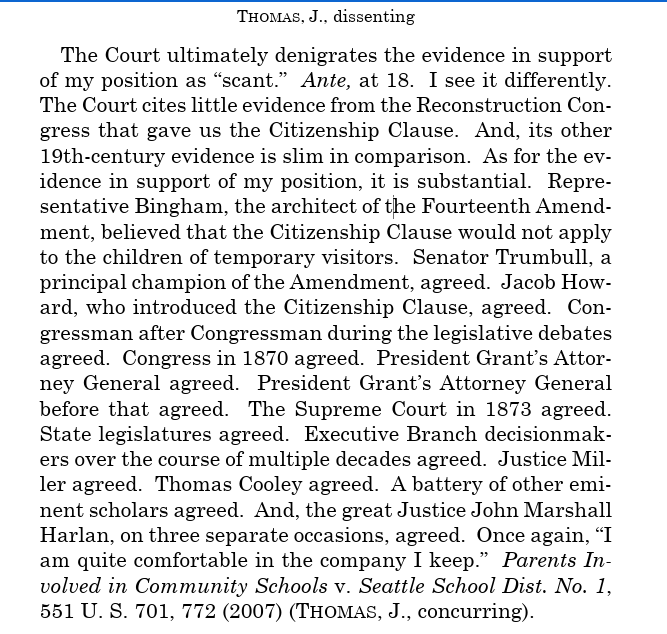
I have just finished reading Justice Clarence Thomas's 91-page dissent in the Supreme Court’s ruling striking down Trump’s birthright citizenship order.
It's incredible.
Here's everything you need to know: 🧵
The *author* of the Citizenship Clause of the 14th Amendment, Senator Jacob Howard, literally explained during the debates that it would obviously not apply to illegal aliens or foreigners not allegiant to the United States…
It was for the children of former slaves.
J. Kavanaugh gets it: "The only apparent principle unifying the four disparate exceptions listed by the Court in Wong Kim Ark—especially in light of the exception for tribal American Indians—is that the parents in all of those varied circumstances were not U. S. citizens and were citizens of other nations, whether tribal or foreign."
Every time you read the words “bipartisan support,” you need to mentally correct it to read “double penetration,” because that is what is about to happen to you
@LibertyLockPod Don’t care. I’m actively voting against Democrats and the GOP are the means to stop them. I’d rather agitate WITHIN the GOP party in control of government, than agitate against a Dems-Commie ran government.
3 hours listening to people rage against the MoU brought to light all the things the hawks are missing:
1) There's an election coming.
2) It's an unpopular war.
3) The Libya model is high risk.
4) No way to secure Hormuz without casualties.
Haven't seen anyone address these.







![tomselliott's tweet photo. To settle the debate over birthright citizenship and the 14th Amendment once & for all, I'm hereby posting the vast majority of the Senate's ratifying debate from May 30, 1866. (Thanks for ChatGPT for spending the last few hours helping me transcribe dozens of screenshots from the original congressional record.)
The transcript runs around 22 pages & it's possible there are some typos, but I'll summarize it briefly: The amendment's author, Sen. Jacob M. Howard, said his purpose in crafting the birthright citizenship clause was to create a standard policy across the United States, premised largely on some states' resistance to enabling newly freed blacks to become fully active members of the body politic.
Noting the provision's specific application to freed blacks, Delaware's Sen. Willard Saulsbury said: "I do not presume that any one will pretend to disguise the fact that the object of this first section is simply to declare that negroes shall be citizens of the United States. There can be no other object in it, I presume, than a further extension of the legislative kindness and beneficence of Congress toward that class of people."
Sen. Howard emphasized from the beginning that birthright citizenship would not apply to anyone born in the United States whose parents were not entirely under American jurisdiction:
"[E]very person born within the limits of the United States, and subject to their jurisdiction, is by virtue of natural law and national law a citizen of the United States. This will not, of course, include persons born in the United States who are foreigners, aliens, who belong to the families of ambassadors or foreign ministers accredited to the government of the United States, but will include every other class of person."
Note here that he's listing various classes of people the provision would not apply to — foreigners, aliens, children of ambassadors or foreign ministers; the word "or" clearly indicates he's listing various groups, not grouping them all into the ambassador category, as some have falsely claimed online.
Maryland Sen. Reverdy Johnson likewise emphasized the provision would not apply to children whose parents were still subject to another country.
"Now, all this amendment provides is, that all persons born in the United States and not subject to some foreign Power—for that, no doubt, is the meaning of the committee who have brought the matter before us—shall be considered as citizens of the United States ... If there are to be citizens of the United States entitled everywhere to the character of citizens of the United States, there should be some certain definition of what citizenship is, what has created the character of citizen as between himself and the United States, and the amendment says citizenship may depend upon birth, and I know of no better way to give rise to citizenship than the fact of birth within the territory of the United States, born of parents who at the time were subject to the authority of the United States"
After this assurance, the debate moved to Gypsies and Chinese people in California, and concern they may game the system to overtake the domestic population. These groups were singled out as examples of peoples not automatically entitled to citizenship merely for being born within the territorial United States, and modern progressives are officially trigger warned upon reading this section.
The debate then moved to Indians, and once again there you'll see agreement that Indians that owed allegiance to a tribe would not be American citizens simply by virtue of being born in U.S. soil. However, the senators did say "civilized" Indians — i.e., those trying to become Americans — could.
Sen. Howard: "Indians born within the limits of the United States, and who maintain their tribal relations, are not, in the sense of this amendment, born subject to the jurisdiction of the United States. They are regarded, and always have been in our legislation and jurisprudence, as being quasi foreign nations."
Illinois' Senator Lyman Trumbull concurred:
"I have already replied to the suggestion as to the Indians being subject to our jurisdiction. They are not subject to our jurisdiction in the sense of owing allegiance solely to the United States; and the Senator from Maryland, if he will look into our statutes, will search in vain for any means of trying these wild Indians. A person can only be tried for a criminal offense in pursuance of laws, and he must be tried in a district which must have been fixed by law before the crime was committed. We have had in this country, and have today, a large region of country within the territorial limits of the United States, unorganized, over which we do not pretend to exercise any civil or criminal jurisdiction, where wild tribes of Indians roam at pleasure, subject to their own laws and regulations, and we do not pretend to interfere with them. They would not be embraced by this provision. For these reasons I think this language is better than the language employed by the civil rights bill [which had recently been passed]."
Sen. Howard repeatedly emphasized the importance of birthright citizenship only applying when BOTH parents were fully under American jurisdiction, not owing loyalty to any other country/tribe/etc.:
"If there are to be citizens of the United States entitled everywhere to the character of citizens of the United States, there should be some certain definition of what citizenship is, what has created the character of citizen as between himself and the United States, and the amendment says that citizenship may depend upon birth, and I know of no better way to give rise to citizenship than the fact of birth within the territory of the United States, born of parents who at the time were subject to the authority of the United States.
"I am, however, by no means prepared to say, as I think I have intimated before, that being born within the United States, independent of any new constitutional provision on the subject, creates the relation of citizen to the United States."
Oregon's Senator George Henry Williams echoed this key point that the provision applies to children whose parents are under the jurisdiction of the United States and the United States only:
"In one sense, all persons born within the geographical limits of the United States are subject to the jurisdiction of the United States, but they are not subject to the jurisdiction of the United States in every sense. Take the child of an ambassador. In one sense, that child born in the United States is subject to the jurisdiction of the United States, because if that child commits the crime of murder, or commits any other crime against the laws of the country, to a certain extent he is subject to the jurisdiction of the United States, but not in every respect; and so with these Indians. All persons living within a judicial district may be said, in one sense, to be subject to the jurisdiction of the court in that district, but they are not in every sense subject to the jurisdiction of the court until they are brought, by proper process, within the reach of the power of the court. I understand the words here, "subject to the jurisdiction of the United States," to mean fully and completely subject to the jurisdiction of the United States."
Read through the whole debate. You won't find anyone arguing that this birthright citizenship provision would apply to anyone born within the territorial United States automatically. Before I paste the text, here's a link to the original source: https://t.co/25JjfmW3IY](https://pbs.twimg.com/media/Gud1B3vXkAAOxou.jpg)