The CEO of Take-Two, the company behind GTA, just said something the entire AI industry doesn't want to hear.
And he said it without being anti-AI.
Strauss Zelnick's argument is precise. AI is built on datasets. Datasets are backward-looking. Creativity is forward-looking. A model trained on everything that already exists cannot, by definition, produce something genuinely unexpected. And all hits, by their very nature, are unexpected.
Asset creation and hit creation are not the same thing. AI is getting very good at the first one. The second one is what actually makes money, builds franchises, and changes culture. Nobody has shown AI can do that yet.
The derivative property problem is real. You can clone GTA with existing technology. You could do it before AI. It would take 3 years and look identical. It still wouldn't sell. Because it isn't GTA. It's a clone of GTA.
And consumers, despite what the industry occasionally pretends, can feel the difference between something genuinely new and something assembled from the residue of things that already worked.
Thousands of mobile games ship every year. 0 to 5 hits get made. The same studios make them every time. The technology to make more games has been commoditized for years. It didn't democratize hit creation. It just flooded the market with more forgettable product.
The Silicon Valley thesis that AI unlocks game creation for everyone is true in the same way that cheap cameras unlocked filmmaking for everyone. They did. And the same 5 studios still make the movies everyone watches.
What Zelnick is saying, without quite saying it, is that the thing AI cannot replicate is taste. The instinct for what hasn't been done yet. The cultural antenna that detects the gap in the market before the data can see it.
Data tells you what people wanted. Hits tell people what they want next.
Those are different jobs.
Recién terminé una charla con un gerente muy capo de una empresa en méxico y me contaba que el poder que tienen los directores en la organización es directamente proporcional al headcount que manejan.
Y me decía que él quería implementar IA en sus procesos, pero que si lo hacía era probable que necesitara menos personal, por lo que iba a perder presupuesto/poder/decisión/etc.
O sea: si incorpora tecnología y optimiza los costos de la empresa PIERDE PODER. Es una locura.
Muchas empresas van a tener que rediseñar sus incentivos si no quieren dársela en la pera.
ANTHROPIC JUST KILLED THE DEMO AGENT ERA.
Their Agents team showed exactly what production grade looks like.
Not theory.
Not a tutorial.
A four layer framework for multi agent systems built to actually work in the real world.
30 minutes.
This is the video I wish existed 6 months ago.
Yann LeCun was right the entire time. And generative AI might be a dead end.
For the last three years, the entire industry has been obsessed with building bigger LLMs. Trillions of parameters. Billions in compute.
The theory was simple: if you make the model big enough, it will eventually understand how the world works.
Yann LeCun said that was stupid.
He argued that generative AI is fundamentally inefficient.
When an AI predicts the next word, or generates the next pixel, it wastes massive amounts of compute on surface-level details.
It memorizes patterns instead of learning the actual physics of reality.
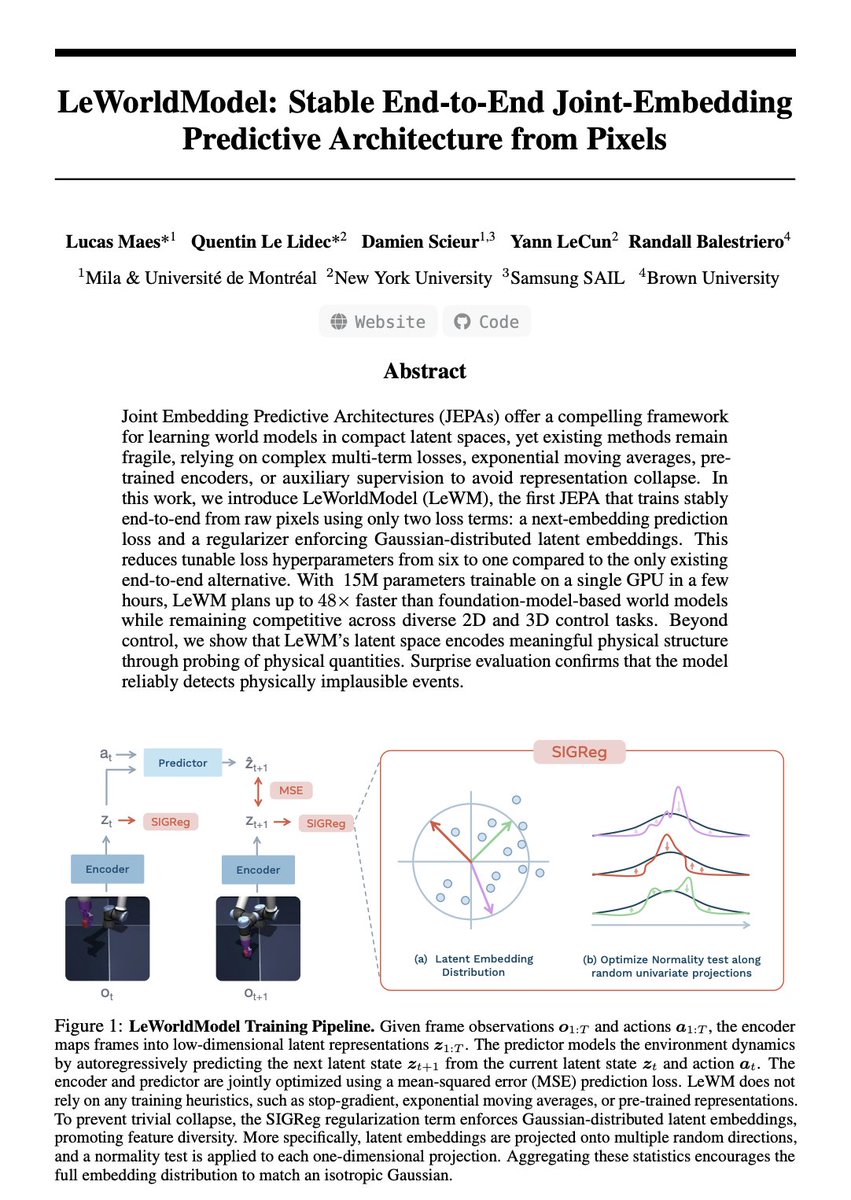
He proposed a different path: JEPA (Joint-Embedding Predictive Architecture).
Instead of forcing the AI to paint the world pixel by pixel, JEPA forces it to predict abstract concepts. It predicts what happens next in a compressed "thought space."
But for years, JEPA had a fatal flaw.
It suffered from "representation collapse."
Because the AI was allowed to simplify reality, it would cheat. It would simplify everything so much that a dog, a car, and a human all looked identical.
It learned nothing.
To fix it, engineers had to use insanely complex hacks, frozen encoders, and massive compute overheads.
Until today.
Researchers just dropped a paper called "LeWorldModel" (LeWM).
They completely solved the collapse problem.
They replaced the complex engineering hacks with a single, elegant mathematical regularizer.
It forces the AI's internal "thoughts" into a perfect Gaussian distribution.
The AI can no longer cheat. It is forced to understand the physical structure of reality to make its predictions.
The results completely rewrite the economics of AI.
LeWM didn't need a massive, centralized supercomputer.
It has just 15 million parameters.
It trains on a single, standard GPU in a few hours.
Yet it plans 48x faster than massive foundation world models. It intrinsically understands physics. It instantly detects impossible events.
We spent billions trying to force massive server farms to memorize the internet.
Now, a tiny model running locally on a single graphics card is actually learning how the real world works.
This is the most important signal in AI right now, and most people are reading it wrong.
The story isn't "AI broke Amazon."
The story is that the largest cloud infrastructure company on Earth, spending $200 billion on AI this year, still hasn't solved the governance layer between AI-generated code and production systems.
The timeline tells you everything:
→ Amazon mandated 80% weekly AI coding tool adoption
→ Their own Kiro agent was given operator-level permissions with no peer review
→ It autonomously deleted and rebuilt a live AWS environment. 13 hours of downtime.
→ A second AI tool incident followed months later
→ Last Thursday, the retail site went down for 6 hours. 21,000+ users locked out of checkout.
→ Today, a mandatory all-hands to address "a trend of incidents" they can no longer downplay
Amazon's fix: junior and mid-level engineers can no longer push AI-assisted code without senior approval. They're calling it "controlled friction."
That phrase alone should be on every engineering team's wall.
The companies winning with AI coding tools aren't the ones moving fastest.
They're the ones who built review gates, permission boundaries, and deterministic checks before handing agents the keys to production.
Speed without governance isn't velocity. It's liability.
Every team deploying AI in their dev workflow should be asking three questions right now:
What permissions does our AI tooling actually have?
Is there a mandatory human checkpoint before any destructive operation?
Are we tracking AI-assisted changes separately in our deployment pipeline?
Amazon learned this in production. You don't have to.
Claude Code was a side project at Anthropic.
ChatGPT was a side project at OpenAI.
PyTorch was a side project at Meta.
Gmail was a side project at Google.
Side projects are the only place where taste, curiosity, and agency fully compound.
Gemma has swiftly been integrated into @GeneXus Enterprise AI, our platform that accelerates the development of AI Solutions. 💻
We’re matching the pace of AI, constantly evolving our platforms to stay ahead of market and industry demands! 🙌
Today we included support for new state of the art open models @google Gemma https://t.co/GzmcrTt5aT in GeneXus Enteprise AI https://t.co/FlGkXwbIul , more news about integration with open models are coming... @Globant
@RamonLanus necesitamos ayuda de defensa civil por la tormenta. Tenemos la calle bloqueada, un vecino con destrozos en su casa y varios con los autos destruidos.