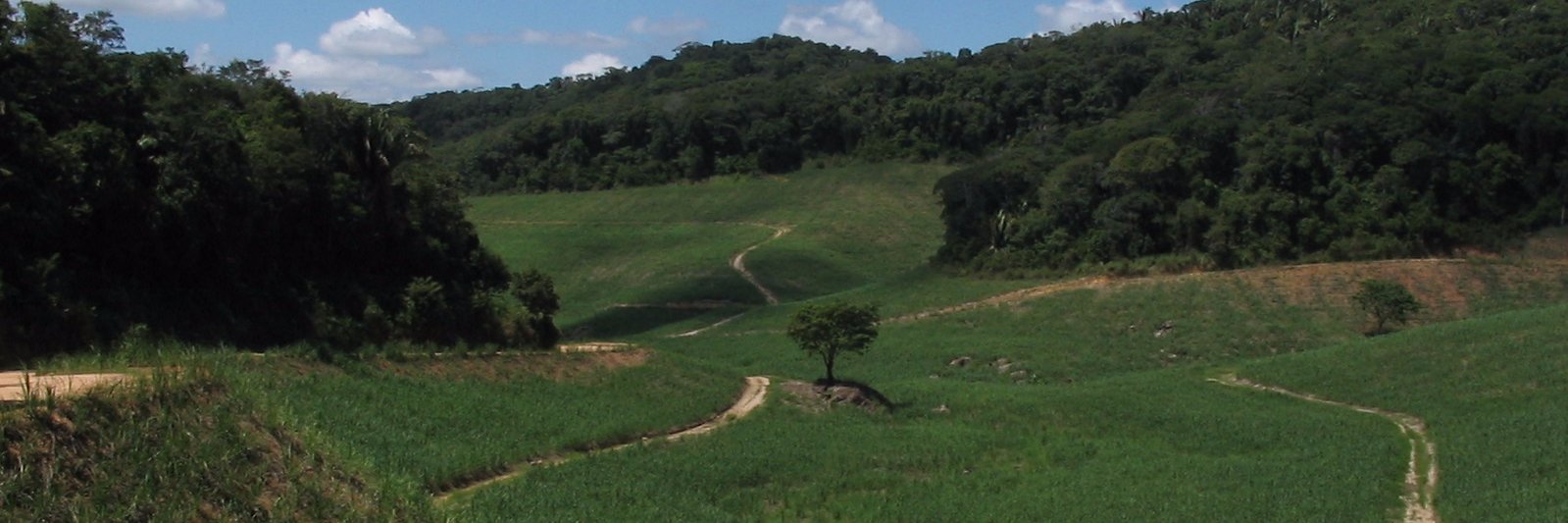
🌍 Earth’s natural carbon sinks are vital for mitigating #ClimateChange.
🌱Did you know soil holds more carbon than you think? Understanding carbon storage in ecosystems is essential for advancing climate action and conservation.
Via @VisualCap
New project to Kick-OFF!
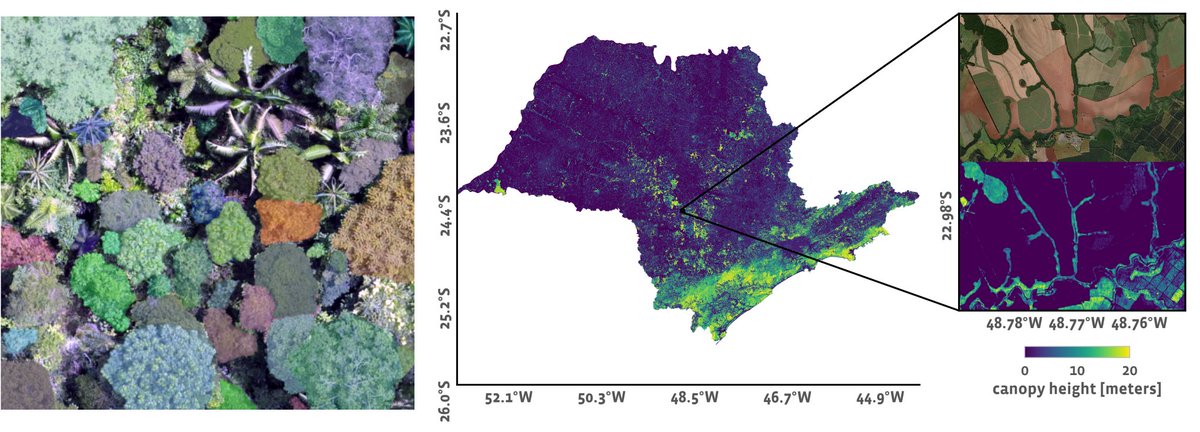
Trait based DGVM + Copernicus data = maps of current, past and future plant above/ belowground functional diversity
this is the VESTA (VEgetation Spatialization of Traits Algorithm) by the ESA Living Planet Fellowship
Poster in https://t.co/HFBgog0GGq
🌳Excited to share our new preprint in which we unravel the intricate eco-evolutionary dynamics of the Amazon Rainforest in response to elevated CO2 concentrations.
👇🏽Expand this thread to dive into our findings!
https://t.co/3L0VfISeWg
Rejection of your paper or grant has NO relevance to the opinion of #research community. It is nothing but the opinion of one person.
Several examples:
1. The first paper on graphene was rejected from Nature because “it did not constitute a sufficient scientific advance”. Later, it was awarded a Nobel prize.
2. The first manuscript showing the microbiome-brain connection was published after 7 submissions that took 3 years. Today, this field has exploded. I expect it will get a Nobel prize in the future.
3. Theodore Maiman tried to publish a paper describing the first operating laser in Physical Review Letters and… got a rejection!
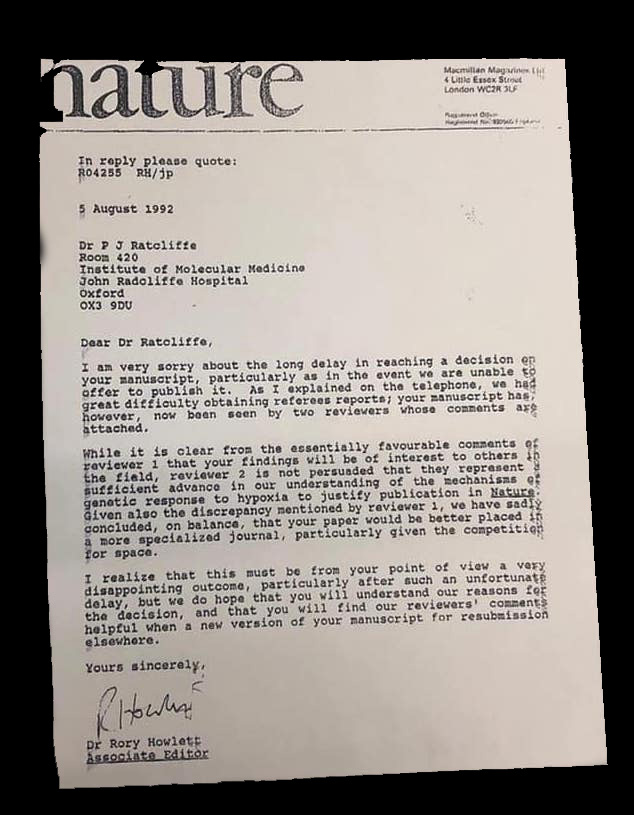
4. Peter Ratcliffe, who worked on cells’ response to changes in oxygen levels, got his key paper rejected from Nature (see photo). Later, he was awarded a Nobel Prize for this work.
And there are many other examples…
.
And yet I see so many young scientists stressing about rejections. For some reason, they seem to genuinely expect that the editors should know which study is truly worth it.
As a result, many rejections are met with surprise and disbelief:
“How could they reject it? They publish so much trash, and yet they think our detailed 3-year-long study is not interesting to the community! WHY?”
.
Well, the reality is:
- Most editors have very little time to delve into your study. They can easily FAIL to recognize the potential impact of your study. Proper communication in the cover letter and clear writing style can help (although only to a limited degree).
- Many reviewers have little idea about the science in your paper. But they can have a big ego. So, if they have a bad day or were rejected recently, it’s easy for them to find 1000 technical reasons to reject your paper as well.
- Most scientists genuinely don’t know if your discovery can make any impact. If we could predict the course of science, we would be living very differently!
My message is simple:
Forget about objectivity. Academia is a very subjective world. Fight for objectivity but don’t take it for granted.
A great study will be found, cited and recognized. Disregard of where it’s published.
A bad study requires a high-impact journal to be found and cited. But the long-time recognition might be a problem.
High-IF journals are simply billboards. Their rejections do NOT represent the opinion of a scientific community.
You can get rejected but don’t reject yourself!
Believe in your results.
#AcademicTwitter #AcademicChatter
1st #LPJ-GUESS vegetation model community meeting this week @lunduniversity Fantastic to have 50 people from across Europe and Aus all together to share ideas, results and future plans. Looking forward to next year already! @becc_sweden
New open-access paper (@agformet). We used optimality principles to verify evapotranspiration fluxes over several major River basins around the world. The kind of study that allowed insightful discussions and partnerships, led by @TanShen13 (@lpicea).
@tomaspueyo 3. The path to (environment?) is (mainly) through a shift in values. first with your personal relationship with all things living, and then with lifestyle changes.
🚨 New @Nature paper led by the incredible @Tavares_JuliaV with an all-star team! 🚨
Basin-wide variation in tree hydraulic safety margins predicts the carbon balance of Amazon forests
Super proud to have Julia currently in our group @PlantEcoEvo_UU!
https://t.co/aj6INOikJu
@tomaspueyo I would say it a little big different in the conclusion, it is not simply that your job is at risk to AI if it is intellectually based, but whether you can claim the results for yourself in your work environment, i.e. do you have a boss which gives you specific tasks?
@tomaspueyo AI is still limited and will be for a long time in two aspects: (1) it solves problems easily, but does not decide the problem to solve. The more you can decide what to do, the more your (intellectual based) job will be safe. (2) It cannot take claim for the results it produces.
AI and #RemoteSensing is moving fast! 🔥
In ~2 weeks @MetaAI released a model that 'Segment Anything' (SAM) (tree segmentation test by @mpferreira3) and the DINOv2 model that estimates forest height from 0.5m satellite imagery (example https://t.co/3GPuzf6lHQ).
What is next? 🤯
Submit an abstract to our session "New methods and applications in trait-based modelling in ecology"
For the European Conference in Ecological Modeling, in Leipzig 4-8 Sept. 2023
Deadline April the 1st!
https://t.co/N6kelkdUWR
Very interesting biotic interactions in modeling conference coming up in Hamburg, organized by Philipp Porada et al. 14-17 May. Abstract submission until March 15th!!!
https://t.co/Q5rx4GJBkJ
Let's dispel any flat-Earth myths.
In this video Carl Sagan explains how Eratosthenes of ancient Greece calculated the circumference of the Earth 2000 years ago.
I included an animation with the math/geometry in the next tweet for those interested. (1/2)