@TheLastNeocon@tracewoodgrains This may be so, but based on exit polls, the midterm voters who chucked Republicans out thought Republicans were better on immigration 45% to 43%, and the ones who identified immigration as an important issue mostly voted Republican.
It’s still a winning issue for Republicans.
@LoeveTristan Partly age.
Partly he hasn't been angling for it.
Partly that he's a straight white male moderate outside the Acela Corridor who hasn't held federal office.
Most D-media types are identitarian Acela Corridor progs. Beshear is young & ambitious & still mostly ignored.
@thegeneralboard Larger ships are pretty much always more efficient at doing most things that they can do at all.
Especially measured in capability per crew member.
@tracewoodgrains Biden had some of the same problem, he promised to build actual infrastructure (including nuclear power) & enforce immigration laws more efficiently and effectively than Trump.
Actual execution on campaign promises is a bit iffy in general.
@tracewoodgrains To be fair, ballot referenda (& issue polling) suggest that outside of tariffs, there’s a lot in the Trump 2024 platform that’s still popular, like not getting stuck in wars in the Middle East.
“Trump 2024 Republican platform but for real” would have been more popular.
@chucktodd I would like to abolish the Electoral College, and I would also like to uncap the House, but uncapping the House would not really fix the core problems with the Electoral College.
The Electoral College does not provide an advantage to small states.
@sleethestak@NateSilver538@MattZeitlin The Framers actually thought the large states would dominate the Electoral College even more thoroughly, which is why the contingent election process in the House uses a “one state, one vote” rule.
(We haven’t had a contingent election since 1824.)
@sleethestak@NateSilver538@MattZeitlin It does the opposite by making large states more important.
Not all large states, just the battleground ones, but the key battleground states are usually 10+ electoral vote states and disproportionately 20+ vote states.
@RobynUrback This is not even the first attempted softball interview the NYT has staged with Hasan Piker.
Ezra Klein has no excuse for not understanding this guy already.
@ImNotOwned His point, which is legit, is that California’s incredibly slow counting means that a close race would not be decided in a timely fashion, which undermines public confidence and creates a period of uncertainty.
@izzybizzy39@StatisticUrban Sanders has made substantial shifts to his politics since 2015.
The pro-gun, tariff-toting, immigration skeptic version of Bernie that was laser focused on economic issues with Joe Rogan and Tulsi Gabbard in his corner was a lot more electable than 2020 Sanders.
@StatisticUrban By raw quantitative fundamentals, Shapiro has a stronger case. (Gov > Sen, PA > GA, slightly stronger election performance.)
That said, the infighting would be even more exciting. I am not convinced the 🇵🇸 fringe of the party will accept Ossoff, much less Shapiro.
@JoeySchmittPhD@JMilesColeman Basically, the big picture should be taken as:
President > other fed exec > state exec > fed legislative > rando.
@JoeySchmittPhD@JMilesColeman Everyone whose most recent office served was VP.
So (1) is no, (2) is yes, (3) is yes, (4) is no.
The VP being more often the president’s handpicked successor vs it usually being a cabinet member earlier means it’s somewhat reasonable to pool with the cabinet, IMO.
@JMilesColeman Lots of small-n tea leaf reading there.
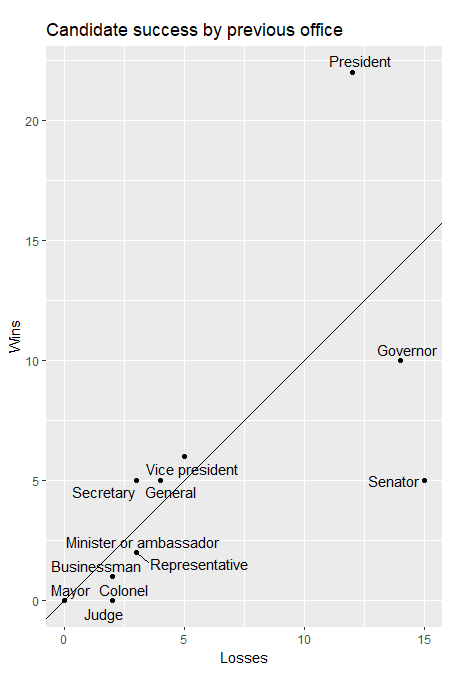
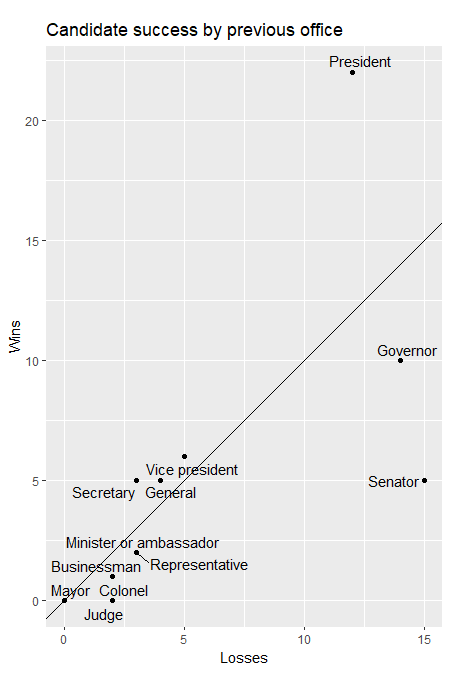
VPs (or more appropriately “member of previous administration other than president”) are slightly over 50%.
Governors are 42%, senators are 25%.
@NateSilver538 Eh, last office being VP actually does pretty well. I plotted this out in 2019, since then we’ve had 1 VP win and 1 VP loss (7-6 W-L).
VPs (or previous non-pres exec office in general) are just over 50% overall.
Governors clock in at 42%, senators clock in at 25%.