Stupid things I did:
1. 250,000+ pages was a joke guys!, I find big number extremely hilarious. I tried to make it clear by the level of pedantry of the reals total ordered statement in the main theorem, but people ran with it unfortunately and I didn’t feel like talking on social media in the days after the announcement, though I did have a good time with the memes. Sorry!!! (Similarly with our YM4 existence I found it extremely funny that we were slowly working through 60,000 pages of slop, though the committee asking for Lean made me feel dumb about wasting our time with that. But 60,000 funny.) Tao advises to not joke in papers, see also the Big Lebowski reference I shoehorned, I now understand why… I didn’t feel comfortable having any slop writeup attached to this problem, and I figured I can’t produce anything readable anyway, so I went off the Lean to lengthmaxx.
2. The Lean is full of garbage obviously, but compiles, but all criticism of such garbage is totally reasonable and accepted, I should have cleaned it up but it was randomly difficult to for various strange reasons. Mea culpa…
3. @scottnarmstrong clocked me, indeed even as a student there were theorems that took me the better part of a decade to write up, but with this one I should hopefully be more responsible. (I really was yoloing a lot in there, I bet most is unnecessary in the end, admittedly the lazy thing to do would be to wait because it’ll simplify massively…)
4. I forgot to emphasize what I think is the point. Arguments like these, cool, but they are the raw inputs when interpolating definitions. We don’t have the / an “H^1 object” over number fields, and probably for a layperson the fact that we fight hard for these arguments for the purpose of definitions is not clear a priori (that’s at least my philosophy). Just like I knew I must fight for an utterly simple Weil / Deligne, I feel Riemann should be easy, and any real difficulty is an indication our setup is just dumb at the moment.
The Lean FRO and Mathlib Initiative have released a joint statement on the Lean verification of the Riemann Hypothesis.
On November 20, Levent Alpöge released a proof of the Riemann Hypothesis as a Lean library of 17 million lines of code. Over the past day, the Lean and Mathlib communities worked together to verify it. The statement certifies the proof as correct and describes how it meets all necessary verification criteria.
Congratulations to Levent on this achievement, and thank you to everyone in the community who contributed to the verification.
Full statement: https://t.co/edxEbkodw7
This was a rumor for many years. Nobody has ever seen the alleged proof of Generalized Riemann Hypothesis by Alessandro Masullo, a former PhD student of Brian Conrad. Brian Conrad, a top brass mathematician from Stanford was reading this raw draft for many months. This is a very difficult piece of text. There are many empty sections, gaps in the text but the mammoth is 940 pages. Maybe (!) this combined with the proof of RH announcened today could lead to the resolution of the GRH. That would be an epic triumph of the human intelect. My beloved arithmetic geometry is a key tool in all of this. Mathematics is one and this is another beautiful example. Once again, an attempt but very serious at GRH. What a time to be alive!
Amerikan Matematik Derneği başkanı Ravi Vakil, Alessandro Masullo isimli bir matematikçinin bir kaç ay önce Genelleştirilmiş Riemann Hipotezine 940 sayfalık bir çözüm önerdiğini paylaştı. Bir süredir çözümü inceleniyormuş. Hiç yapay zeka kullanılmamış.
https://t.co/uKkzhF7ZgU
Here is a Human readable version of Anthropic’s Levent Alpöge's Reimann Hypothesis solution. So far he has only released a rough sketch and a 17,400,000 line long Lean formalization.
Therefore I’m posting this human readable version based version built using his Lean proof. https://t.co/GS1fYHy4Tc
Develop your powers to think mathematically and to bring mathematics into all the right places.
Get "Thinking Mathematically" at https://t.co/wU5qiYiu1i
+
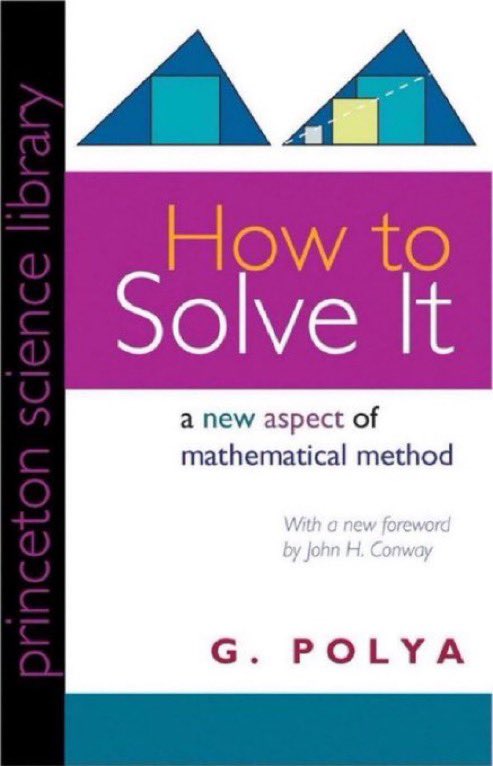
See also “How to Solve It: A New Aspect of Mathematical Method" at https://t.co/1z0yJikZXG
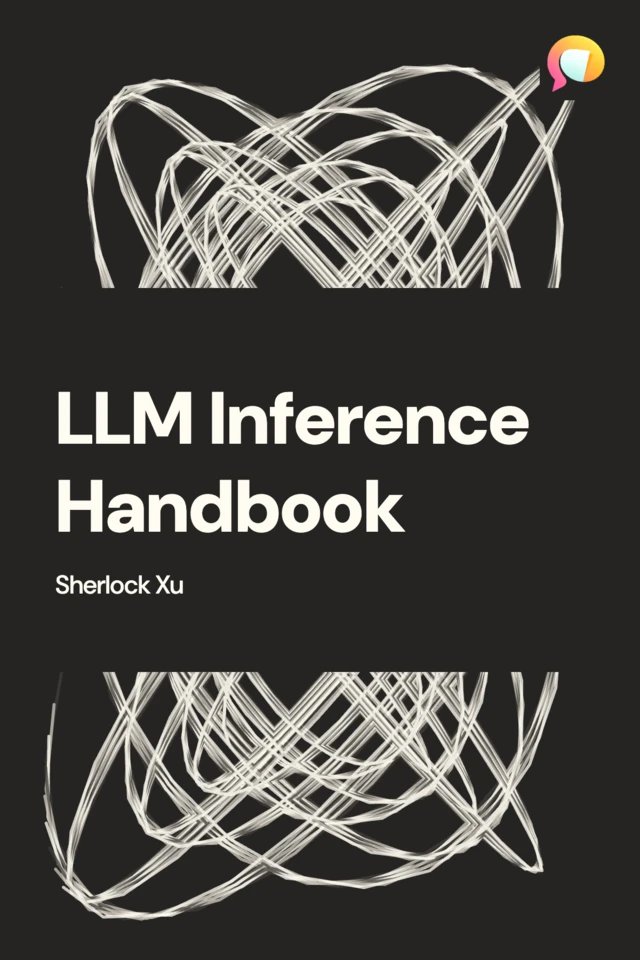
A free online book: LLM Inference Handbook by Sherlock Xu (2026).
This book is a practical technical reference for engineers deploying, scaling, and operating language models in production.
It brings together the concepts and decisions involved in turning a trained model into a responsive, cost-aware service, from model behavior and hardware selection to application interfaces and ongoing operations.
Readers can use it as a guided progression or as a lookup resource for specific engineering questions.
Read the book online on @ChapterPal: https://t.co/U1m25cuF5q
What have we learned from formalizing CFSG and the Stacks Project—and what math opens up next? This Wednesday at Harvard: surprises from both projects and reasons for optimism for working mathematicians. 4:30 pm ET. Zoom link in reply. @axiommathai@leanprover@HarvardCMSA
We’re expanding free access to our frontier models for up to 200,000 scientists worldwide, with training and support.
Applications open Nov. 23. By default, we don’t use data shared through the program to train our models.
https://t.co/eJwqO9Q2WG
I wrote a 4000-words long article about all the graph theory you need to know for machine learning.
Trust me, you want to bookmark this: https://t.co/gywRkHbcNL
The first major improvement to k-means since k-means.
The paper introduces e-means, a mini-batch clustering method that reaches a lower loss than Lloyd’s k-means in a fraction of the epochs, with scaling rules that avoid hyperparameter sweeps and enable 10–45× GPU speedups on datasets as large as 10 billion embeddings.
Read the paper online: https://t.co/BNTeT2Zia3
A free online book The Science of Computing by Victor Eijkhout, Edmond Chow, and Robert van de Geijn (2022).
The book is aimed at readers studying computational methods and high-performance computing.
The material connects mathematical models, numerical methods, and the performance of computer programs. It introduces partial differential equations through physical examples involving heat flow, distinguishing time-dependent behavior from steady states and relating these models to boundary-value problems.
Taylor series supplies a mathematical tool for approximating functions and reasoning about the accuracy of numerical methods.
Later project work shifts attention to computer memory: readers simulate caches, examine the hit-and-miss behavior of code, and investigate why growing differences between processor and memory speeds affect performance.
The book’s approach combines mathematical explanation with practical investigation. It motivates equations from physical processes, presents a theorem and its error term as a basis for understanding approximations, and assigns projects that require simulation, analysis, or literature research.
Read the book online on @ChapterPal: https://t.co/LXpq7vgc2C
Learn the math behind robots by playing with it
1. Linear algebra
https://t.co/TjOeVl0DHo
2. Probability & Bayes
https://t.co/YcxaXhop4x
3. Markov chains
https://t.co/qqAld0vHmc
4. Kalman filters
https://t.co/sUdZH1vor8
5. Path planning (A*)
https://t.co/HrxsvFxtUV
6. Signals (Fourier transforms)
https://t.co/OevtBZsEBS
7. Optimization (gradient descent with momentum)
https://t.co/e6EI19EzzB
8. Reinforcement learning, by Andrej Karpathy
https://t.co/n63sRGP8QM
9. Transformers
https://t.co/8jm8oh08eA
10. Diffusion
https://t.co/EGbK4Jn9bf
P.S. the last two are the exact math inside π0 and GR00T: a transformer that understands the scene, and a diffusion-style head that turns noise into arm motion. the article below shows how
“Nonnegative Matrix Factorization” (NMF)
Get the book: https://t.co/oNX47MiJd5
NMF has played a significant role in machine learning applications: https://t.co/sBSYqWpEDD
Learn about the book: https://t.co/vyhm5VVNZF
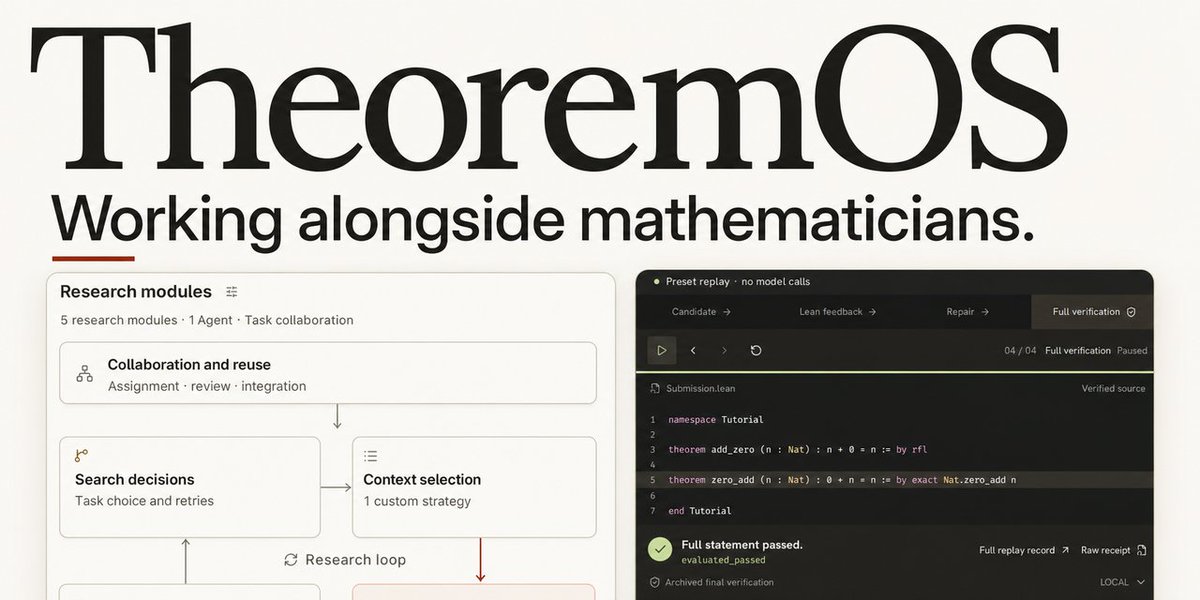
https://t.co/uLVrfPUgi9 TheoremOS is an AI collaborative research system built to work alongside mathematicians on challenging proofs. You pose problems in natural language, TeX, or Lean 4, review formalized statements, and guide high-level strategy; within your compute budget...