India will never produce an NVIDIA, and it has nothing to do with talent. R&D is the purest form of investment, and the central bank has spent decades making investment the dumbest thing you can do with a rupee.
I've been surfing the semiconductor wave for a while now, reading 10-Ks for fun. Spent last month in the Bay Area and the gap between India and the US is not a gap; it's a different universe. Conversations about agentic AI and the next decade of hardware, with my boomer relatives Waymo-ing around SF and self-driving home on Tesla FSD like it's normal. Nobody there thinks any of this is remarkable; they already live in the future.
NVIDIA spends nearly twice as much on R&D as every listed company in India combined. Silicon Motion, the world's leading maker of NAND flash controllers and around since 1995, ploughs 29.7% of revenue back into R&D. Micron runs 10.2%, NVIDIA 9.9%, on revenue bases that dwarf anything we have. India Inc? 0.85% of turnover, and half our listed companies report zero R&D at all.
The easy move is to lambast our promoters and the dhandomaxxing capitalist class, or the foreign MNCs running India as a glorified offshoring unit, or the babus who fund nothing useful. Satisfying. But Wrong. The reason no rational Indian founder pours money into frontier R&D is that there is genuinely no payoff at the end of it. Why?
1. R&D compounds, and compounding punishes laggards. At the edge of science a 1-2% gain is a moat; Intel spent 20+ years performing impossible physics every 24 months because Moore's Law was the business model, and that consistency makes them one of the goated companies of all time even after they got mogged recently. NVIDIA lives the same way today: invent at the limit or cease to exist. If you're 50% behind, no quantum of innovation closes that. You never touch the high end. You stay a mass-market producer of things that already exist. India is precisely there.
2. The supply side is the real thesis, and it's monetary. Two decades of high inflation, high money-printing, high nominal rates. That regime subsidises consumption and taxes patience. R&D is the longest-duration, highest-variance bet on the board; it is the first thing a 8% risk-free rate kills. Frontier R&D only ever gets funded two ways: a psychopathically risk-tolerant capitalist with cheap capital, or a state with Stalin-grade control. The USSR took agrarian peasants to the first man in space in 20 years; China built its own version. India has neither the state capacity, the political will, nor the balance sheet to do that. So nobody does it.
Talent was never the bottleneck. Capital structure was. If you want a SpaceX or a TSMC born here, you need an environment where a conglomerate can deploy $10B and sleep at night: a low-rate regime that makes long-duration investment rational, IP and patent courts that actually function, and policy that doesn't get rewritten every 2-3 years on a minister's whim. Stability is the input. Innovation is the output.
Bay Area versus Bombay, we are several universes apart, and you cannot print your way across that distance; you can only compound your way there, and we've spent years optimising for the opposite. The gap won't be bridged. With luck, it narrows.
CBSE received two bids to digitise 99 lakh student answer sheets. One quoted 65 rupees per sheet. The other quoted 24 rupees. The government gave the contract to the 24 rupee bidder. What happened next should surprise nobody.
Students opened their re-evaluation requests and found answer sheets that were not theirs. Unfamiliar handwriting. Missing pages. Another student's answers sitting inside their file. For kids whose college admissions depended on these marks, this was not a technical glitch. It was a life-altering crisis caused entirely by a procurement decision made on a spreadsheet.
The technology was not the problem. The system that chose the cheapest vendor regardless of capability was.
Before CBSE even awarded this contract, the board had already quietly revised its technical standards downward twice. Minimum scan resolution dropped from 300 DPI to 200 DPI. Robotic scanning removed as a mandatory requirement. The bar was lowered specifically so cheaper bidders could qualify. Then the cheapest qualifying bidder won. That is not how you protect 99 lakh student futures. That is how you manufacture a crisis.
Nobody asked the only question that mattered. How does one vendor do this work for 24 rupees when another vendor needs 65 rupees for the same job. The answer was always obvious. It does it badly.
Then came the server crashes. The login errors. The payment failures on the re-evaluation portal. The blurred scans. The cybersecurity vulnerability flagged publicly on a connected system. Every failure compounding the one before it.
This is not a CBSE story. This is India's L1 procurement system on display. Lowest bidder wins. Every time. Across defence contracts. Infrastructure projects. Health systems. Education. The number on the bid matters. The capability behind it does not.
The result is predictable and it repeats itself with different names and different ministries on a cycle so regular it barely registers as news anymore.
CBSE should have piloted this in one zone first. Should have assessed whether a company quoting 62 percent below the next bidder could actually execute at this scale. Should have asked why Coempt Edu Teck, formerly Globarena Technologies, faced scrutiny in the 2019 Telangana Intermediate Exam controversy before handing it 99 lakh answer sheets.
It did none of those things because the system does not reward those questions. It rewards the lowest number.
The students did not fail this exam. The procurement system failed the students.
And until India has the courage to fix the L1 bidding logic, the next version of this scandal is already being contracted right now at the cheapest possible price.
Indian Economic Policy is like the peeling of an onion - you peel a layer, and you cry; you peel another layer , and you cry some more. The attached BITs story reveals the power of the bureaucracy, and its complete lack of accountability and censorship of its actions - they are the onion.
https://t.co/9oyWAr3JfG
They are important actors of the non-transparent (by definition!) Deep State. Governments are censured by the people. Senior bureaucrats (IAS and IFS) enact policy that persists against national interest, that survives changes of government, that protects institutional actors over citizens and the economy — The Deep State in practice.
The biggest deterrent to doing a PhD in India is Indian faculty members. They treat their students like slaves and PhDs drag on for years and years. Things have improved considerably but the absolute quality is just terrible. And this IITs and IISc that I am opining on. Other universities are just a filthy cesspool of mediocrity. Please don't point to the odd exception. Every swamp has a couple of lotuses.
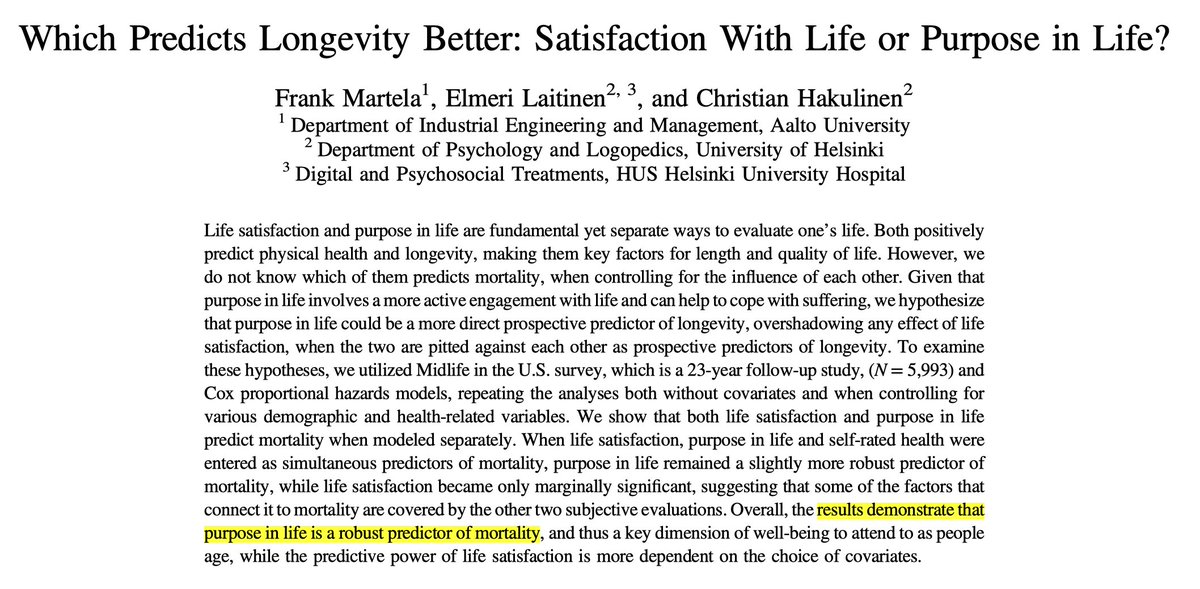
Purpose in life predicts longevity better than life satisfaction
Why? Purpose leads to:
- Active engagement vs. passive contentment
- Resilience during stress
- Meaningful activity and self-worth
तुलसीदास की वो एक लाइन जो ज़िंदगी बदल दे
हम वही दुनिया देखते हैं जो हमारे अंदर चल रही होती है।
गोस्वामी तुलसीदास ने रामचरितमानस में लिखा
“जाकी रही भावना जैसी। प्रभु मूरत तिन देखी तैसी॥”
मतलब, भगवान (या दुनिया) वैसा नहीं दिखता जैसा वो है,
वो वैसा दिखता है जैसी हमारी भावना होती है।
अगर मन में डर है, तो हर अवसर खतरा लगता है ।
अगर मन में विश्वास है, तो हर मुश्किल में रास्ता दिखता है ।
दो लोग एक ही mock test में fail हो सकते हैं एक कहता है , “मैं तो बना ही नहीं इसके लिए।”
दूसरा सोचता है , “कमी पता लग गई, ऐन इसे ठीक करता हूँ success के लिए ।”
फर्क दुनिया में नहीं, lens में है।
कभी-कभी जवाब कहीं बाहर नहीं, आपके perspective , आपके दृष्टिकोण में छुपा है।
दोस्तों Lens बदलो… Game बदल जाता है 🙏😊