In case you missed it the first time, we @Denis_V_Titov updated our preprint! We show that E. coli, yeast, and mammalian cells exhibit Warburg Effect-like metabolism as a result of faster ATP production from glycolysis in the finite space of the cell.
https://t.co/E7TyZSe4GW
Does every enhancer work with every promoter?
With @jengreitz and @WJGreenleaf, we revisit this long-debated question and resolve an outstanding contradiction in the field.
A tour 🧵👇
https://t.co/iFzqPqKzhN
My lab is looking to recruit postdoctoral scholars over multiple projects including combinatorial expression perturbations for cell state engineering, and modeling and perturbing human tissue development with tractable human organoid systems (primarily heart and brain)
Congrats to @juliaschaepe and @marklundem on the recent publication of their work linking the binding behaviors of TFs in vitro and in vivo! Out in Cell now: https://t.co/pF3H6EIX9b
1/ 🧵Happy to share our preprint from @WJGreenleaf’s Lab: beCasKAS, our method to directly detect #CRISPR base editor off-targets in primary cells. We additionally show how non-coding edits can be triaged for epigenetic dysregulation using deep learning.
https://t.co/i7eHqKXrje
Excited to share our new preprint led by PhD student Alex Ekvik reporting a genetically encoded tool for manipulation of ATP/ADP ratio in human cells that we called ATPGobble. A 🧵... (1/6) https://t.co/eUIjVFmfDp
An elegant model:
- TF binding events on nucleosome-free DNA are independent.
- Yet, the activation domains of TFs recruit cofactors that destabilize nucleosomes, resulting in cooperative TF binding.
- Average TF occupancy linearly determines promoter activity
Excited to share our lab's new paper led by @ChoeMangyu where we co-opt UCP as a genetically encoded tool for manipulation of mitochondrial membrane potential. We use this to demonstrate that high ΔΨm drives integrative stress response in response ATP synthase inhibition... 1/2
New preprint from our lab showing that calorie restriction extends lifespan by inhibiting vitellogenesis. Awesome collaboration with @airstreets lab led by Bowen Yang, Bryce Manifold and Leon Han. A 🧵... 1/n https://t.co/2GJFSsBlN3
A new study led by @mattabolite and @BerkeleyMetBio professor @Denis_V_Titov provides compelling insight into why cancer cells choose a seemingly inefficient way of producing energy, even when higher-yielding alternatives are available.
https://t.co/UH5CJZ8wwM
Excited to share our new paper led by @mattabolite in collaboration with Saharon Rosset showing that the Warburg Effect is the result of faster ATP production by glycolysis than respiration. A 🧵... 1/n https://t.co/m32QAaK4i0
New preprint w/ @apsarruda! Tour de force from grad student extraordinaire @alymathiowetz! >20 CRISPR screens enabled the discovery of a key role for CLCC1 in hepatic neutral lipid flux and nuclear pore complex assembly. Many surprises! #LipidDroplets 1/3 https://t.co/Z5iJioxk1l
New preprint from our lab led by @ChoeMangyu where we develop a genetically encoded tool for manipulation of ΔΨm and use it to show that uncouplers have major side effects and ISR in response to ATP synthase dysfunction is driven by ΔΨm. A 🧵... 1/8 https://t.co/RpNCqSgdn8
Excited to share updated preprint by @ChoeMangyu showing that, contrary to textbook view, the role of allosteric regulation of glycolysis is not to control rate but to maintain ATP levels by preventing a futile cycle between upper and lower glycolysis. 🧵https://t.co/gofGtCvwu7
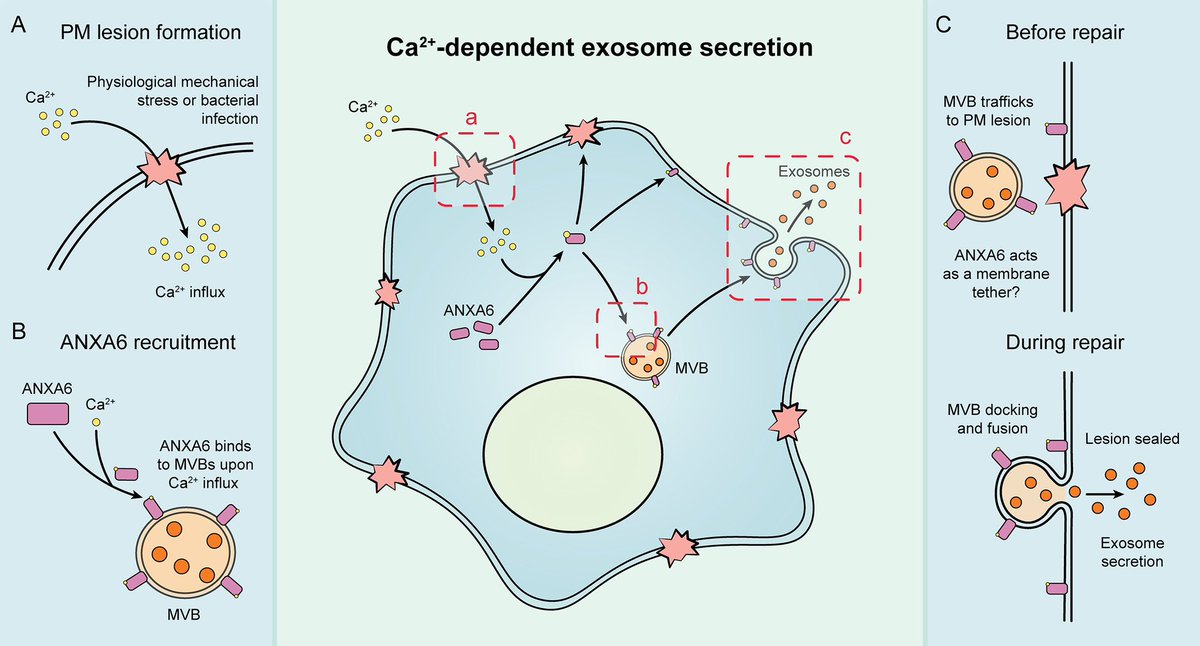
A late update, but mine and Justin’s paper was published in @eLife last month! We show, in both intact and permeabilized cells, that calcium influx upon plasma membrane wounding triggers #exosome secretion and that this process is mediated by Annexin A6!
https://t.co/xDczemzhNd
Rejection of your paper or grant has NO relevance to the opinion of #research community. It is nothing but the opinion of one person.
Several examples:
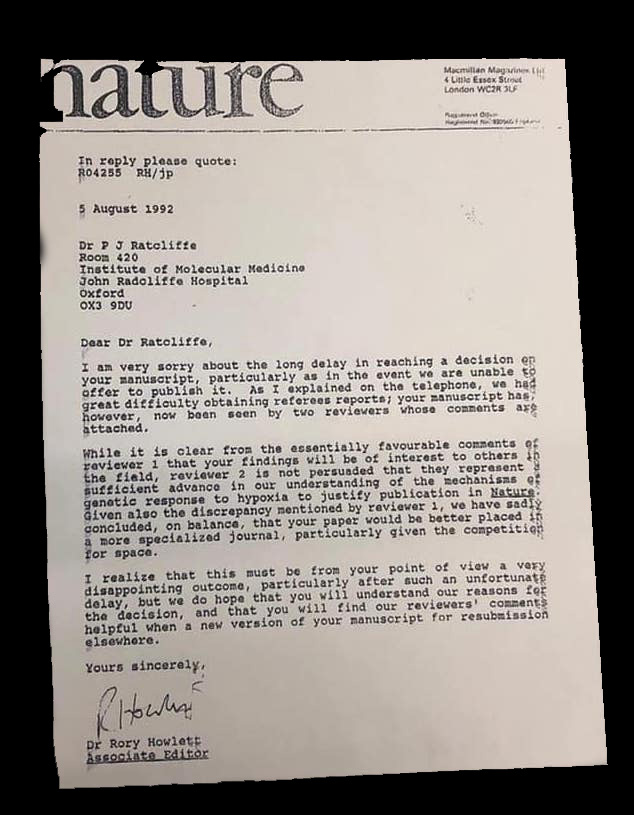
1. The first paper on graphene was rejected from Nature because “it did not constitute a sufficient scientific advance”. Later, it was awarded a Nobel prize.
2. The first manuscript showing the microbiome-brain connection was published after 7 submissions that took 3 years. Today, this field has exploded. I expect it will get a Nobel prize in the future.
3. Theodore Maiman tried to publish a paper describing the first operating laser in Physical Review Letters and… got a rejection!
4. Peter Ratcliffe, who worked on cells’ response to changes in oxygen levels, got his key paper rejected from Nature (see photo). Later, he was awarded a Nobel Prize for this work.
And there are many other examples…
.
And yet I see so many young scientists stressing about rejections. For some reason, they seem to genuinely expect that the editors should know which study is truly worth it.
As a result, many rejections are met with surprise and disbelief:
“How could they reject it? They publish so much trash, and yet they think our detailed 3-year-long study is not interesting to the community! WHY?”
.
Well, the reality is:
- Most editors have very little time to delve into your study. They can easily FAIL to recognize the potential impact of your study. Proper communication in the cover letter and clear writing style can help (although only to a limited degree).
- Many reviewers have little idea about the science in your paper. But they can have a big ego. So, if they have a bad day or were rejected recently, it’s easy for them to find 1000 technical reasons to reject your paper as well.
- Most scientists genuinely don’t know if your discovery can make any impact. If we could predict the course of science, we would be living very differently!
My message is simple:
Forget about objectivity. Academia is a very subjective world. Fight for objectivity but don’t take it for granted.
A great study will be found, cited and recognized. Disregard of where it’s published.
A bad study requires a high-impact journal to be found and cited. But the long-time recognition might be a problem.
High-IF journals are simply billboards. Their rejections do NOT represent the opinion of a scientific community.
You can get rejected but don’t reject yourself!
Believe in your results.
#AcademicTwitter #AcademicChatter
Excited to share a new preprint from our lab led by @berkeleyMCB student @mattabolite where we propose and test a unifying hypothesis for the occurrence of Warburg Effect-like metabolism in E. coli, yeast and mammalian cells. A very long 🧵... (1/n) https://t.co/5aiy5wEyWd
In case you missed it the first time, we @Denis_V_Titov updated our preprint! We show that E. coli, yeast, and mammalian cells exhibit Warburg Effect-like metabolism as a result of faster ATP production from glycolysis in the finite space of the cell.
https://t.co/E7TyZSe4GW
Specifically, we show that glycolysis produces ATP faster per gram of pathway protein than respiration in all three organisms. With limited space, cells resort to the lower yielding pathway to increase the ATP production rate when glucose is abundant.