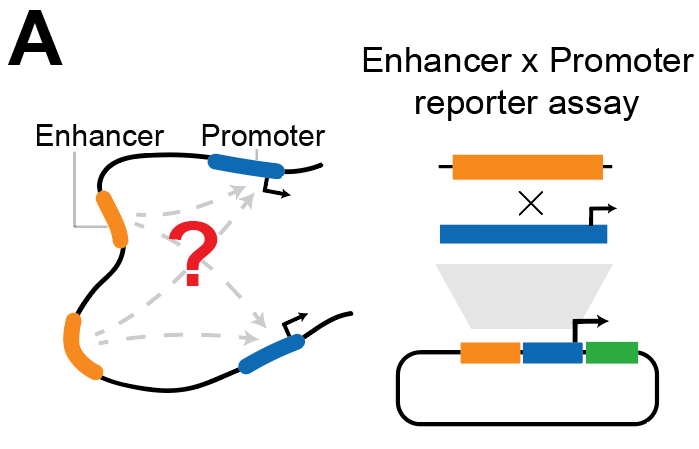
Does every enhancer work with every promoter?
With @jengreitz and @WJGreenleaf, we revisit this long-debated question and resolve an outstanding contradiction in the field.
A tour 🧵👇
https://t.co/iFzqPqKzhN
I used to think scientists argued about great truths. Now I’m a scientist.
My team recently spent 40 minutes arguing about what to name our new algorithm.
Beautiful study - congrats! Excited to see direct experimental evidence for intrinsic promoter responsiveness. I like how the motif-level patterns connect with our promoter responsiveness/selectivity analysis from Puffin.
@BorisLenhard@anshulkundaje Could not agree more on the need to study promoter 'customizations' more!
I prev (naively) thought that the core promoter is a "passive" entity. But that clearly obfuscates so much unexpected gene reg. Cool examples in ur study and https://t.co/RoPOiE1hst
@anshulkundaje@yxjtan Absolutely. There is a superposition of discrete promoter architectures, physical overlap of multiple architectures (e.g. https://t.co/dsk2j65WPl ) and evolutionary promoter-specific customisations, which need to be pried apart, and this paper is a great step in that direction.
@zhou_jian Fig4 of Dudnyk et al was very inspiring in the early stages of this analysis, and it was affirming when our data showed similar patterns!
Would love to connect on future ideas for understanding prom. architecture with seq mutagenesis in silico and with MPRA
Great experience compiling years of collective screening experience to produce what we hope is a comprehensive protocol for others to accessibly scale up experiments! And some fun new data hidden in there :) thanks @JoshTycko for being better and faster at Twitter than me 🎉
This was all made possible by @JudhajeetR, @mayayayas, @bgrdoughty and my advisors who supported me down this rabbit hole.
We look forward to your feedback! We’re excited to further explore possible mechanisms of responsiveness and incorporate it into more predictive modeling.🛑
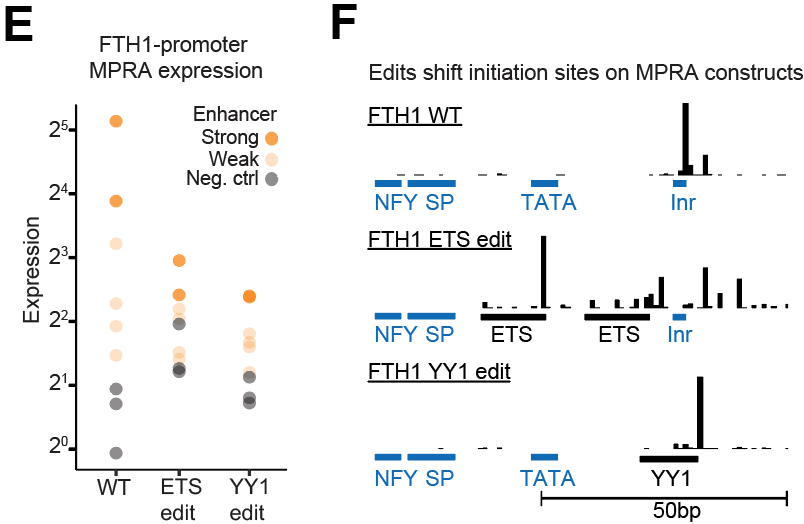
Editing these motifs modulates promoter responsiveness to produce a non-intuitive effect:
basal activity increases but maximum output decreases!
Edits also redistribute TSSs, implicating recruitment or assembly of the PIC as possible mechanisms to mediate responsiveness.
Finally, how is responsiveness encoded? Most promoters lack classical “core promoter motifs” yet vary in responsiveness.
With ProCapNet from @kellycochra and @anshulkundaje, we nominate several sequence motifs in the core promoter associated with differential responsiveness.
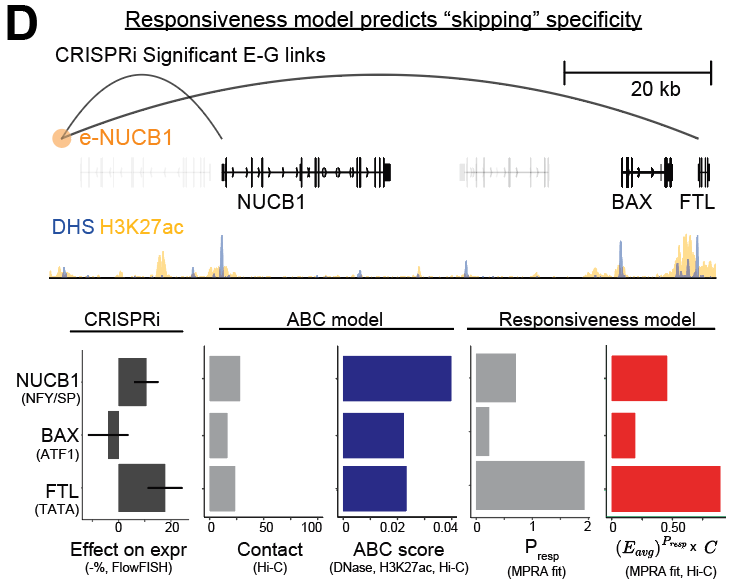
Genes with responsive promoters are regulated by more enhancers and sensitive to their perturbation.
Genes with non-responsive promoters (many housekeeping genes) are insensitive to and skipped by enhancers.
Incorporating responsiveness into the Activity-by-Contact model improves prediction of native regulation and explains 2 long-observed phenomena:
1) Why are housekeeping genes often insensitive to distal enhancers?
2) How do enhancers skip active genes?
We find that promoters differ dramatically in their intrinsic capacity to be activated by *any* enhancer (>100-fold vs 1.1-fold) -- from highly- to effectively non-activatable!
Promoter responsiveness scales the magnitude of activation while enhancer rank-order stays similar.
To cleanly re-assess E-P compatibility, we develop improved assays and apply them across >25,000 E-P pairs, including 7 endogenous loci supported by previous CRISPR tiling experiments.
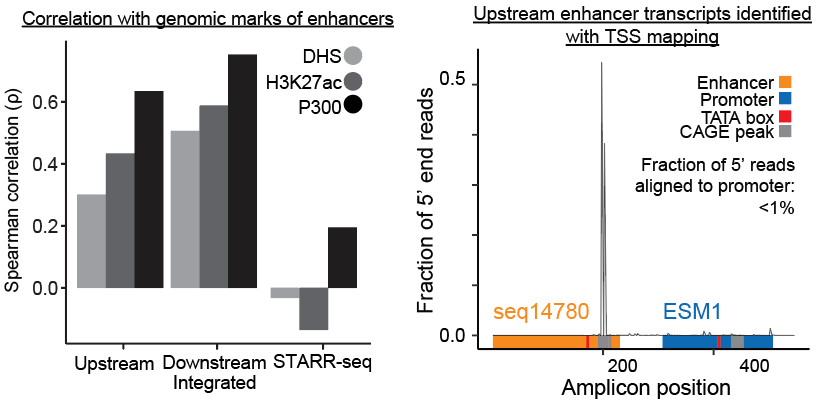
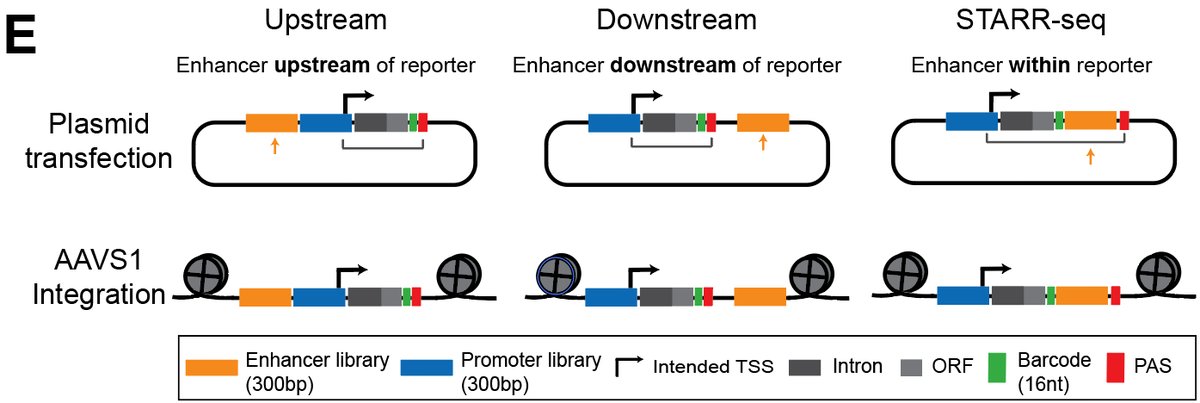
Surprisingly, confounders in widely used upstream and STARR-seq designs distort measurements of enhancer activity and lead to contradictory conclusions about E-P compatibility!
Enhancer-promoter (E-P) wiring is complex and hard to predict.
Decoding the underlying factors is essential for interpreting human genetic variants, modeling gene regulation, and designing gene therapies.
Prior studies used different reporter designs. After some tinkering, we began to suspect two variables were confounding results; so, we compared 6 designs head-to-head.
Do the same E-P pairs give different results in different assays?
Does E-P compatibility play a role? We and others have used massively parallel reporter assays (MPRAs) to test thousands of combinations.
Yet, findings have ranged widely — from enhancers activating all promoters equally to highly specific activation of select promoters.
Does every enhancer work with every promoter?
With @jengreitz and @WJGreenleaf, we revisit this long-debated question and resolve an outstanding contradiction in the field.
A tour 🧵👇
https://t.co/iFzqPqKzhN
1/ 🧵Happy to share our preprint from @WJGreenleaf’s Lab: beCasKAS, our method to directly detect #CRISPR base editor off-targets in primary cells. We additionally show how non-coding edits can be triaged for epigenetic dysregulation using deep learning.
https://t.co/i7eHqKXrje