Husband. Father. UnionElectrician. Catholic. Capitalist. Tesla Fan. Tesla SolarRoof Certified Installer. I tweet about EVs, Future Technologies, and Electrical.
$OPEN is going to cut the banks out of the middle of real estate deals. People only keep mortgages for a handful of years and the majority of each of those payments is interest. This function will be gone after real estate is tokenized. This will mean that regular people can get exposure to the real estate market via purchasing real estate tokens and then realize a monthly yield while watching their equity grow at the same time. No debt to service. I don’t think people understand how much this is going to change things. Potentially, I can see this fixing the housing shortage issue, construction will boom due to increased liquidity. It will also lower rents, because the roi on the deal, from the landlords point of view, is dramatically changed when you remove debt/interest from the equation. I’m so excited for the future.
@rabois@nejatian@morganb
@blueorigin@NASA This contract will be worthless because there will already be thousands of starlink satellites in Mars orbit before blue origin launches their first mission.
BREAKING: 𝕏 reveals it uncovered a Chinese bot farm of roughly 200,000 accounts, including hundreds used to influence U.S. debate over AI data centers & energy policy.
Introducing Starbase, Louisiana – a high-cadence launch site that will enable Starship to open a pathway to the stars for humanity.
Thank you to @LAGovJeffLandry and the great people of Louisiana for all of their support as we work together on this audacious project → https://t.co/zGKVOGSxfW
There shouldn’t be any voltage drop at 8 ft of distance. The wire size should be 6awg or 4awg, copper. You might check that if you’re still curious.
Is your power utility meter near the main panel? If no, how far is that? If yes, you should call your power company and let them know that your voltage got below 200V, they may need to check on their transformer (may be overloaded).
@rj_crafts@SparkPlugEV Is your charger a long ways from the electrical panel. It’s probably voltage drop due to undersized circuit wiring to the charger.
MY DATA CENTER POLICY PLEDGE: OHIOANS-FIRST
A top concern I hear from Ohioans across our state – second only to property taxes – is the accelerating pace of data center expansion. Key citizen concerns about data centers include rising electric bills, noise, pollution, and the absence of clearly defined economic benefits for Ohio families. The data center industry has badly failed to earn the trust of millions of everyday Ohioans who are struggling with electric bills and property taxes, wondering why large corporations receive property tax abatements while ordinary homeowners don’t receive the same.
There are hundreds of data centers already across our state, and the pace of construction is accelerating. While I had no part in these past projects, I am committed to ensuring our policies catch up to current realities. Despite my opponents’ claims, I’m not “pro-data center.” I’m pro-Ohio, and I have a plan to fix the problem.
At the same time, I also hear from Ohio's workers about the need to attract high-paying construction jobs to our state, for which the data center boom has been helpful. Preserving economic growth, capital investment, and high-paying jobs in Ohio is also a vital objective.
After traveling all 88 counties and listening to workers, farmers, union leaders, building trades, small business owners, environmental groups, and grassroots activists, I am convinced that the best path forward is neither unrestrained data center growth nor a permanent categorical ban. The right answer is a policy framework that allows Ohio families to prosper economically while protecting local communities.
Today I am announcing my policy pledge to Ohioans on data centers. If a data center is built in your community, then (i) you will no longer have to pay for your home’s electricity, (ii) you will pay lower property taxes, and (iii) the data center will be required to abide by all air and water quality standards without exception, and we will take the necessary steps to protect Ohio’s fertile farmland. If any one of these three conditions is not met, the data center won’t be built. Period. I will work with Ohio’s state legislature to codify these commitments into law immediately after I assume office.
To ensure urgency, I will further issue an executive order on my first day in office to immediately halt the approval of any new data center project announcements in Ohio, until the above-mentioned data center legislation takes effect. These policy objectives are consistent with the principles I have articulated over the first 18 months of my campaign, and today I am making a legislative commitment to codify them into state law.
My Democrat opponent recently announced that data centers must not contribute to higher electric bills for ratepayers, a concept that I advocated for in early 2025 long before she started parroting the same. This is obvious but insufficient. We can and must go further for Ohio families.
Eliminating electricity costs is the right objective. If Ohio’s governor sets this as a clear requirement and negotiates accordingly, I am confident that hyper scalers would be willing to fully cover the cost of power for Ohioans who reside near a data center. That requires the acumen of a businessman, not a bureaucrat, at the top.
This is very practical to implement. Data centers could generate power behind their own meter, and the excess power generated can be credited to the electric charges on a residential customer’s electric bill within a certain radius (the “benefit zone”). This would operate as if customers in the benefit zone had executed a power purchase agreement with the power plant, but at no cost.
For example, if a data center is constructed along with a 1,000 megawatt (MW) natural gas or nuclear power plant, and the data center uses 700MW of that electricity, the remaining 300MW would flow to the power grid. State law would define the benefit zone and credit the 300MW across all residential customers within that zone. Even 100MW would power 75,000-100,000 homes. Given the potential to power so many homes, most of Ohio’s counties would fit entirely within a benefit zone – which means every resident in the county would pay nothing for their electricity if a data center were built there. Alternatively, data centers could also directly reimburse residential customers within the benefit zone for their electric bills.
In addition to providing free electricity for local residents, my plan would also deliver property tax relief to Ohioans within the benefit zone – by prohibiting property tax abatements for future data centers and creating a property tax rebate for Ohio homeowners. That is, data centers would be required to pay 100% of their property taxes without abatements, and these property tax revenues would directly fund property tax rebates for homeowners. This helps deliver major property tax relief for Ohio families without hurting local police, schools, or firemen – and may become essential with a looming ballot initiative to eliminate property taxes expected in 2027.
Finally, my plan ensures that data centers do not receive special exemptions on air and water quality standards and that our farmland is protected. This respects local conservation objectives, while also giving companies a predictable regulatory environment. Simply put: if a data center is going to be built in Ohio, we will require it to minimize its water usage by recycling and reusing its water with the best available technology. We will also require that when the water is released, it comes out just as clean as when the data center took it in. That’s common sense. We will also emphasize the use of vacant and former industrial sites known as brownfields, rather than the use of fertile farmland. Our water and farmland are some of Ohio’s greatest and most precious resources, and my plan ensures that they are protected for all Ohioans.
Ohio requires a governor who is willing to listen and to adopt thoughtful solutions that actually put Ohioans first, by carefully weighing costs and benefits rather than spouting off meaningless proclamations.
That means supporting economic growth for Ohio’s workers, while ensuring that we do it in a way that helps all Ohioans. In sum, my administration will eliminate electricity costs and reduce property taxes for homeowners, while also ensuring that all environmental laws are respected and that farmland is preserved. No data center will be built in Ohio without actualizing these commitments. I look forward to signing legislation in early 2027 to turn this vision into reality.
@GovTinaKotek This project would give so much opportunity to local union craftspeople. What a shame. Not to mention, it would strengthen our power grid. 🤦🏻♂️
Half baked thought: Maybe data center developers should work out deals like this, but with the local power utility. A large one time payment (or annual payment) to the local power utility to subsidize residential and small commercial rates in the community.
Things like this are going to be needed to change the current mood on data center construction.
BREAKING: SpaceX has paid Grimes County $10 million ahead of schedule under its Terafab tax agreement, a major step forward for the proposed project.
• It equals nearly 40% of the county’s expected $26.5 million in property-tax revenue for all of 2026
• County leaders may use the money for infrastructure, employee pay and retention
• SpaceX/Terafab representatives are scheduled for a Q&A at the August 5 Commissioners Court meeting
• The broader Terafab project could eventually involve up to $119 billion in investment, as per KBTX.
Very interesting. A $5.1B data center project is about to fall through in Salem, Or.
I’ve been suspicious of foreign PR campaigns against our AI progress, then I just saw this…
@ORDems Framing this as a win ignores the real costs to Oregon workers and communities.
Kotek just blocked the $5.1B Verrus data center in Salem (Oakline at Mill Creek). Here’s what that decision risks:
Construction:
400 average workers over 3 years = 1,200 FTE-years
At $160k avg pay → **$192 million** in wages not paid to tradespeople (mostly union trades people)
Operations:
75 permanent high-paying jobs → $6.75 million/year in wages
Health benefits → $1.125 million/year (900 person-months of coverage annually)
Salem city revenue → **$10.5 million/year** after abatement (~$210M over 20 years)
Plus state tax revenue and local multiplier effects.
Stopping the land sale may poll well with some, but the lost jobs, wages, benefits, and tax dollars are real. Oregon needs economic opportunity.
@ORDems Framing this as a win ignores the real costs to Oregon workers and communities.
Kotek just blocked the $5.1B Verrus data center in Salem (Oakline at Mill Creek). Here’s what that decision risks:
Construction:
400 average workers over 3 years = 1,200 FTE-years
At $160k avg pay → **$192 million** in wages not paid to tradespeople (mostly union trades people)
Operations:
75 permanent high-paying jobs → $6.75 million/year in wages
Health benefits → $1.125 million/year (900 person-months of coverage annually)
Salem city revenue → **$10.5 million/year** after abatement (~$210M over 20 years)
Plus state tax revenue and local multiplier effects.
Stopping the land sale may poll well with some, but the lost jobs, wages, benefits, and tax dollars are real. Oregon needs economic opportunity.
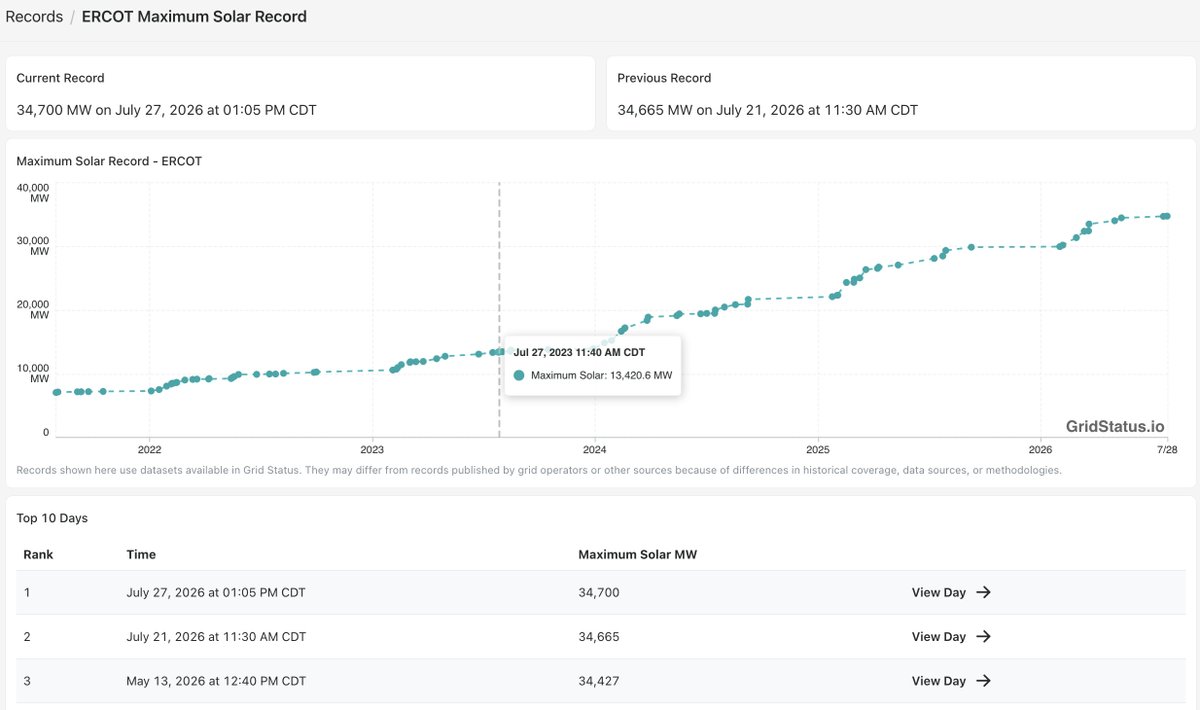
Solar set a new ERCOT record today w/ 34,700 megawatts. Three years ago to the day, solar set a record at 13,400 megawatts: less than 40% of today's number. This extra 20,000 megawatts generated during the heat of the day makes all the difference. No conservation alerts. #txlege