Postdoc Scholar @osuceoas. Coastal geomorphology, nearshore processes, coastal remote sensing. Here to build and connect with a community of scholars. He/Him.
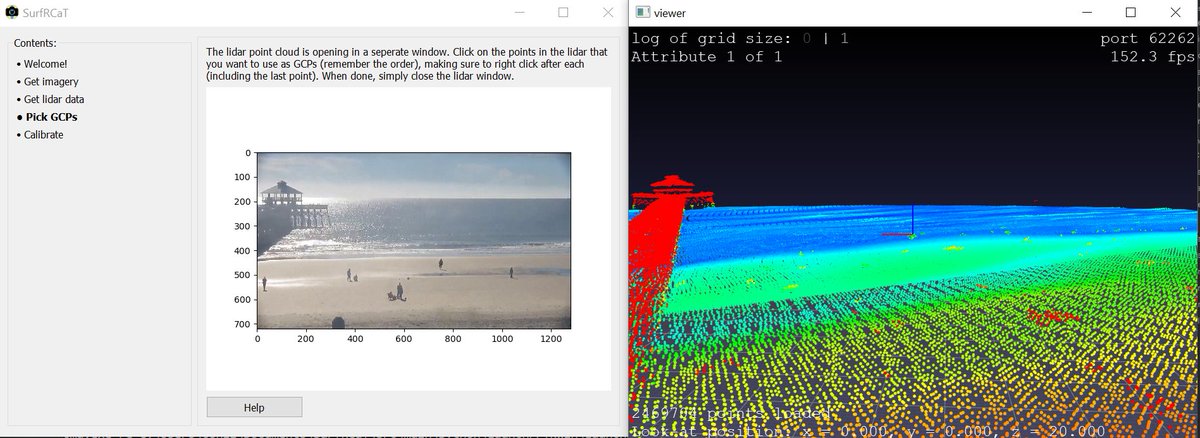
Have a coastal webcam that you enjoy watching the beach from? SurfRCaT can help you turn it into a coastal monitoring tool! Check it out at https://t.co/1Xh18MmmXi #SurfRCaT#Surfcams#CoastalMonitoring
The Surf-camera Remote Calibration Tool, or SurfRCaT, is an open-source tool that solves for camera parameters needed to transform webcam landscape images into bird’s-eye-view maps that are scaled and oriented.
Learn more: https://t.co/GF1LsDu4vR
SECOORA and NOAA CO-OPS have partnered to integrate webcam imagery from WebCOOS into the Coastal Inundation Dashboard, allowing users to quickly visualize real-time flooding impacts while monitoring water levels during a coastal flooding event.
https://t.co/rgqXNGs6II
Researchers examined #foredune toe retreat in response to 9 major storms on the Outer Banks, North Carolina. This work is a partnership between @USACEHQ and @UF, results from the study (open access until 9/2) can be read below.
🔗https://t.co/y0ojCftzo0
Thinking of attending the Ocean Sciences Meeting in New Orleans next year?
Submit a manuscript to the session “OT017: Remote Sensing of Nearshore Physical Processes and Coastal Morphology”.
Abstracts due 13 September!
https://t.co/oSfBHE7dJ4
When dunes erode during a storm, does the dune toe move up or down? Our new work shows the height and duration of total water level above the dune toe is an important (nonlinear) control. Fun (OA) work with @ntcohn and @UFgeomorph, check it out!
https://t.co/SJxlt64zLe
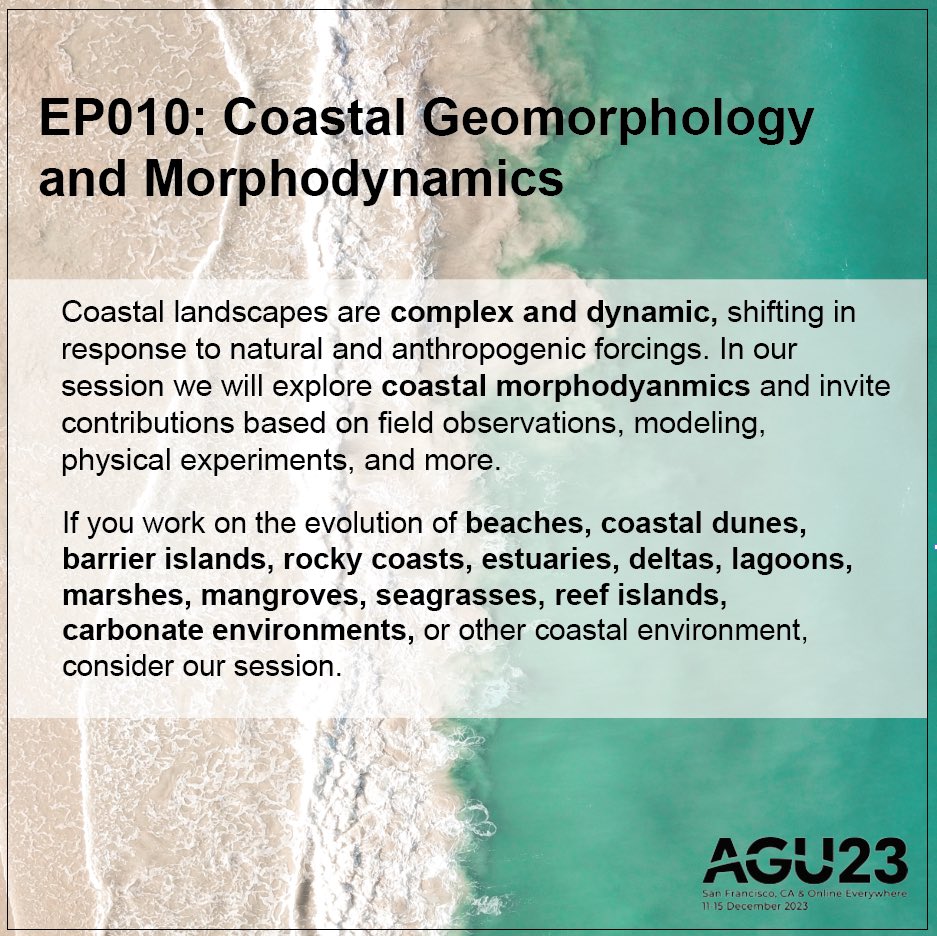
Attending #AGU2023 & work in the #coastal geo field? Submit your abstract to our session EP010: Coastal Geomorphology & Morphodynamics by Aug. 2nd!
We welcome work across all coastal systems, using a variety of approaches! 🌊🏖️🪸
Submit here ⬇️⬇️⬇️
https://t.co/EO1sOSbxYK
@NWSPortland Thanks for providing the detailed info and methods! Something I’m curious about: does something like a multi-model ensemble mean typically get used in wx forecasting? Or are some models known to be better for certain conditions? Or are certain models cherry picked in other ways?
It’s easy to think of the ocean as a permanent fixture, given how ancient it is. But those salty waters had to come from something, somewhere. How did we end up with this vast, shimmering source of life? https://t.co/Ckp005SC4f
Grateful to have the opportunity to share some info about the ocean with @NewsHour and reporter @bella_is_ for World Oceans Day 2023.
How did the ocean form? 4 things to know about its past and present https://t.co/qlgRbILXox
Had to capture this moment. Rob Holman, who pretty much invented the use of cameras to measure beach change in the 1980s, taking his first #CoastSnap. 4 decades later and now we can use smartphones too!
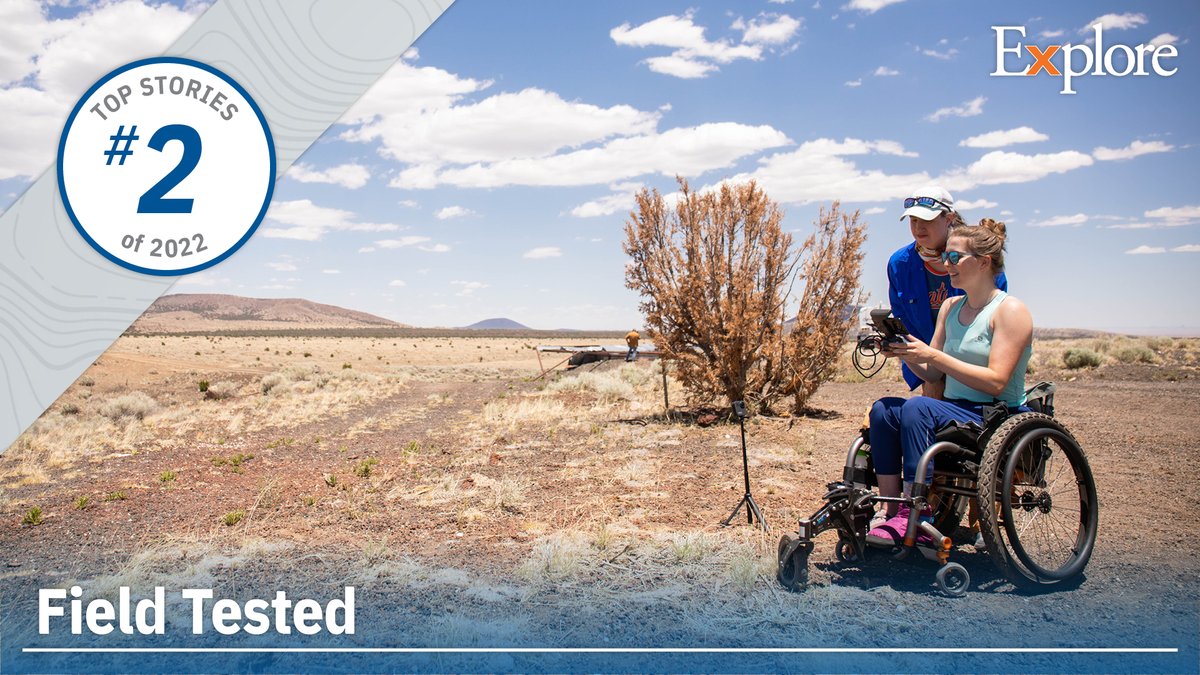
In the #2 most-read story of 2022, we followed @UF_CLAS geologist @BakingSodaVolc on a groundbreaking mission to make field experience more accessible to Earth science students with disabilities. ➡ https://t.co/2rW8iRNX6o
FYI for speakers at #AGU22 since @theAGU hasn’t communicated this at all - talks are 8 MINUTES with 2 minutes for questions. Because 12 minutes wasn’t had enough!
Hey @theAGU and others in the know, are #AGU22 oral presentation time slots all 10 mins now? Does that mean 8 min talk + 2 for questions? Or 10 min talk + group discussion at end of session? This reeeally needs to be communicated, like now, in big red letter text 😬
@Tom_Coulthard The UTide (formerly TTide) Matlab toolbox facilitates harmonic analysis of tidal constituents from modern observations, the output of which can be used to hindcast. It’s a great tool.
Why should you care about #WorldKrillDay on August 11? Marine ecologist Kim Bernard @psycho_kriller weighs in on the importance of these thumb-sized crustaceans in the Southern Ocean and their contribution to the food web, carbon cycling and more. https://t.co/i5knwp1mBR
Do you study physical processes in the transitional zone from land to the open ocean? We encourage you to submit an abstract to the hybrid Nearshore Processes (OS015) session at #agu2022. Join our conversation about the dynamics influencing our coastlines.
https://t.co/x56KFjkcwI
🚨 Headed to AGU in person or virtually this December? Studying coastal processes/morphodynamics across a range of settings/scales? Consider submitting an abstract to this year’s Coastal Geomorphology and Morophodynamics session! Please share widely!👇 https://t.co/JOJsvDza5Y