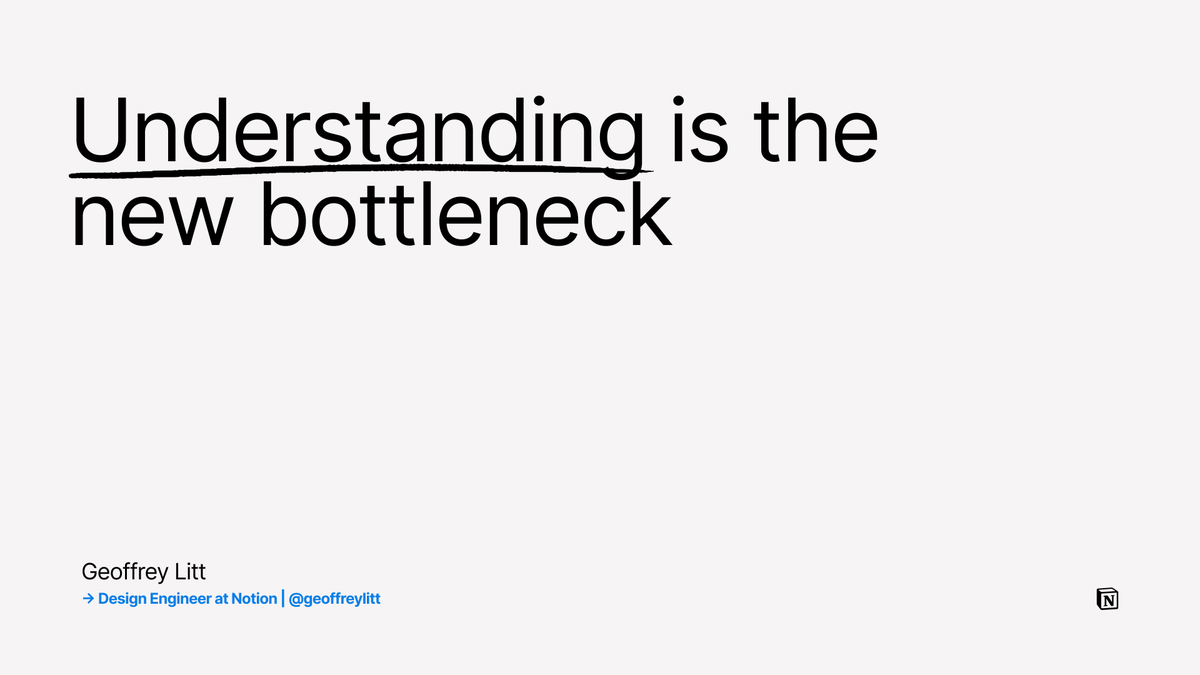
Hot take: I think it's still important to understand the code that our agents write!
In this mega thread (based on my AIE talk today), I will explain why that's the case, and show some ideas for how to efficiently understand code. Alright, let's dive in. 1/
introducing tau τ — an educational agent harness that teaches you how to build agent harnesses
i will be publishing tutorials and demos on how to use it to create your own TUIs, harnesses, extensions, etc.
Happy Tau Day!! 🤓
👉 https://t.co/5sWxNtXTZP
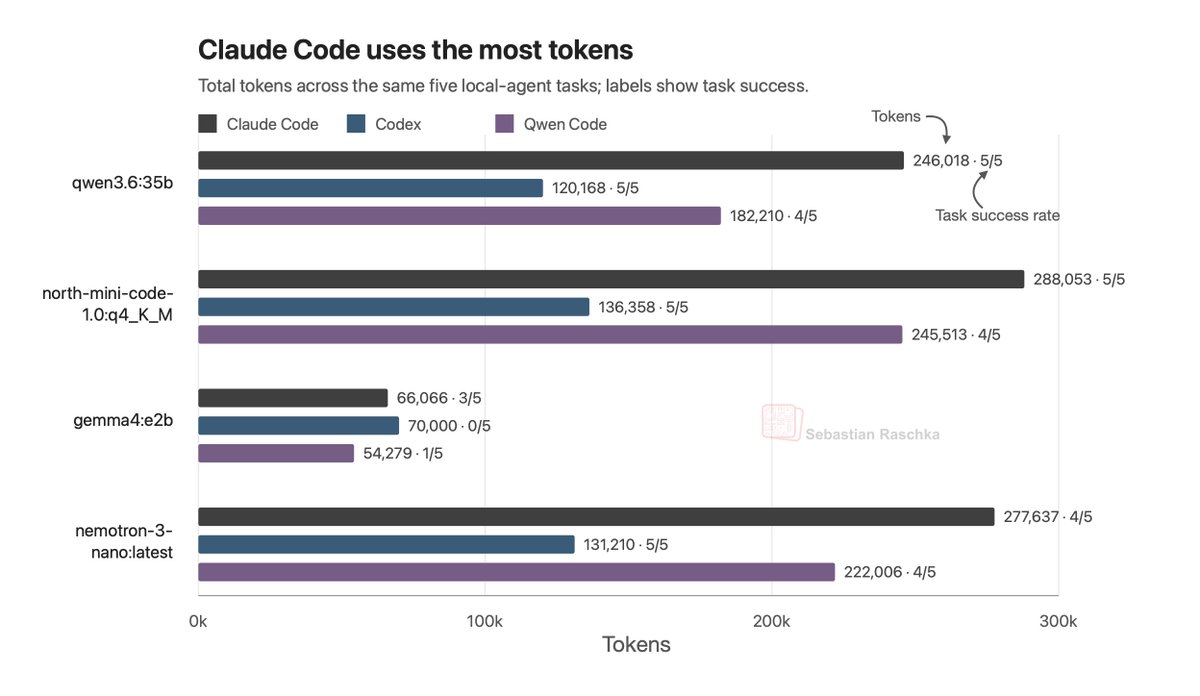
Have been taking different local open-weight LLMs for a test drive in different harnesses (Qwen-Code, Codex, Claude Code).
30B Mixture-of-Expert models are kind of a nice sweet spot and can solve challenging problems. And they get roughly 40 tok/sec on a Mac or DGX Spark, which is similar to GPT 5.5 in a Pro subscription and totally useable for everyday work.
More interesting is also the harness choice! Claude Code seems to be using 2x many tokens as Codex.
Gemma 4 E2B is here just for reference to show that the tasks can't be trivially solved by smaller models.
Just finishing a longer write-up about this and will share soon (likely tomorrow)!
The 4-bit quant is now available, making our first open-source agentic coding model small enough to be run on a Mac. Get the weights here: https://t.co/8amCVzzunE
Crazy model! It actually uses the old Qwen2.5-Coder-3B stack and got really great performance with their post-training stack.
Need to use it in the next days to see if vibes of VibeCoder actually check out in practice. But impressive first impression!
Based on the tech report, some of the important pieces of their post-training stack:
1. High-signal synthetic data (math problems with credible solutions, code with tests)
2. Multiple reasoning paths for each answer
3. Filtering, filtering, filtering
4. 2-stage SFT (start with broad training, then train on hard long-reasoning samples)
5. Use target (pass@k) accuracy over validation loss for checkpoint selection
6. MGPO (MaxEnt-Guided Policy Optimization) for RLVR: basically a GRPO-style RL method with an extra weighting that favors examples that are neither too easy nor too hard for the current policy
7. Single 64k long-context RL (they found that the usual progressive context expansion hurt this model because early truncation damaged long-thinking behavior)
8. Training data order: they do Math RL, then Code RL, then STEM RL in this particular oder which they found helped overall
9. After optimizing for accuracy, they add a stage that rewards shorter correct trajectories; basically making the model more efficient without accuracy degradation
Introducing GLM-5.2: Frontier Intelligence, Open Weights
- Significant improvements in coding and agentic tasks
- Strong long-horizon capabilities with a 1M context window
- Two levels of reasoning effort: GLM-5.2 (max) pushes the limits, while GLM-5.2 (high) strikes a strong balance between performance and token efficiency
- MIT-licensed open weights
- Same API pricing as GLM-5.1
Tech Blog: https://t.co/LAsxUdN0JZ
Weights: https://t.co/g0A1C4UWx4
API: https://t.co/Kc3E22cbN7
Coding Plan: https://t.co/Nk8Y98HNhU
Chat: https://t.co/WCqWT0qCQb
this basically shows all my workflows and reasoning behind them.
i would love to learn how you folks work compared to that. as i said, i'm a caveman and i'd be super happy to learn how to become better. post below.
Introducing Cohere's first open-source coding model: North Mini Code
Small & efficient, designed for agentic performance and built for community input.
Introducing Harness-1, a 20B search agent trained with a state-externalizing harness.
> frontier-level long-horizon search, rivaling Opus-4.6 and outperforming GPT-5.4
> Context-1-level cost and latency
> externalizes candidates, evidence, verification, and search history
> open-source
I went HAM on git worktrees when I learned they were a thing like 6 months ago but slowly drifted back to single branch flows.
It's just way easier to manage and far less repeat/conflicting work.
But how do you make sure multiple agents don't collide?
The flow is simple:
You need proper planning. Measure twice cut once has never been more true.
After the plan is created, I prompt the model if it's 100% clear on what to do, and if not to surface non obvious questions + edge cases we haven't yet covered.
Now with a SOLID plan, I turn it into a directed graph of tasks where they know the clear order of operations.
The task graph is then fed into a swarm of tmux sessions running [insert your favorite harness here] by a top level agent, lets call it the "ring leader"
The agent sessions collaborate via file reservations and their own agent mail messaging system. This ensures no edits are conflicting and duplicate work is not done.
The top level ring leader agent just sits there on a cron, checking in to the sessions every ~5 minutes to nudge them to pickup unblocked tasks from the graph if there are any until all the work is done.
Then when its all done, I prompt for a summary of work completed and a QA plan for me or other agent to verify.
This is like the "ralph loop" but on galactic steroids. It gets work done would have taken several weeks a year ago to get done in a ~2 hour session.
If this all sounds too hard to manage, I thought so too. But then I stumbled across what @doodlestein was doing thru one of @johnlindquist's AI workshops.
Then Jeffrey released his skills https://t.co/aHly1cpc2A and holy cow everything I just mentioned above unlocked.
🚀 Gemma 4 12B is here!
We partnered with @GoogleDeepMind to bring and optimize their new dense and unifed multimodal model for Apple Silicon.
◈ 12B dense · 256K context
◈ Thinking mode (built-in reasoning)
◈ Vision: dynamic res, OCR, UI + charts
◈ Native audio: ASR + speech translation
◈ Function calling for agents
◈ Text + image + audio, interleaved
Runs local. Get started now ⚡
> uv pip install -U mlx-vlm
https://t.co/7BvnEuzKvj
Meet Gemma 4 12B!
A unified, encoder-free multimodal model designed to bring high-performance intelligence directly to your laptop, and released under an Apache 2.0 license.
Bridging the gap between edge efficiency and advanced reasoning. Here is what’s new with Gemma 4 12B: 👇