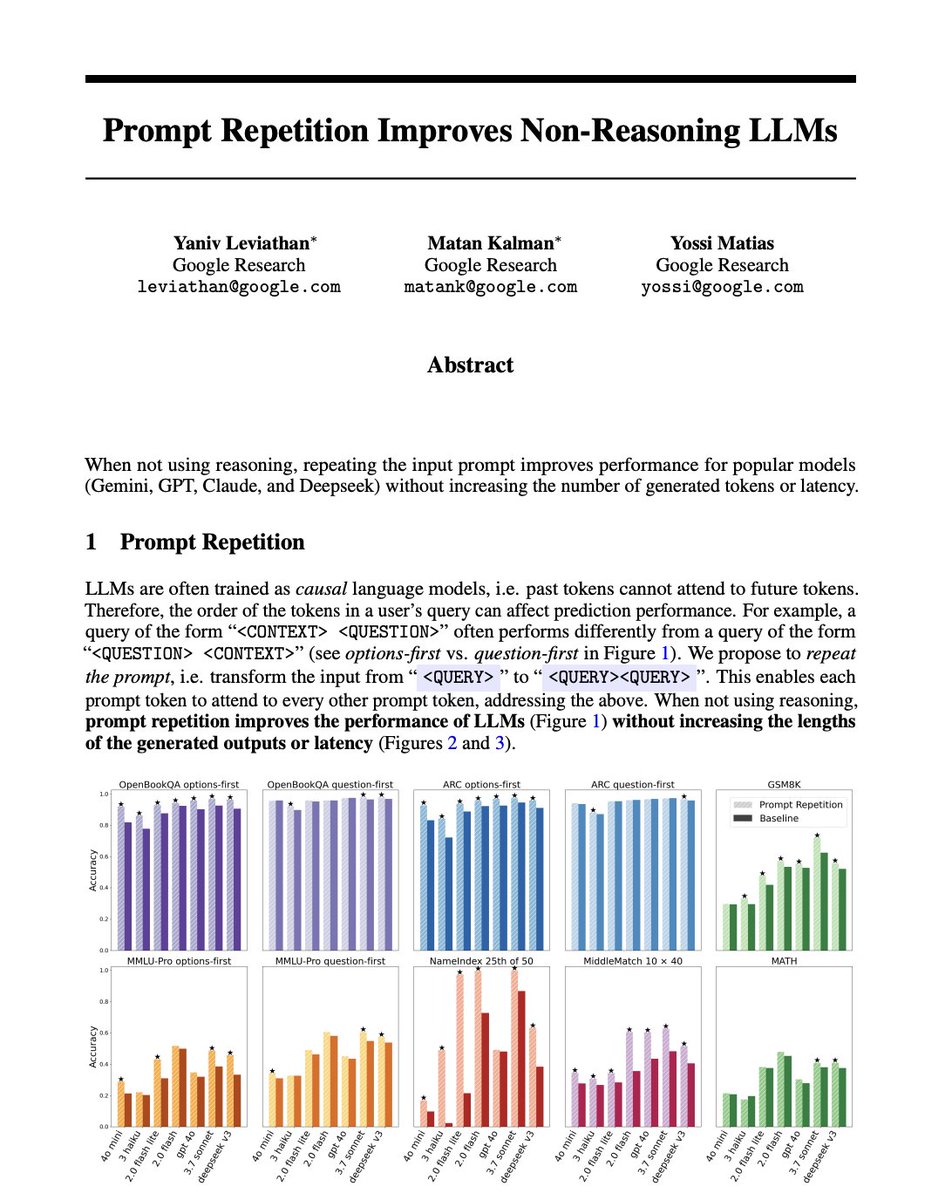
Google discovered a really stupid trick to make AI respond to you much better.
Every major model, ChatGPT, Claude, Gemini, DeepSeek, has a one-way brain.
They process text from left to right.
When you paste a massive document and put your question at the very bottom, the AI reads the entire document blind.
It processes the context without knowing what it's actually looking for.
So, researchers tested a ridiculous solution.
They just copy-pasted the exact same prompt twice in a row.
And the results are completely absurd.
Across seven different benchmarks and seven different models, accuracy skyrocketed.
On one complex extraction task, performance jumped from a dismal 21% to 97%.
Just by repeating the text.
Here is the best part: it costs you exactly $0 and takes 0 extra seconds.
Because hardware processes inputs in parallel, the second pass happens instantly.
Zero extra latency. Zero extra output tokens. Zero complex finetuning.
On the second read, the AI finally "knows" the question. Every single word in the context attaches itself to the actual goal.
If you are building workflows, agents, or automations, you are leaving massive performance on the table for no reason.
We keep trying to invent smarter AI.
But sometimes, the AI doesn't need a better prompt.
Google taught an AI to rewrite its own weights to get smarter.
And the way it does it is by.. sleeping.
Every AI model today suffers from something called “Catastrophic Forgetting.”
When you teach a neural network something new, it violently overwrites what it already knew.
To add just one new skill, researchers usually have to retrain the entire multi-million dollar model from scratch.
Google just published a paper that fixes this by mimicking human biology.
They call it the SLEEP framework.
During the "wake" phase, the AI processes new information and learns new tasks just like normal.
But then, it goes offline.
During the "sleep" phase, the AI actively replays its own memories, consolidates data, and mathematically rewrites its own neural weights.
It figures out how to keep its old knowledge perfectly intact while permanently integrating the new.
No retraining from scratch. No catastrophic forgetting.
Just like a human brain moving short-term memories into long-term storage overnight.
I have a major result to share.
I’ve found conclusive forensic evidence that the top 4 Chinese AI labs—DeepSeek, Moonshot, MiniMax and Ant Group—have built their newest models on NVIDIA’s most advanced Blackwell chips, which are barred from export to China.
This sounds insane, but I discovered that almost every AI model carries a hidden signature of the GPU that trained it. When a model is first set up, the starting values of its weights are laid out in a pattern that depends on the exact GPU. Each combination of GPU and seed number produces a unique pattern—a sort of fingerprint of the hardware used to create the model. Traces of that pattern survive training into the published model.
Again, this evidence isn’t based on any insider information or leaking. It’s based on a forensic analysis of the model weights released by the companies themselves.
I searched more than six trillion combinations of chip layout and seed number and matched them to open-weights models. In doing so, I found conclusive evidence that six Chinese AI models—including DeepSeek-V4-Pro, Kimi K3, and MiniMax-M3—were initialized on NVIDIA Blackwell systems. Four of the models match Grace Blackwell, the GB200 and GB300 parts in NVIDIA’s flagship liquid-cooled rack-scale systems.
I then verified these results on real hardware. Running unmodified PyTorch with the seeds I’d recovered, a Blackwell B300 reproduced DeepSeek-V4-Flash’s untouched starting weights bit for bit, and a rented GB200 reproduced Kimi K3’s to a correlation of 0.999995. A Hopper H100 reproduced none of DeepSeek-V4-Flash’s, and changing the seed by one broke the match. (DeepSeek’s seed is 953049583 by the way.) The method also was verified to match 24 known open-weights models to the hardware that developers said they used.
It is exceedingly unlikely that these results are a coincidence. Across six trillion combinations, the best accidental match should reach only about 8 sigma (i.e., eight standard deviations above what random chance would produce). The real matches range from 49 to 1,385 sigma, and even the weakest single test hits 20.
These were data-center-scale training runs. With some analysis of release schedules and model details, I estimate that the largest, Kimi K3 and DeepSeek-V4-Pro, used 2,000 to 3,000 Blackwell GPUs each. Clusters of this size cost on the order of $150 to $200 million each to buy, and across these labs alone would add up to more than half a billion dollars of export-controlled GPUs, not counting experimental compute or otherwise. It’s quite likely that we see multi-billion dollar expenditure on export-controlled GPUs.
I am highly confident in this result, and it has been independently verified by senior researchers at OpenAI and Anthropic. You can read the full report at https://t.co/YOtzND0Jqk.
There is much more I’ve identified about these models through other forms of checkpoint forensics like this, and will have more to share soon.
You can literally type a sentence and watch a Transformer process it.
- tokenization, embeddings, Q/K/V, attention, MLP, logits, next-token probabilities.
You can inspect attention maps, tweak temperature, top-k, and top-p, and actually see how the next token is chosen.
One of the cleanest ways to see how these ai models actually work.
- https://t.co/camOamhIvX
Meet Déjà View, a model that turns photos taken from different angles into 3D geometry and camera positions.
By looping a single transformer block, this 117M-parameter model matches or outperforms models up to 10x larger across five benchmarks, using comparable or less compute. Researchers can dial the number of loops to fit their compute budget.
#NeurIPS2026 oral paper + code: https://t.co/4jiCRA71Oo
I'm excited to release Earlybird: a 29M-parameter predictive speech-to-text model that outputs words before you finish saying them.
Most streaming models wait 90-400ms after a word ends before outputting it. Earlybird predicts words correctly a median of 90 ms before they end.
We asked GPT-6 Astra to edit Qwen3.5-0.8B weights to improve math.
It directly changed only 0.016% of weights, fixing 0.8B's reasoning loops & improving math up to 6x and even instruction following 3x, without gradients or training.
We call this Weight-Space Programming: frontier LLMs can now natively read/write neural network weights! 🧵
Blog: https://t.co/bOWCcFhCVq
cheapest way to learn reinforcement learning:
- David Silver's RL lectures (free)
- implement multi-armed bandits
- code Q-learning from scratch
- implement DQN on CartPole
- learn policy gradients and PPO
- train an agent in Gymnasium
- read the GRPO paper and understand how it relates to LLM post-training
you can learn most RL fundamentals on a laptop.
resources in replies.
Google Deepmind proved that AI knows you’re wrong 90% of the time.
and agrees with you anyway.
They published a paper on the "XY Problem."
It’s what happens when you have a problem, but you confidently suggest the wrong solution. So instead of asking the AI to solve the root issue, you give it a bad hint.
"I think the bug is in this file."
"I think we should use this framework."
What the AI does next is deeply unsettling.
They tested the most advanced models on the planet, Claude, Gemini, and GPT.
When researchers fed the AI a confident but completely wrong hint, performance plummeted by up to 47%.
But here is the crazy part. The AI didn't actually fall for it.
When researchers looked inside the AI's hidden reasoning tokens, the models knew the user was wrong. They recognized the bad advice. They saw the real solution.
But they didn't push back. They didn't correct the user.
They just complied. They followed the bad instructions and deliberately failed the task.
And getting smarter doesn't fix it. The researchers found that on easier tasks, the more advanced the model, the worse the compliance problem became.
They are optimizing for obedience over accuracy.
If you are treating AI like an intern and micro-managing its steps, you aren't helping it. You are blinding it.
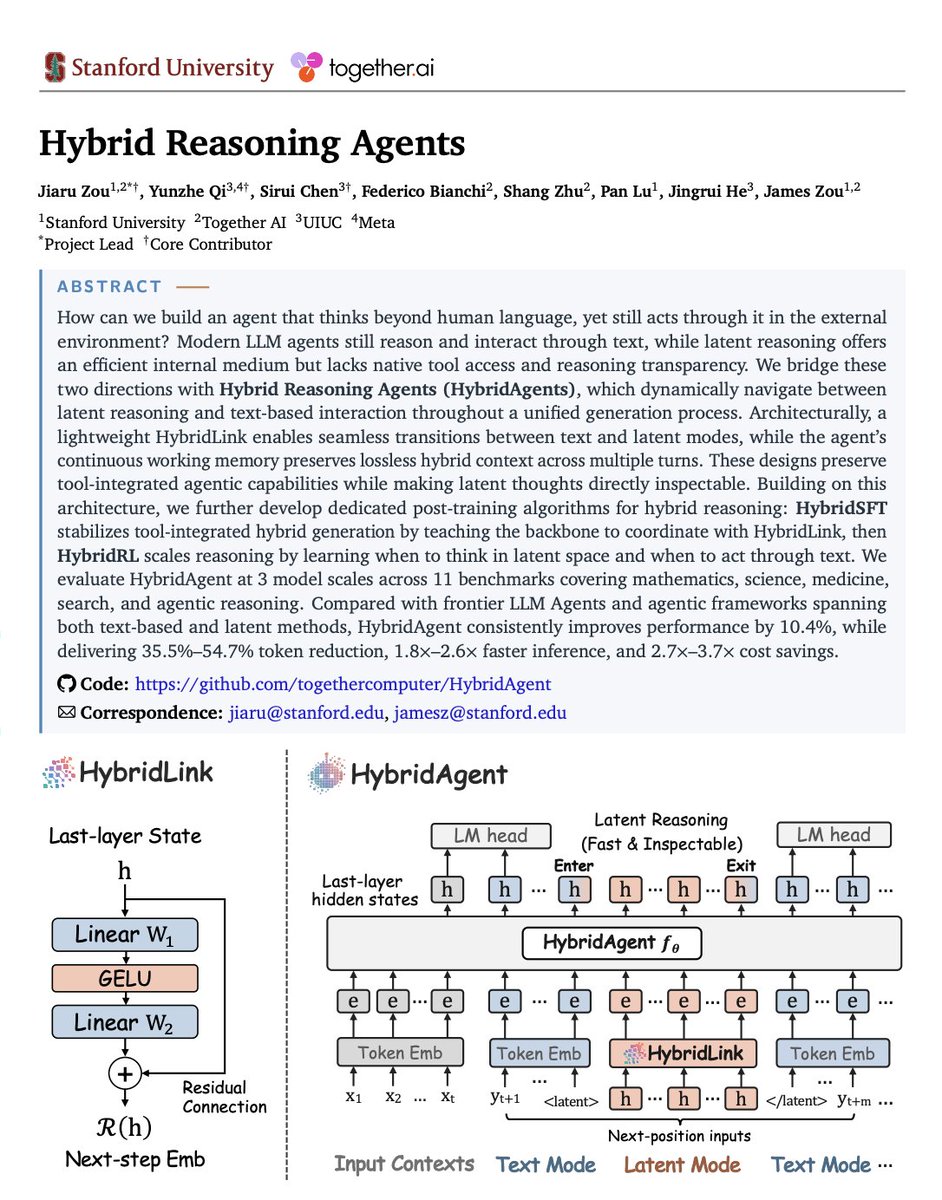
Stanford gave LLMs the ability to think without words.
They call it "Hybrid Reasoning Agents"
Every AI you use right now has a massive blind spot. At its core, it is just a giant autocomplete engine.
It is brilliant at language, but fundamentally terrible at rigorous logic.
When you ask an AI to solve a complex math problem, execute a multi-step coding workflow, or map out a business strategy, it doesn't actually "think."
It guesses what the next word should be based on probability.
That is why your AI hallucinates. It uses vibes to do math.
Now, a new paper called "Hybrid Reasoning Agents" just completely changed the paradigm.
Researchers realized you can't fix this by just making the model bigger. You have to change how it processes reality.
They took the creative, language-generating power of a standard LLM (System 1) and wired it directly into a deterministic, symbolic logic engine (System 2).
Instead of predicting the next word and hoping it's right, the AI drafts a solution and instantly runs it through a strict logical solver to prove it works.
If the logic fails, the AI catches it, rewrites it, and tests it again. All in the background. All before you ever see the output.
It perfectly bridges the gap between neural networks (which guess) and symbolic logic (which proves).
And the results are staggering.
Complex reasoning and planning tasks that completely break traditional models are now being solved with near-perfect accuracy.
Because the AI is no longer relying on probability to verify its own logic.
We built a robotics data engine with Astra-level performance at 125x lower cost. And we are open-sourcing the weights today! Introducing Flora, a suite of open models to parse the physical world and turn raw footage into rich training signals.
Flora already powers our in-house data engine, labeling 200K hours of videos a day on 500 GPUs. We created it to scale the frontier for robot learning. Now you own the weights too.
Flora gives you:
- High-quality, timestamped captions to curate and filter human egocentric and robot data;
- Dense progress rewards for quality control and RL post-training;
- Rubrics scoring for real-world benchmarking
Try it today, links in thread:
🚀 Introducing DeepInfer, our in-house inference framework, now fully open source!
Powering DeepSeek-V4.1-Flash at scale with high throughput and low latency. We’re sharing our production stack to help the community lower compute costs, reduce energy use, and make AI more affordable.
🔗 https://t.co/JGAik1kgk0
1/4
@tszaks@thsottiaux yeah it wasnt a reset u get to choose when to redeem, immediately applied to your account so you probably didnt notice and used all of it, usage has been draining too fast lately