Ministers and advisers often complain about how hard it is to make government work. They pull a lever and nothing happens.
I've been lucky enough to work in govt in several guises. Here are 14 lessons on how to get things done that I learnt the hard way.
(Please note I’m not giving a view on how govt should work or if it should be reformed. But rather how best to make things happen within the confines of the current system.)
1. KNOW WHAT YOU WANT AND SET A DIRECTION.
Sounds obvious but it is surprisingly common for Ministers to not ask for anything.
The civil service flooded their time with advice and questions, and the Minister responded. But the Minister never put a fresh demand on the system.
They never invented something new or decided to go in a new direction, said it had to happen, and forced the civil service to reorganise itself to deliver.
This isn’t just about being ‘demanding’; plenty of Ministers know how to fuss about small items of business.
They splash around on the surface while the river carries on its usual course. What’s hard, and rare, is for Secretaries of State to redirect the river.
That is a lot of work. The first reaction of the civil service will be fatigue - they are already busy.
But deep down, all officials know that Secretaries of State with clear demands make for happier departments.
The civil service craves that direction. Without it, they float in the wind, buffeted by external events, the media and whims.
2. BE WILLING TO UPSET PEOPLE.
If you redirect the river this will mean new winners and new losers.
The civil service - incentivised to be risk averse - will raise this as a reason to take no action. This fear of “new losers” is one of the common reasons for Government inertia.
You have to look past these concerns, make the trade-off, tell people you accept the downside and that there will be costs but we have to get to a new position.
You have to provide the political cover for unhappiness.
3. MAKING IT HAPPEN IS YOUR RESPONSIBILITY.
It’s a myth that an adviser spends their whole time practicing “dark arts”, wooing MPs or conspiring with the media.
A good adviser spends 90%+ of their time project managing priorities.
What does that mean?
It’s basic stuff. Meet the team responsible on Monday afternoon. Then Thursday. Then Monday again.
Repeat until it's done.
If you aren't willing to do this then don't complain if nothing happens.
4. PEOPLE, PEOPLE, PEOPLE.
Steve Jobs once said “the most important job of someone like myself is recruiting”.
A good startup CEO spends 80%+ of their time recruiting.
I guarantee you that the Prime Minister, Ministers and advisers all spend <10% on recruitment.
This is madness.
Go find the best talent.
Identify the best civil servants in the system and persuade them to work in your department.
Recruit from outside.
5. ONLY EVER WRITE “GOOD” ON A MINISTERIAL SUBMISSION.
Ministers receive a red box of memos at the end of each day.
These memos - submissions - have a covering page in which advisers can pass their commentary on the material within (‘the box note’).
The only thing an adviser should write is:
"I've worked with the team on this. I am happy and agree with their approach and recommendation."
Anything else and you haven't done your job properly.
That doesn’t mean you are going easy on the civil service.
On the contrary: it means that you have been up in their business for weeks getting the advice to the right place.
You asked them to take you through the model, the options disregarded, the assumptions made, the assumptions rejected.
Now, you’re able to give your endorsement to the place they’ve reached.
This is how you build mutual respect and trust.
Advisers who use that little comment box to slag off the advice aren’t helping their Minister.
They’re signalling that they think the role of an adviser is to pass comment, not to help get things done.
The Minister has a role here in not indulging this mindset.
They should ask advisers who are disappointed with a submission: “what have you done to make it better?”
There will be legitimate occasions for advice to differ. In that case openly present two conflicting opinions for a decision.
But these should be rare.
Box notes rubbishing advice tend to represent a failure of the SPADs to get upstream and work with the civil service team.
6. DO AS LITTLE AS POSSIBLE CROSS GOVERNMENT.
Getting stuff done in your own department is hard enough.
Requiring other departments to do what you want is 200% harder.
Focus on what you can control.
7. NEVER DO A 'WRITE-ROUND”.
A write round is when one dept asks all the other depts to give their view on their policy and veto it.
It’s obviously ludicrous for education to ask transport if it is ok to change A-levels.
All it does is lead to cross Whitehall negotiations slowing things down.
Officials will always suggest one because of “protocol”.
But ask to see the written rules about this. They don’t exist. Get No10/HMT backing and crack on.
8. LEGISLATION IS A LAST RESORT.
It takes forever. And once every MP and Lord has had their say it will be compromised into oblivion.
Use other levers to get what you want done. Statutory instruments, guidance or whatever is appropriate. Find a way.
9. FIND A FORCING FUNCTION.
Govt moves slowly.
Summits, speeches, deadlines. Nothing concentrates the mind like a public event.
Create your own moments to force the system to act.
The Bletchley Park AI Summit led to the AI Security Institute, the Bristol Isambard data centre, AI tools for teachers to cut their admin & the Bletchley declaration signed by 30 countries inc the US & China.
No summit = none of that. Or taken years longer.
10. NO MACHINERY OF GOVERNMENT CHANGES.
Reorgs stop everything for 6-9 months. Avoid unless absolutely necessary.
11. DO NOT OVER CLAIM.
Never say "The PM or Secretary of State wants X" if it isn't true. You will be found out and lose all credibility.
Conversely, it can help an adviser early on in their tenure if their principal makes it clear that the adviser speaks for and on the Minister’s behalf.
The civil service will look for and want these signals.
Equally a SoS should never undermine their adviser in front of officials. Even if they disagree they must wait until behind closed doors.
An adviser that officials suspect doesn’t speak for their principal loses their ability to get things done.
12. CONTROL YOUR DIARY.
Seems obvious but it’s shocking how many people complain about their diary.
Private office will fill it up. That's their job.
I have no sympathy for any cries of how full your diary is. It’s your job to clear it for your priorities.
13. IT’S ALWAYS COCK UP NOT CONSPIRACY.
Government is huge. Leaks and failures happen.
Don't immediately jump to conclusions or assume malice.
Overreacting will make things worse.
14. STAY UPBEAT.
Government is slow and painful. It gets you down.
You need to bring optimism, agency and energy to push through.
Yes, it is hard. But there is no other place in the world where you can affect so much positive change.
FINAL THOUGHT:
A lot of these lessons apply in any large organisation.
The real divide in performance is not Public vs Private.
It's Small vs Large.
As orgs grow, they slow. Become more bureaucratic. That isn’t unique to the public sector.
So while I wrote this as advice for advisers in government, I hope a lot of it applies more broadly than that.
Being an adviser is a privilege. I’m lucky to have done it in a few different guises. I hope these lessons are helpful. And look forward to any critiques.
This is an abridged version of a piece I wrote for @Samfr's great substack. You can read the full version at the link in the next tweet.
We're pleased to see the new NHS Medium Term Planning Framework has committed to achieving all Cancer Waiting Time targets by March 2029.
This vital commitment is a key step towards ensuring people affected by cancer have timely diagnosis and treatment 1/
https://t.co/AMZTZlTmkZ
🚨Upcoming policy webinar📢
Join @IanWalker_CRUK, @naserturabi & Professor Sir Mike Richards CBE to discuss findings from our 'Cancer in the UK: Overview 2025' report and how we can make the National Cancer Plan a turning point for cancer.
📅 Tues 29 July, 10:30–11:30am
🔗 Register: https://t.co/ZzRc06gau4
A mammoth task for me and @CRUK_Policy colleagues over the last day to get our heads around the 10 Year Health Plan - the good, the gaps, and what's now needed in the upcoming National Cancer Plan.
If you're wondering what the 10YHP could mean for cancer, take a look ⬇️
Yesterday, the UK Government published its 10 Year Health Plan, aiming to reform the NHS over the next decade.
⬇️ for what it means for cancer, and what needs to come next in the National Cancer Plan (NCP) 1/
Our new economic analysis shows that the UK loses £10.3bn every year due to lives cut short by cancer - more than any other major health condition. Read more 👇 https://t.co/9eEexY6oYB
Pleasure to work with @CRUK_Policy colleagues to develop our proposals for the upcoming National Cancer Plan - a once in a decade opportunity to close the gap between England and the best in the world on cancer survival
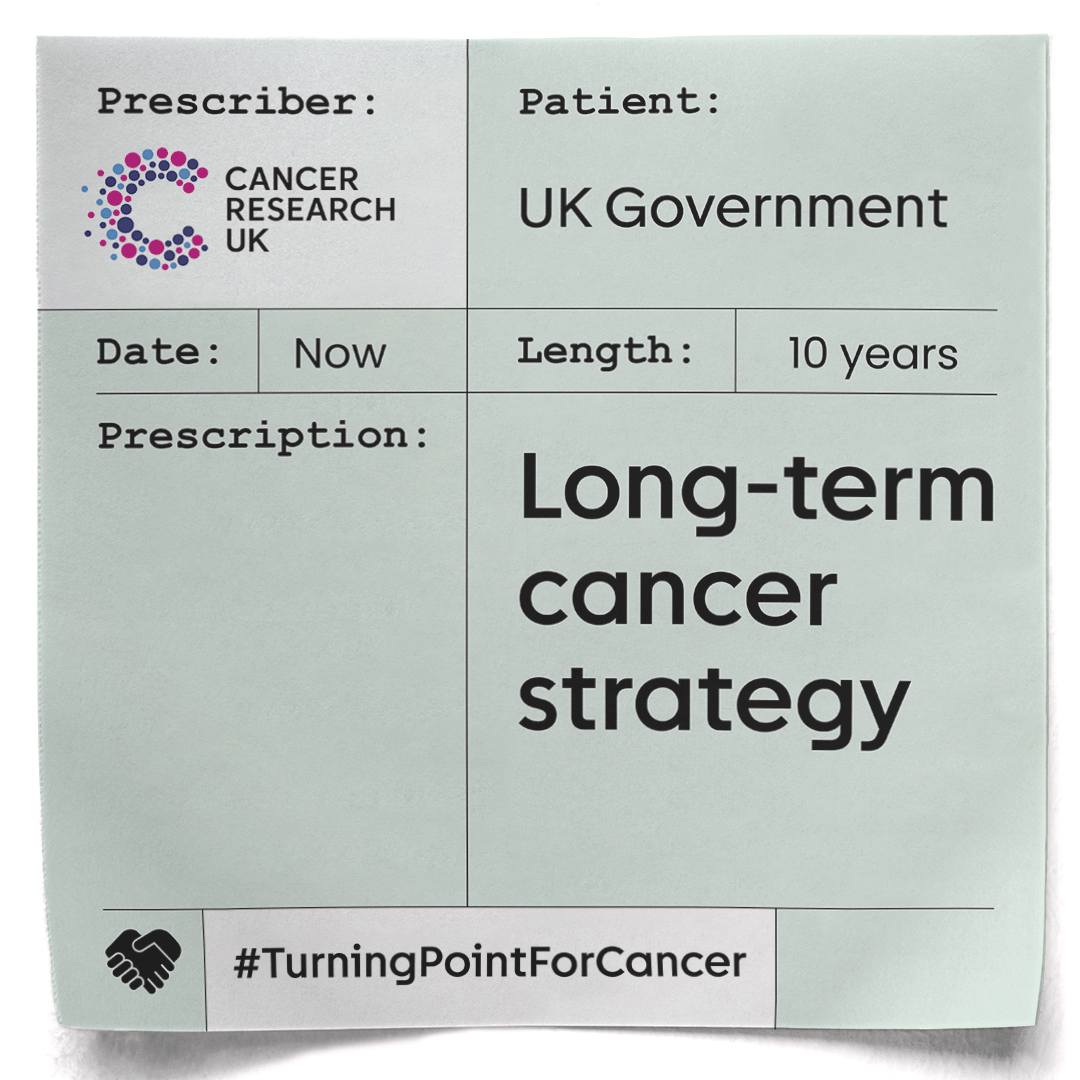
The upcoming National Cancer Plan could be a #TurningPointForCancer, delivering the change people affected by cancer deserve.
We’ve set out the actions that will deliver that change in our response to the UK Govt call for evidence 👇
https://t.co/68Mr3v6vg2
Fantastic to see @wesstreeting visit a @CR_UK@BowelbabeF lab today - a brilliant opportunity to reflect on the legacy and ongoing impact of the amazing Dame Deborah, and talk about the future of cancer research and care in the upcoming National Cancer Plan
Dame Deborah James dedicated her life to raising awareness of bowel cancer.
Today @WesStreeting visited a @CR_UK research lab renamed in her memory, bringing scientists together to improve diagnosis and develop new treatments.
More:
https://t.co/qgERlIUQae
A National Cancer Plan was a key call in our #TurningPointForCancer campaign 📢
The plan needs a focus on diagnosing cancers earlier, reducing waiting times, and bringing cutting-edge treatment to people sooner - and the necessary funding to deliver long-term change
On #WorldCancerDay, we welcome the UK government's commitment to publishing a National Cancer Plan for England this year and we look forward to working with them to make sure it delivers for everyone affected by cancer.
#TurningPointForCancer
How can a smoke free generation in the UK be created?
@Alizee_Froguel from @CR_UK and lung cancer survivor Susie Hartley share their thoughts
#KayBurley SS
📢 Staff update
Following the brilliant conclusion of the Commission on Health and Prosperity, @cthomasippr has been asked to join @DHSCgovuk's new strategy unit on an 18-month secondment!
A huge congratulations to Chris—taking his expertise to shape the future of health policy.
So great to see this out in the world. Genomics has real potential to drive a paradigm shift in our approach to detecting, treating and even preventing cancer.
Congrats to @EEagles_ for a fascinating and engaging explainer article to accompany the report publication!
Genomics is central to building our understanding of cancer. UK govts & health systems have recognised its potential to transform cancer research & care
Here we lay out our ambitions for the future of genomics in the UK & our recs for how to attain them⬇️
https://t.co/eGukou8NJH
A fantastic article by @CRUK_Policy's @EEagles_
charting the history of genomic medicine and the role it plays today in cancer research and care - give it a read, and our new position statement on genomic research and healthcare, here ⬇️
https://t.co/3aYHrhI2fB
This is the biggest single measure we could take to prevent cancer + other conditions, and constitute massive progress on the UK Government's plans to shift from ill health to prevention.
Now's the time for MPs across parliament to back this vital legislation #SmokefreeUK
Legislation to tackle the biggest cause of cancer in the UK was brought to Parliament today. Raising the age of sale of tobacco would help prevent future generations from ever starting smoking.
We urge all MPs to vote in favour of this important step towards a #SmokefreeUK.🚭
ICYMI - Last week the UK Government made the vital commitment to develop a dedicated National Cancer Plan. This could be crucial in delivering the #TurningPointForCancer we need to see, and we look forward to working with them to make it a reality.
(And as a final note if you're wondering why a cancer plan is so important, @Michelle_CRUK wrote answering exactly that question just a few weeks ago for @LabourList) https://t.co/eJZljw8yYF
Incredibly pleased to see Government make the commitment to a dedicated National Cancer Plan for England.
There's still loads of detail to figure out, but if we get this right, it will help drive properly transformative change for people affected by cancer in coming years 1/3
Exciting news today, that the UK government have committed to development of a dedicated National Cancer Plan. This is a vital step towards delivering the #TurningPointForCancer we've been calling for, and we look forward to working alongside them to ensure that this is transformative for the 1 in 2 of us who will be affected by cancer in our lifetime.
Well, we've done that thinking already - and you can read what we know a cancer strategy needs to deliver in our fantastic report, published just a few months ago, right here 3/3
https://t.co/YMQfpW9ubT