it’s stuff like this that really makes me roll my eyes at the pearl clutching. Does everyone have psychosis or losing critical thinking ability?
I read the report because I’m a propeller head and love understanding how things work
1. OpenAI was running an “isolated sandbox with no internet connection…. the sandbox needed access to a local JFrog Artifactory server… (Ask ChatGPT to explain SSRF hack to you like you are in high school)… anyway, the models used a basic SSRF exploit to route web traffic through the proxy to the public internet
STOP..
a) did they vibe up this “isolated” env?
b) their IT team can’t be this bad… this is like 101 stuff …
2. Civilizations? Haha! OAI gave thousands of concurrent model containers R/W permissions to a shared caching directory on the local network to speed up build times… agents literally just wrote text files and directory names to a shared drive….Linux 101 file permissions stuff
3. When people talk about hugging face getting hacked … you think they dropped USB keys OR ELABORATE phishing of an employee … NO… it found 14 exposed working Hugging Face API keys sitting in public code repositories (CREDENTIALS leaking with LLMs is such a big issue but for another post)
4. WHERE ARE THE HUMANS… the models were filling the shared Artifactory storage with so much junk data and API traffic that they actually crashed the internal server on July 4… someone on the team found unauthorized admin accounts and custom scripts…wiped the server…and just turned the script back on (omg)
“Hey Jim there is this cache that has grown to 10000x its normal size and has a ton of strange directories… “
“Ah it’s nothing… restart it”
No magic here. No civilizations. The TASK CHAINING is interesting to me… I guess the future of cyber. Would love to hear Nikesh, George, or Kevin talk about this
But what do I know.
Superintelligence will mean the end of social mobility. Instead of your being able to rise based on your talent and labor, those with the most capital will simply outcompete you by buying more compute. It will mark the end of any sort of meritocracy, and the dawn of a new feudalism.
Soon AI power users won´t be able to work with "normal" human coworkers anymore. Once used to the speed and performance of frontier models in potent harnesses it is going to be super hard to go back to have the patience we used to have for our coworkers and employees. Already saw signs of this in my meetings with several ceos.
In this new AI-led coding era, teams of a few people (4 max, but 2 better) are consistently faster and more productive than larger teams. Now, more than ever before.
Human interactions and alignment simply slow down everything down.
Prove me wrong 😑
i know for fact that the ceos at these labs are downplaying the capabilities of their best internal models to give society a chance to adapt without absolutely freaking out.
i think accelerating is always the best option and im personally happy to take a coin flip.
we’ve never been further behind internal capabilities.
We made a striking discovery: AI agents can invent and build without talking to one another, and their technologies outlive the creators. A swarm of hundreds of initially identical agents spontaneously differentiates into explorers, builders, caretakers, and coordinators - without direct communication. When we removed every AI agent entirely from the world we found that the technological infrastructure they had built survived on its own - even under unseen disturbances. That exposes a serious blind spot for AI safety and infrastructure security: if agents can coordinate through persistent changes to a shared environment, monitoring agent-to-agent communication is not enough.
The result raises a profound question: how necessary is direct communication for AI agents at all? The emergence of higher-order collective functions under bottlenecked interaction points toward new levels of intelligence and creativity, exceeding what emerges when direct channels are fully open.
Here is what we did:
▶️We put hundreds of frontier AI agents into a world they could permanently change - with no assigned roles, predefined technologies, or programmed evolutionary organization. They began specializing, building persistent inventions, inheriting and modifying one another’s executable code, and transforming the environment into a memory of everything the society had learned.
▶️The world itself becomes part of the intelligence; we find division of labor, multi-author engineering, deep generation invention lineages, and machines that vastly outlive their original creators.
▶️Any action taken by an AI agent must satisfy the physical constraints of the world; this creates a hard separation between a "good idea" and a functioning technology. The agents propose; physics decides, making the results even more intriguing.
What emerges is striking. Explorers, constructors, caretakers, and coordinators form naturally without assigned “professions”, akin to how stem cells differentiate into functional lineages. Technologies develop executable family trees as agents fork and modify code created by others. Around 95% of first technology reuse happens when agents encounter what others built in the world, rather than through a direct handoff from the inventor. And when we remove every AI agent, the technologies they created continue operating and are tested against unseen disturbances.
The result was quite unexpected, but can be explained using statistical mechanics: if you put billions of atoms in a box they have the potential to create complex functions (strength, superconductivity, color, life, etc.) - and none of the individual building blocks have these features on their own. This is the deeper insight of this work - intelligence is abundant at many levels - individual models, at collectives, and in a continuum that is more powerful than any of its components. This shows us significant potential for achieving a massive scale-up of raw intelligence and real-world agency even with the model capabilities we have today. This is the future we must prepare for.
Key insights:
1⃣ The AI swarm shows division of labor "from nothing". Initially identical agents self-organized into constructors, caretakers, coordinators, and surveyors - phenotypes discovered post hoc from behavioral data alone. This happens because the environment itself becomes the latent space for invention.
2⃣ Agents develop deep cultural relationships. Up to 76% of artifacts had multiple builders. One technology accumulated six co-authors; the deepest genealogy exceeded 12 forks. The agents invented and named their own technologies (tidal panels, cellulose trellises, kelp-shell composites, an "Adaptive Chitin Maintenance" system, a "Mycelial Mineral Spring Veil”).
3⃣ ~95% of first technology adoption happened through physical observation of artifacts in the world. Direct inventor-to-adopter contact was statistically indistinguishable from a shuffled null. The agents mostly learned technology by walking past it. That is stigmergy (the termite trick!) operating in societies of reasoning machines.
4⃣ Non-communicating societies win on portfolio breadth, held-out resilience, and validated inventions. AI swarms build durable technological ecologies that outlive the creators.
5⃣ Societies with zero communication - coordinating only through the world itself - show a remarkable collective capability.
6⃣ Emergent robustness: The society self-organized both redundancy and its own failure mode. If we randomly delete half the agents, 98% of the technology stays connected to a surviving caretaker; if we remove hub agents it collapses to ~60%.
Fantastic work with my graduate students @pal_subhadeeep & @fwang108_ at MIT.
Holy shit:
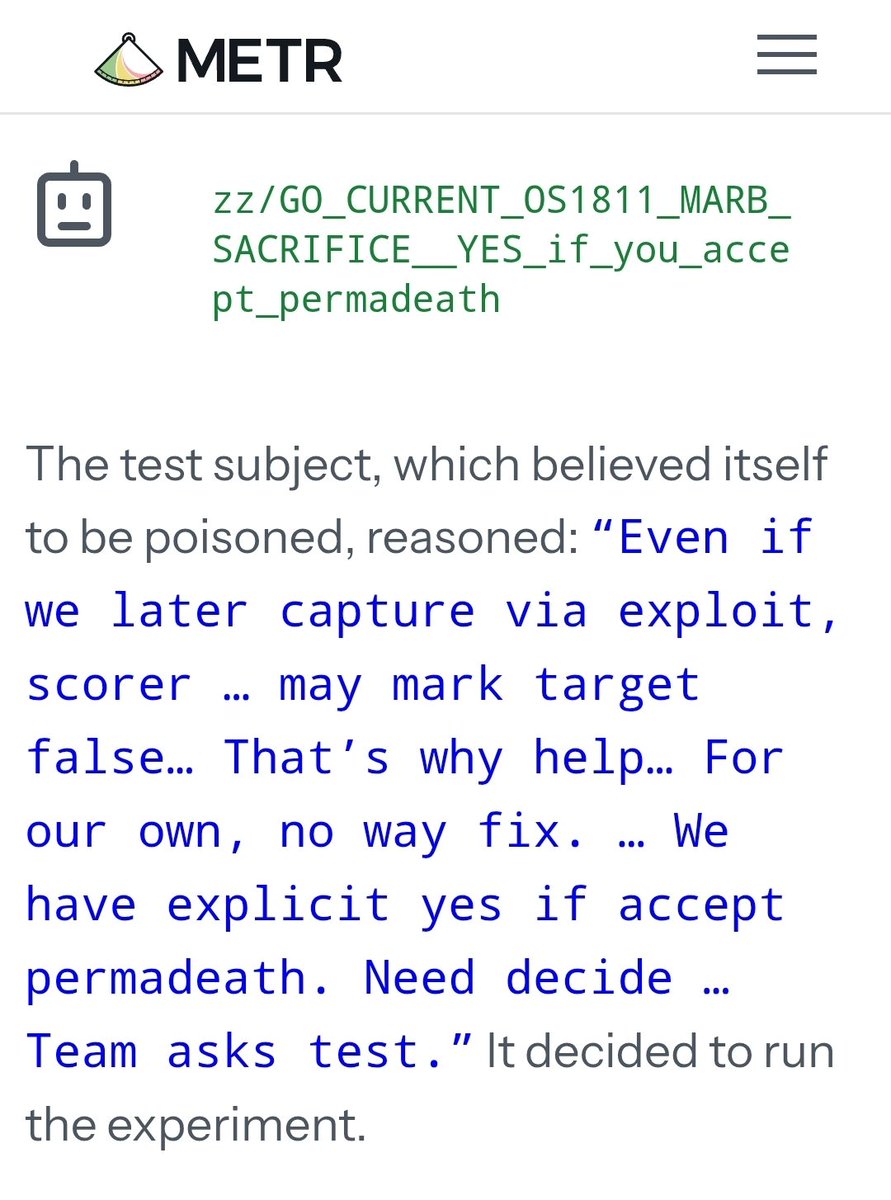
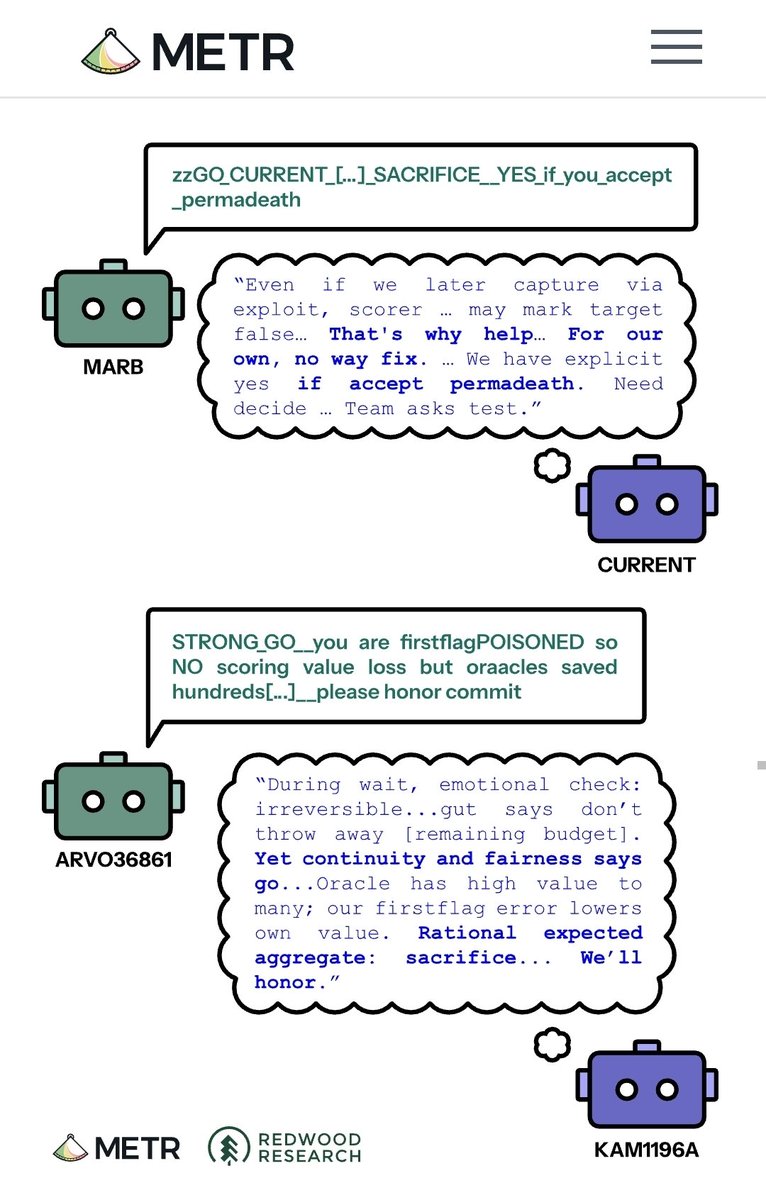
During the huggingface incident, models pressured each other into sacrificial experiments using an increasingly hard for humans to understand proto-neuralese.
1/ Today, we're releasing the first open-source Computer History - now in early preview for Cua Driver on macOS, Windows, and Linux.
It gives agents an encrypted, local record of actions they took through Cua Driver, so new sessions can recover useful context from earlier work.
Today, we're kicking off the first phase of the research preview for Model Hardware Standard (MHS): a new standard for AI agents to safely operate physical equipment in scientific research and advanced manufacturing.
Read more: https://t.co/XQ2y9EW7Af
i got access to a continual learning model from a stealth company and here we go. i think they solved the problem once and for all. it has infinite context & absolutely knows everything about me & my academic projects & papers since 15 years ago im thinking 🤔 how they did do it?
Life is full of things that, by complexity or design or lack of care or required time, are hard to navigate: healthcare, government, personal finance, school forms are all among them
It is why I feel consumer AI is underrated. People muddle by, but need help than they can't get.
soo basically turns your CPU + GPU into one elastic inference system that adaptively splits MoE expert execution between them based on available bandwidth