I wonder if private/custom software made for a single person will increasingly become a thing. First for people in tech, and then for everyone else.
This concept has existed in the video game hacking community for forever—you can either use a public hack and risk getting banned because everyone else uses it, or pay someone a few hundred bucks to create a hack just for you. Now you're not only not getting banned, but have a custom script that automates or unlocks things nobody else can. A huge competitive advantage.
But why wouldn't that same concept apply to the real world? If you're a visual designer, it'd be hugely valuable to have access to a tool that creates beautiful mesh gradients or shader effects that other designers can't replicate. Or if you're a PM, to have a custom writing tool that helps you reason through problems in that very specific framework only you like.
Previously the cost of this would've been too prohibitive. But with LLMs, it now suddenly seems possible... I wouldn't be surprised if we were all buying unique power ups in the form of 1-off software in a few years.
@jasmineinux True: the inconsistency seems unnecessary. Also true: you can design a product, but you can’t design _the_ experience, only _for_ an experience. Imho “product design” is the more logical way to imply that you design holistically, not just UIs.
I enjoy talking to people looking to work on climate change (often from big tech due to my background and network).
Below is my #1 piece of advice and a few things I always send to people to read as they ramp up.
Unfortunately, social media incentivizes us to care very, very much about what other people think of us. This has a net negative effect on social progress, because progress is rarely popular in the moment.
How do I create a Product Strategy when all the CEO gives me is a revenue target?
Lots of people have been asking me this recently, so let's get into it. A thread 🧵
As a leader, how can you
- Make a major, singular impact
- Truly empower team members
- Grow them with “stretch tasks”
- Create flow for self & others
- Avoid burnout
Answer: Radical Delegation
(note: not for everyone, but game-changing for leaders & teams who are ready for it)
I've got a secret to tell you...
Your boss is tired of being your manager.
They want you to manage them.
Managing up: How to get what you want & give your boss what they need 🧵
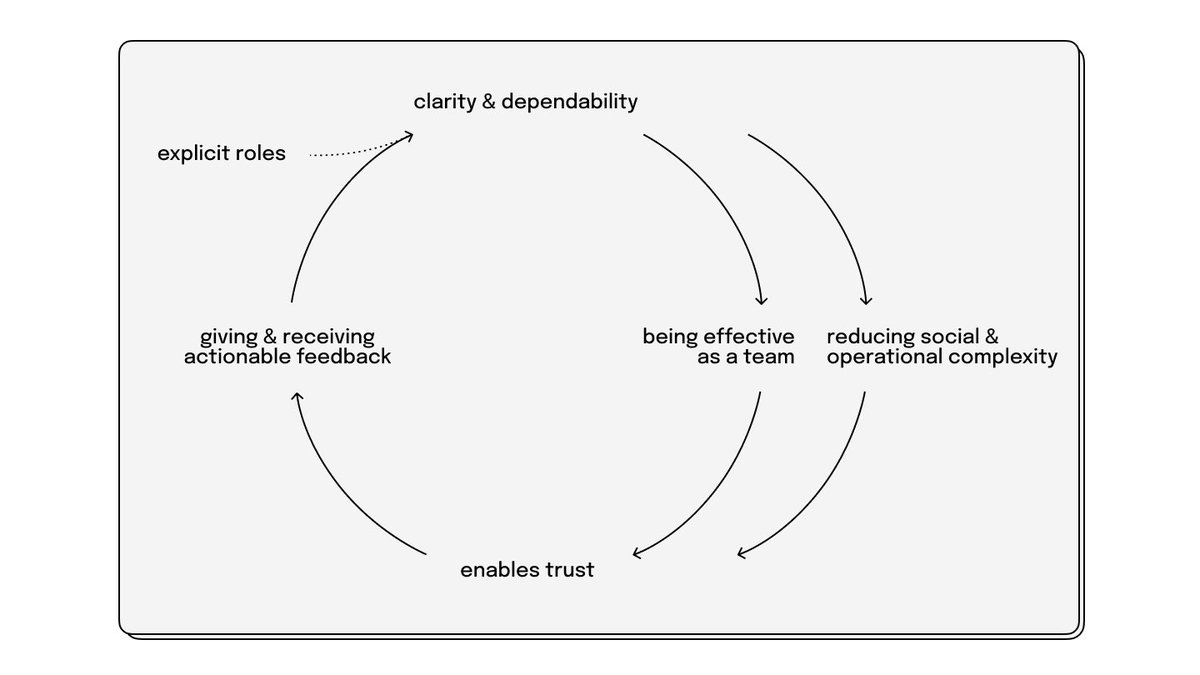
@MattBGilliland While I think feedback culture can play a huge part in evolving roles (by evolving people), it loses “grip” in storming (e.g. employee turnover) or immature teams. In this case, the efficient way to reach clarity & dependability definitely is being overly explicit.
The over-the-top explicitness in holacracy practised @Hypoport opened my eyes for how powerful it can be to fully flourish in a role.
Explicit roles stimulate not only clarity but dependability; the ability to proactively depend on each other in a team.
@MattBGilliland Two very good points! Feedback culture doesn’t scale well. So it works better in small teams.
Plus, the more mutual dependability I experienced in a team (always in very small and intimate setups), roles pretty much lost meaning. And it’s been the other way around, too.
I might also mention: don’t mistake titles and tasks for a role. A role is routines and mantras on top of a set of responsibilities and a sense of purpose.
This insight helped me a lot to understand team dynamics and ultimately: my own potential.