It is a source of continuous delight to watch the AI community rediscover the fundamentals and the dynamics of software engineering as they take those things and embellish them with AI adjectives, making them sound all fresh and new and sparkly while in truth, those fundamentals remain, well, fundamental.
Remove AI from the discourse below, and what Andrew promotes are things one heard all the time as we saw - starting decades ago - the transition from assembly language to FORTRAN and COBOL, from structured to object-oriented, from waterfall to agile.
The past, as is said, does not repeat itself but rather rhymes.
Don’t get me wrong: I celebrate what Andrew et al are doing: developing software-intense systems that are meaningful and that endure requires intention and discipline, and I embrace that.
Two dangling threads before I close:
I don’t grok the semantics of “traditional teams”. The cosmos of computing is so wide and deep and diverse and crosses so many domains, I conclude that “traditional teams” is what one says when their experience is in a relatively narrow space, and they are witnessing a shift from what they grew up with in the Valley in particular, where web-centric systems of global elastic scale remain the primary focus.
Second, I am dismayed at the focus on speed. If you are driving head long Thelma and Louise style toward an IPO then certainly speed will be a critical factor. But for most of the domain of computing, for systems that are meaningful and that endure, other factors are far more important: correctness, repeatability, safety, maintainability, these dominate, and as such, don’t be distracted by the noise and smoke and heat and light of an AI first style that may get you out of the starting gate quickly, but will fail you in the ultra marathon of most development.
I invite all speaker friends to consider submitting proposals for CincyDeliver, scheduled for July 24. The Call for Proposals (CFP) is open until March 16. New speakers are encouraged to submit. Complete details are available at https://t.co/2yuXMtO6Co.
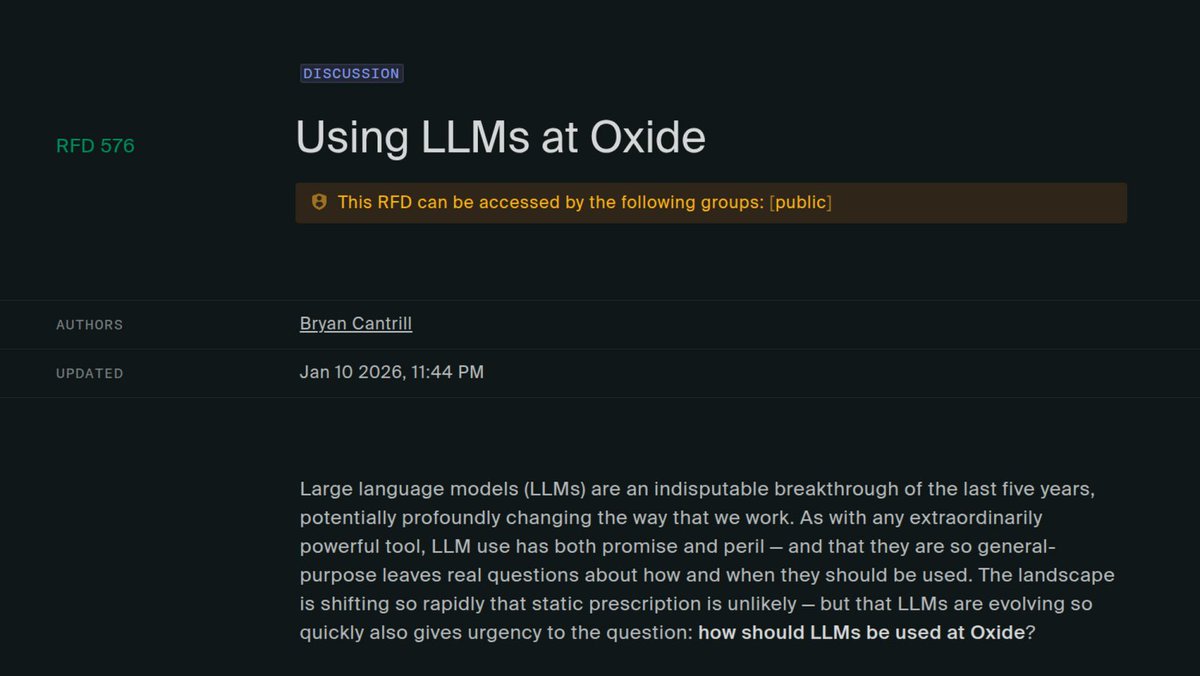
One of my favorite people in tech is @bcantrill and he wrote one of the most thoughtful essays about LLMs I've read in the last two years:
https://t.co/c3EjLujYMM
Every congressional democrat and every democrat who's running for president should be asked a simple question:
Do you think this officer was wrong in defending his life against a deranged leftist who tried to run him over?
These people are going to try to arrest our law enforcement for doing their jobs. The least the media could do is ask them about it.
https://t.co/yM4cIR20Zt
Kristi Noem must resign today.
Her time as Secretary has been a complete moral failure and a public safety disaster. ICE under her leadership has repeatedly ignored our laws, terrorized communities, and made America less safe.
She must resign.
Early observations between Claude Code and Cursor. Composer 1 is really fast. I'm used to asking Claude questions, ask Composer 1 a question (in Agent mode) and it'll rewrite half your code base before you realize it's not going to answer your question.
Claude Code and Codex do not replace Copilot and Cursor.
I've already heard multiple people make this argument, and I think it comes from the vibe-coding community because of the way they use these tools.
First, Claude Code and Codex are agentic coding tools. They are good at following instructions and generating a ton of code at once.
Second, you have Copilot, Cursor Tab, and similar AI assistants. They help with interactive development, where a human writes the code, and the tool autocompletes and suggests what to type next.
A way to think about this:
• Mode 1: AI writes the code, and the human copilots.
• Mode 2: The human writes the code, and AI copilots.
These two are very different. One doesn't replace the other.
Professional developers use both.
The IDE is still king.