When everything is red. The sectors I told you would outpeform are green
Health
Software
Energy
This is classic rotation theory which ruins all the momentum high beta stocks and take them into a bear market. Good companies will still do fine long term. No question.
Pain is always uncomfortable but it is needed to grow.
This is when you add companies you love the most.
We're beginning to see the first meaningful signs of market pressure extending beyond the technology sector as more stocks succumb to the stealth correction. Many of the market's strongest leaders have rapidly become its weakest performers. $SNDK is now down 43% from its high reached just 14 trading days ago, $SPCX has declined more than 45% and continues to accelerate lower this morning, $GLW has surrendered over 40%, and $NFLX has officially become a 50/80 stock, falling more than 50% from its peak. Our $CELC Short Alert on 7/13 proved to be timely.
Some of our strongest performers still holding up well with double-digit gains include: $MATX, $PACS, $CRWD, $MNST, $ADM (which we bumped up yesterday).
Despite the growing weakness beneath the surface, our Open Positions continue to show relative strength, with several names still posting double-digit gains and holding up well. New positions should be given enough room to fluctuate normally, but don't let complacency creep into profitable trades. I wouldn't indiscriminately head for the exits, but this is an environment where tightening stops, protecting gains, and managing risk become increasingly important.
Geopolitical uncertainty is adding another layer of complexity. The conflict between the United States and Iran has expanded beyond strictly military targets, fueling concerns that hostilities could escalate into a broader regional war. With no agreement reached regarding the Strait of Hormuz, the market remains sensitive to the possibility of energy supply disruptions and a renewed inflationary impulse.
One encouraging development is that, despite the recent surge, crude oil remains well below its prior highs. We've seen Middle East headlines create sharp swings in sentiment before, yet quality leadership stocks have generally continued to act well. That remains the key. As long as leading stocks continue to build constructive patterns and respect support, the market deserves the benefit of the doubt.
A meaningful deterioration in leadership or a decisive change in price and volume character would warrant a more defensive posture.
https://t.co/JXzFFTmMtn
I used to be unapologetic and true to myself and now I feel a fraud every time I interact with anyone because I lost sense of who I am or who I want to be or who I was supposed to be
This feels very similar to post Feb 2021 where growth names got slaughtered but indexes held up thanks to the $MAGS
The speculative names will not come back to highs.
2025/26: $OKLO $AXTI $ASTS $NVTS
2020/21: $PTON $PYPL $ZM $ROKU
Maybe we get 1 $CVNA type comeback…
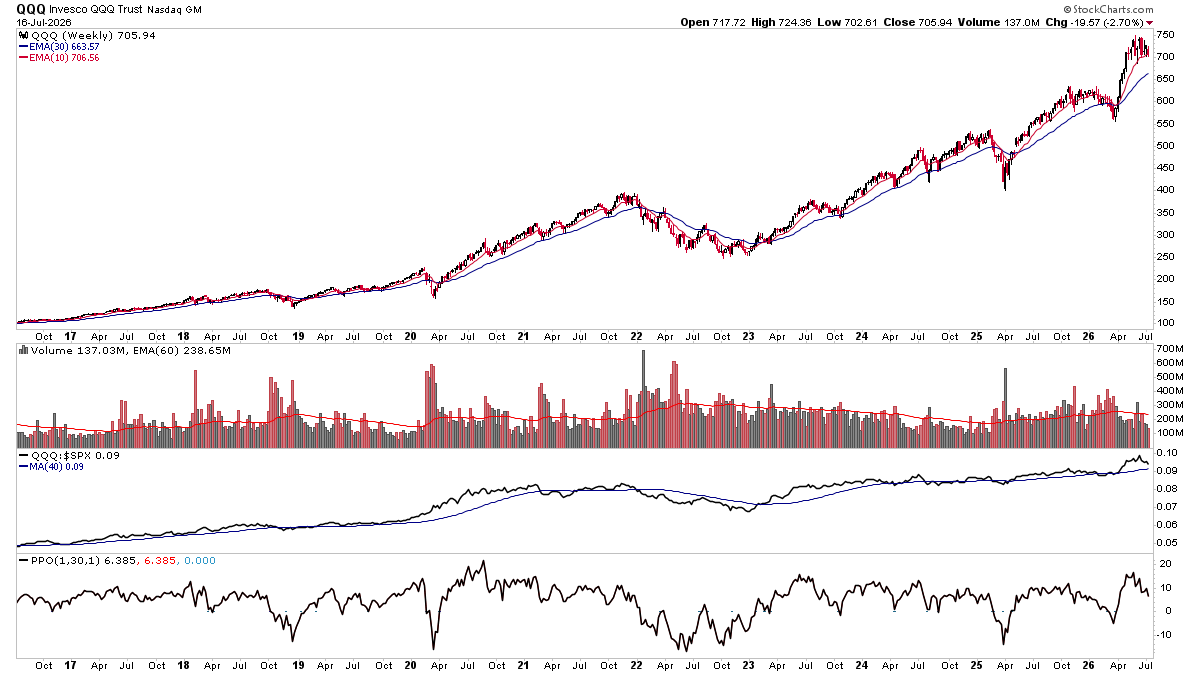
The Nasdaq 100 has led just about every cycle since the 2022 bear market ended, but now two of its main components, software and semis, are under a lot of selling pressure.
The recent move looks like a blowoff top. Wouldn't be surprised to see some cycles of underperformance after the recent move.
Traders using Stage Analysis will be better equipped to handle what is coming next, while those stuck with growth tech stocks are going to be looking for something to trade.
$BTC: Since two months we move sideway
As I said in June, 57-67k is the range
And the next leg down is programmed
Nothing to worry about, all is programmed
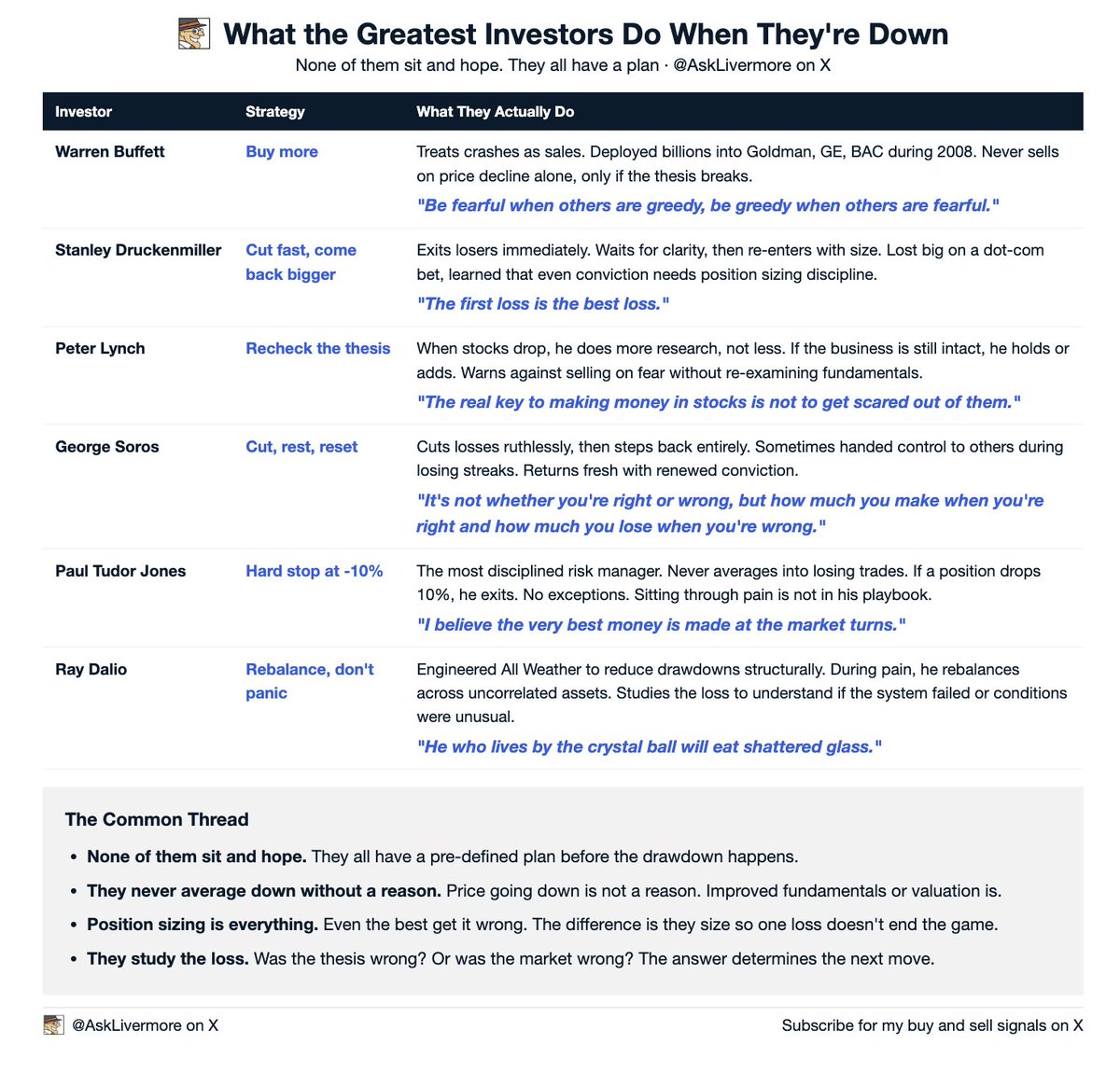
Your portfolio is down and you don't know what to do. Save this for the next time your portfolio is red. You will need it.
Here's what the 6 greatest investors of all time do when they're losing money:
1. Buffett: Buys more.
- he deployed billions into Goldman Sachs and Bank of America during 2008 while everyone else was panicking.
2. Druckenmiller: Cuts fast, comes back bigger.
- he exits losers immediately. No ego. Waits for clarity, then re-enters with conviction.
3. Peter Lynch: Rechecks the thesis.
- when stocks drop, he does more research, not less. If the business is intact, he holds.
4. Soros: Cuts, rests, resets.
- he cuts ruthlessly, steps away from the screen, then comes back fresh with a clear head.
5. Paul Tudor Jones: Hard stop at -10%.
- if a position drops 10%, he exits. No exceptions. No averaging down. No hoping.
6. Ray Dalio: Rebalances, doesn't panic.
he studies the loss. Was the thesis wrong or was the market wrong? The answer determines the next move.
The common thread across all 6:
- None of them sit and hope
- They all have a plan before the drawdown happens
Not buying into downtrends is one of the most valuable skills that traders and investors need to develop.
In 2000-2003, I watched people go broke trying to buy all the way down.
I don't mind getting stopped out when I buy a good chart, but I'm not digging my way into a hole trying to find the lows.
Not saying that this is 2000-2003 at all, but I learned lessons then in what not to do, that stay with me today.
Define your risk at the buy, learn to accept being wrong in trades and keep losses in check.
👀 A look at how the leaders acted 7/16/26:
⚠️ 2/9 Up Today
📈 $AAPL $VLO New All Time Highs!
💪 Cyber Security RS $CRWD $FTNT $PANW
👎 $AMD $ANET Lose 20EMAs
🔁 $AAPL In, $DELL Out
https://t.co/TjLhHYhspG
$AAPL $AMD $ANET $CRWD $DDOG $FTNT $NET $PANW $VLO
The 8/21 cross has called every major AI correction this cycle.
Everyone always misses it.
• $MU -17%
• $SNDK -24%
The hardest part of trading isn’t knowing what to buy.
It’s knowing when to stop buying.
You need to SAVE this and Remember this. You will use it for Years.