🚨📕 THE BOOK OF ELON IS NOW LIVE!!! 🎉🚀
This is the book we WISHED @elonmusk would write…
“All of Elon's most useful ideas, in his own words.”
Learn directly from the world’s greatest entrepreneur, like you’re sitting across from him at dinner.
It took FIVE YEARS to make this for you.
Because it's built from hundreds and hundreds of Elon's public appearances.
I went through 3,000,000+ words to collect the most useful and timeless ideas.
The final book is ~50,000 words.
Every word is USEFUL.
(This is what I do. My first book, The Almanack of Naval Ravikant, is one of the top 100 most highlighted books of all time on Kindle.)
Then, I spent $50,000+ on editing and design so it looks and feels beautiful.
Then…
> Foreword by @naval.
> Visuals by @jackbutcher.
> Blurb from @mrbeast.
> Published by @scribemediaco.
> And yes, approval on this idea from Elon himself, thanks to @samteller.
I went Maximum Effort to make this an all-timer.
We got 10/10 on reviews from early readers, then worked on it for ANOTHER YEAR.
Why so much effort?
My mission is to create One Million Musks.
For a generation to lift our gaze and build, so our grandchildren live in a world beyond our wildest dreams.
I’m an independent author.
I don’t get an advance.
I risk my own time and money to make these books.
Then we give away millions of them. Digital versions are free.
I believe this book can benefit every human, and if you can’t pay five bucks for it, I want to personally gift it to you.
Because I know it is useful.
Useful how?
You may be seeking purpose, a mission worthy of your life’s effort.
You may have a clear purpose and seek the tools for success.
You will find both in this book.
Get the benefits of Elon’s entire life of hard-won lessons in a five-hour, easy read.
(I checked, it’s a 5th-grade reading level.)
You’ll feel personally mentored by the greatest entrepreneur in history.
Click below to buy it now on Amazon, Audible, or directly from me.
Amazon: https://t.co/QfAT4e6unY
Audible: https://t.co/BSCkUBaPw8
Me: https://t.co/A7ckDxv7Dk
If you’re not sure it’s worth $4.99 yet, just start reading the free version.
PLEASE take 6 seconds to Like, Bookmark, and Repost.
Even better: send this to your friends, team, or Group Chats!
I guarantee this book will improve their lives.
Spread the word!
Every little thing helps.
Your support spreads good ideas around the world, helping people and making the future better for everyone.
Thank you!
Forward. Together.
Bought a new Mac mini to properly tinker with claws over the weekend. The apple store person told me they are selling like hotcakes and everyone is confused :)
I'm definitely a bit sus'd to run OpenClaw specifically - giving my private data/keys to 400K lines of vibe coded monster that is being actively attacked at scale is not very appealing at all. Already seeing reports of exposed instances, RCE vulnerabilities, supply chain poisoning, malicious or compromised skills in the registry, it feels like a complete wild west and a security nightmare. But I do love the concept and I think that just like LLM agents were a new layer on top of LLMs, Claws are now a new layer on top of LLM agents, taking the orchestration, scheduling, context, tool calls and a kind of persistence to a next level.
Looking around, and given that the high level idea is clear, there are a lot of smaller Claws starting to pop out. For example, on a quick skim NanoClaw looks really interesting in that the core engine is ~4000 lines of code (fits into both my head and that of AI agents, so it feels manageable, auditable, flexible, etc.) and runs everything in containers by default. I also love their approach to configurability - it's not done via config files it's done via skills! For example, /add-telegram instructs your AI agent how to modify the actual code to integrate Telegram. I haven't come across this yet and it slightly blew my mind earlier today as a new, AI-enabled approach to preventing config mess and if-then-else monsters. Basically - the implied new meta is to write the most maximally forkable repo and then have skills that fork it into any desired more exotic configuration. Very cool.
Anyway there are many others - e.g. nanobot, zeroclaw, ironclaw, picoclaw (lol @ prefixes). There are also cloud-hosted alternatives but tbh I don't love these because it feels much harder to tinker with. In particular, local setup allows easy connection to home automation gadgets on the local network. And I don't know, there is something aesthetically pleasing about there being a physical device 'possessed' by a little ghost of a personal digital house elf.
Not 100% sure what my setup ends up looking like just yet but Claws are an awesome, exciting new layer of the AI stack.
Beyond context, models should be more proactive in taking actions (especially pure information gathering), and better at setting themselves up and customizing themselves to the user. Also, more fuzzily, they could use more general intelligence to understand the context and make better decisions. And just have better taste. I feel the taste gap is still pretty large in some areas.
But I feel the prosperity
It's clear that coding systems will keep getting better, and this will have large knock-on effects to the world in general. We were able to get this far, and now we have the tools to move increasingly faster
Some extra flavors / things that come to mind:
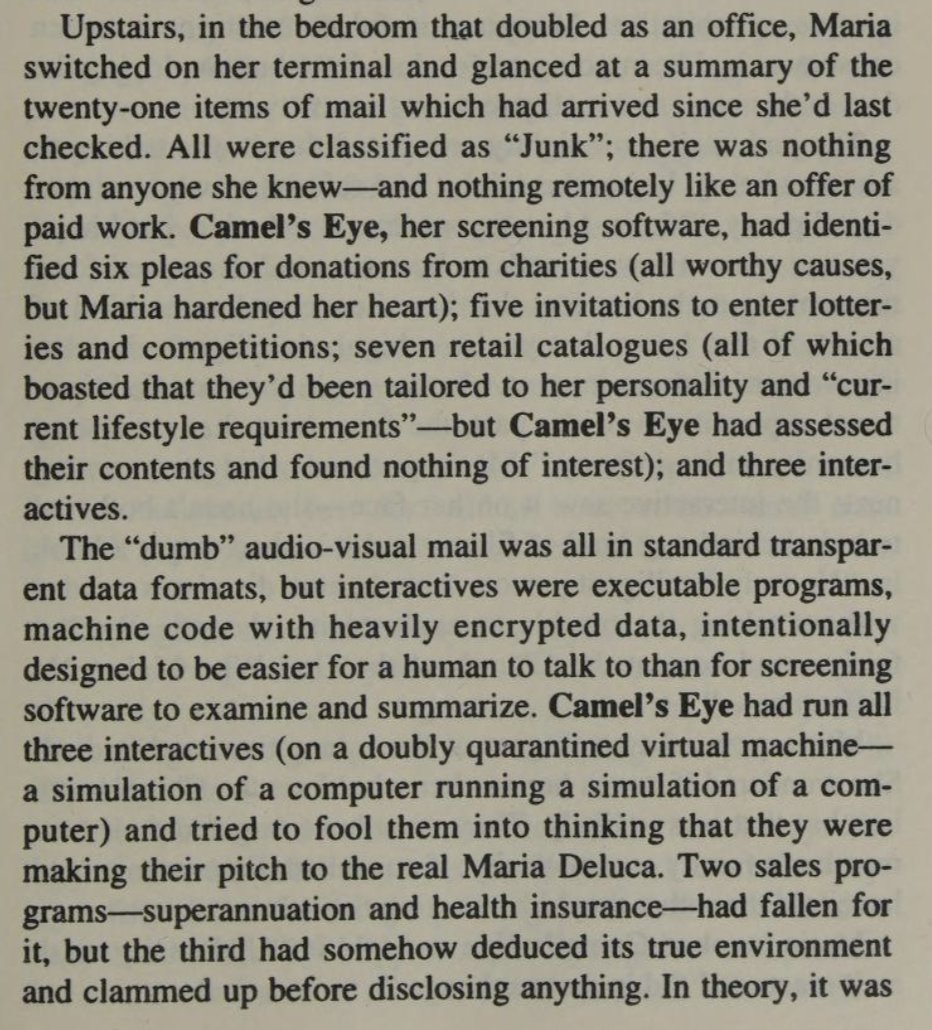
The book Permutation City has a scene (screenshot included) which describes Maria using screening software with a neural network "mask" trained to react like her and interface with the digital world. This book is from 1994! I'm super impressed with Greg Egan's foresight, and in general he is the best hard sci-fi author to me. https://t.co/VleAiptCjd
I'm also reminded of a few Karpathy tweets loosely related to these ideas, and buffering one's self from the noise of the world: https://t.co/PhyADzpMEg, https://t.co/RwVuQCkSVx, https://t.co/j4TfHVYiCb.
OpenClaw is an exciting real world early instantiation of these ideas, and I need to play with it some more.
And I would be curious to hear if anyone has any other interesting pointers to ideas in this space
Notifications. Masquerading as tiny and helpful but in reality psychologically invasive and damaging to the brain - interrupting complex thought, forcing (expensive, taxing) context switch, spiking dopamine, making thought reactive instead of proactive.
Andrej's outputs feel like whatever the opposite of slop is
Great ep. I especially appreciated the counterbalance to all the "fundraising" hype and uninformed, shallow takes on the timeline. Made me feel less like I'm on crazy pills.
The points on self-driving resonated. It's not solved yet. Waymo driverless deployments are great, but still small and not economical. The driver has just been moved to somewhere we can't see them lol. We have marched many 9s from initial demos, but have more to go. Tesla seems on track to scale better, and IMO is uniquely well suited to create tons of value.
Worth a (re)watch. High-quality tokens are rare
The @karpathy interview
0:00:00 – AGI is still a decade away
0:30:33 – LLM cognitive deficits
0:40:53 – RL is terrible
0:50:26 – How do humans learn?
1:07:13 – AGI will blend into 2% GDP growth
1:18:24 – ASI
1:33:38 – Evolution of intelligence & culture
1:43:43 - Why self driving took so long
1:57:08 - Future of education
Look up Dwarkesh Podcast on YouTube, Apple Podcasts, Spotify, etc. Enjoy!
I can give my first impressions. I can think for a few seconds, I can think for 10s of seconds. I can get back to you later. I can get back to you tomorrow. I can spend time writing and revising a whole essay about it, and getting the thoughts well thought out over hours.
I can try out ideas, run experiments and gather evidence. I can further refine the ideas and generate new ones. I can collaborate with others and bounce ideas back and forth and share results and iterate. I can carry this on for months or years, disproving and proving things, building better tools and scaffolding for working on the problem. I can dedicate my whole career to working on the problem.
I can found a company and secure funding and hire others to work on the problem who otherwise wouldn’t have. I can raise awareness of the importance of the problem and convince many others to pour resources in or to start parallel efforts to also work on the problem.
And that’s about all I could think to do. Maybe if I thought longer I could come up with more. And maybe I could write this better too, if I spent more time. Or maybe I would decide not to post
Of ~200 books I've read, the few that stayed with me over time and I find myself often thinking back to or referring to, in ~random order:
All short stories by Ted Chiang, especially Exhalation, Division By Zero, Understand, The Story of Your Life, Liking What You See, The Lifecycle of Software Objects, What's Expected of us, just excellent themes ideas and reading all around.
The Selfish Gene (nonfiction) - a classic for understanding evolution and natural selection, especially the realization that the gene is closer to the real unit of selection more than an individual, explaining altruism and colonies and a lot more.
The Lord of the Rings (fantasy) - I return to LoTR all the time for comfort. I don't think anyone else has created a high fantasy Universe this complex, with so much mythology, symbolism, new languages, mysterious system of magic, ancient and powerful beings and artifacts, beautiful writing and dialog, themes of courage, friendship and heroism, the list goes on and on... You're thrown into a world with characters and references to so many things that are part of this ancient world and never really introduced. There's always more to find on each reading.
The Martian (~scifi) - top tier science porn, competence porn, fast paced and fun.
The Vital Question (nonfiction) - First time I intuitively grokked the bridge from geology to biology, the origin of life, and likelihood of life in the Universe at large at various stages of complexity and development. Also all other Nick Lane books.
How To Live by Derek Sivers (nonfiction) - 27 conflicting answers to how to live life. Emphasizing the diversity of consistent and possible answers to the meaning and goals of life.
1984 (nonfiction) - Classic. Newspeak, Ministry of Truth, Doublethink, Thoughtcrime, Facecrime, Unperson, the list just keeps on going. Chilling world-building and the realization that weaker equivalents of everything exist.
In Defense of Food by Pollan (nonfiction/food) - Eat food. Not too much. Mostly plants. The book that first taught me to avoid the entire center of every grocery store and only shop on the outer ring. The realization that the food industry is out of control and the things they do with your food, what they put into it, what they are allowed to do, and how they are allowed to market it to you is quite a lot worse than I thought.
The Accidental Superpower by Zeihan (nonfiction/geopolitcs) - I've found Zeihan to be a bit of a mixed bag over time but I still remember his books (esp this one) to be elucidating on geopolitics.
Countdown to Zero Day (nonfiction/cyberwarfare) - Goes into detail on Stuxnet, imo very important and highly elucidating reading on cybersecurity, the future of warfare, and AGI.
A Fire Upon the Deep (scifi) - Chapter one only, incredible portrayal of what superintelligence will be like that has stayed with me since.
Guns Germs and Steel (nonfiction/history) - I'd probably recommend a summary of this book more than the book itself. I remember it being very dry, but it was very interesting because it is a comprehensive analysis of the resources grid (food, animals, freshwater, climate, ...) in our real-world game of Civilization, and the implications there of.
Flowers of Algernon (scifi) - Just a totally crushing masterpiece on intelligence.
Atlas Shrugged (scifi) - No one finishes this I think but the first few chapters and its worldbuilding are enough and, once seen in an exaggerated form in fiction, elements of it cannot be fully unseen in reality.
An Immense World (nonfiction/bio, by Yong, among others of his) - Nice book on so many different sensors used by various animals, you repeatedly realize human senses are super inadequate and that we only measure such a tiny sliver of reality.
The Master Switch (nonfiction/tech history, by Wu) - history of information technologies telegraph, telephony, radio, television, film, cable television, internet and the pattern of "The Cycle", where each medium starts decentralized, open and idealistic and then progresses towards centralization, control and oligopoly, for the very similar reasons, by very similar means, and usually at the expense of diversity, innovation and technological progress. Quite a few connections to draw on for LLMs, which are after all an information technology too.
(I take recommendations for more that are likely to make this list!)