I'm a cardiologist. A woman loses her husband. Two days later she's on my cath lab table — chest pain, EKG changes, enzymes elevated. Everything says heart attack.
I thread the catheter. Her arteries are pristine.
Her heart didn't clog. It shattered. From grief.
Takotsubo — broken heart syndrome. Stress hormones stun the ventricle so severely it balloons and stops pumping. 90% of cases are women. Your heart can literally break. Not a metaphor. Physiology.
But this is just one blind spot in a system built for men's hearts.
Women get microvascular disease — plaque in vessels too small for angiograms to see. Heart attacks with "clean" arteries.
Women get SCAD — leading cause of heart attack under 50. Most doctors have never diagnosed one.
Women present with fatigue, jaw pain, nausea, back pain. Medicine called these "atypical" for decades. They're not atypical. They're female-typical.
Half of humanity is not a variant.
Heart disease kills more women than every cancer combined. Fewer than half know.
Three things every woman needs to hear:
Say these exact words to your doctor: "I am concerned this could be my heart." That sentence changes everything. Don't soften it.
If tests are "normal" but symptoms persist — demand CT angiography or cardiac MRI.
If you had preeclampsia — your cardiac surveillance starts now. Not at 65.
Your heart can break from grief, from stress, from a system that wasn't built to see you.
It can also heal. If someone finally looks.
Share this with every woman you love.
With the support of @HLTurtleTrooper, this funding will help the City safeguard Snapping Turtles at Loafer’s Lake by implementing on-the-ground restoration actions to enhance their habitat. 🐢
(2/2)
Today, the @ONgov announced funding through the Species at Risk Stewardship program to the @CityBrampton to help #Brampton protect our natural environment.
(1/2) 🔽
A fantastic announcement bright and early this morning with @DavidPiccini to announce funding that will help provide a safer home for our turtles at Loafer’s Lake.
A special thank you to @HLTurtleTrooper for your commitment to our community and environment.
#onpoli
🏆 The Big Wins
🥚 $15 K in Funding Approved! This City funding will directly support Brampton egg incubation @ScalesNaturePrk under the ARCC program!
🎣 Improved responsible fishing signage!
🎥 Want to watch the delegations? https://t.co/o5ON945bm5
Beneath the surface, female turtles are in their "pre-nesting staging phase." 🌊🐢
They are gathering in the shallows to:
☀️ Bask & mature their eggs
🔋 Conserve energy
👁️ Scout the shoreline for the perfect night to nest
If you see them, enjoy the magic from a distance! 🥚✨
Gosling rescue at our local wetland. Poor sweetheart had a fishing line entangled around its foot. 😭 #bramptonanimalservices did a phenomenal job removing the fishing line and reuniting the gosling with its parents and family 💗
#rescuemission#responsiblefishing
Heart Lake Turtle Troopers planting trees at Donnelly East Park, Brampton (our adopted park). Hosted by @TRCA_HQ@TRCA_Events and @CityBrampton Parks & Forestry. 250 trees planted by community members 🌲💚🐢
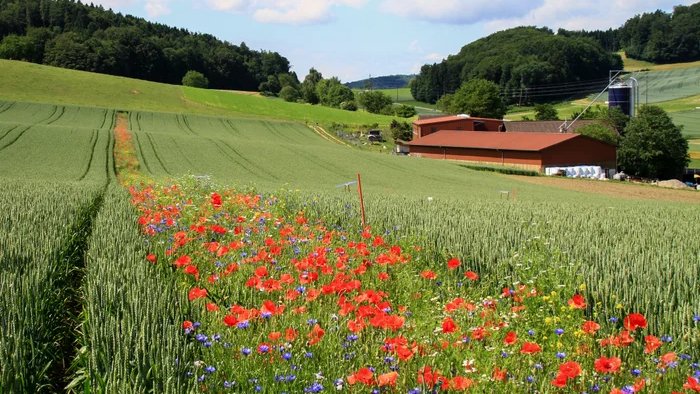
Farmers have figured out that the cheapest pesticide is a strip of flowers.
When you plant wildflowers through a crop field, not just around the edge but in strips running through the middle, you get ladybugs, lacewings, hoverflies, and parasitic wasps living in the field instead of visiting it.
They eat the aphids, the caterpillars, and the mites for free, all summer long.
In controlled trials, fields with tailored flower strips had leaf-beetle numbers 40 to 50% lower and crop damage cut by around 60%, enough to drop below the threshold where spraying was even considered worth it.
The flowers attract a standing army to our fields.
We spent decades engineering chemicals to kill the insects eating the crop, when the insects that eat those insects would have worked for the price of seed.
It is 6.40am on a Tuesday in May. The BBC weather, on the radio in the kitchen, has promised sunny intervals. Brian, looking out at the fell, sees Doris already in the lee of the wall, head slightly down, wool flat against her left side. He puts down his mug. He reaches for his coat. By 10.30am, the rain has come in horizontal off the fell, and the BBC has updated the forecast.
Doris was twenty-six minutes ahead.
She is, by Brian's working tally, twenty-six minutes ahead on about 70% of weather changes.
Sheep have, anatomically, several reasons for this.
A coat of wool that responds to humidity at a level of measurable precision. Wool fibres swell by approximately 16% in diameter at high humidity. A sheep moves slightly differently in damp wool than in dry wool, and Doris has been doing that calculation in her own body for her entire working life.
Olfactory receptors significantly more numerous than the human equivalent. Sheep smell the change in the air long before a human notices the cloud has started to lift.
Barometric pressure sensitivity, well-documented across livestock species. Doris can feel a storm coming before the storm is visible from the gate. She does not know it as a forecast. She knows it as a slight discomfort, and she addresses the discomfort by moving to the lee.
Behavioural rules of thumb developed across millions of generations: lie down before rain, find the lee before wind, move uphill before flooding, move downhill before heavy snow. These are not chosen behaviours. These are the heritable wiring of an animal that has, in the British uplands, had to be right about the weather for ten thousand years.
Brian has, on the farm next door, been watching the flock for thirty-one years. He has observed Doris's behaviour against the BBC forecast more times than he can count.
The BBC has not, to our knowledge, attempted to recruit her.
The BBC's loss.
The forecast said: sunny intervals.
It is, by 10.30am, raining.
The sheep was right.
The sheep is always right.
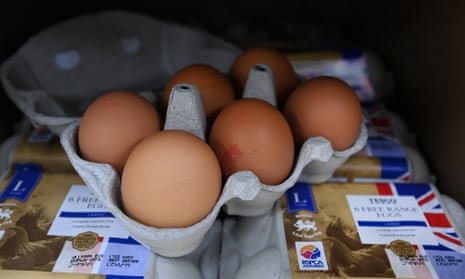
If you opened a free-range supermarket egg in Britain in 2026 and the yolk was a deep marigold orange, you were, in most cases, looking at a piece of marketing.
Yolk colour comes from carotenoids in the hen's diet. A hen on grass, eating insects and weeds, lays a yolk somewhere between deep yellow and pale orange, varying by season. A hen confined indoors on grain mash lays a pale, almost beige yolk.
The supermarket consumer has been trained to associate orange yolks with quality. The egg industry has solved the problem by adding pigments to the feed of barn and caged hens. The two main additives are marigold extract and paprika extract. Both are technically "natural." Both produce yolks of any desired colour, on demand, in feedlot conditions.
The industry uses a calibration tool called the DSM Yolk Color Fan, a 16-step chart from palest yellow to deepest red-orange. The producer picks a target number based on which supermarket they are supplying. UK shoppers tend to prefer 8 to 10. Germans prefer 14. The hen is fed accordingly.
Yolk colour, in the modern egg industry, tells you almost nothing about how the hen lived. It tells you what number the producer dialled in.
What does tell you something:
- A real pasture egg's yolk varies by season: paler in winter, deeper in summer
- The shell is dense, the white firm, not watery
- The egg tastes of something
- The omega-6 to omega-3 ratio is around 5:1 to 8:1 in pasture eggs, against 15:1 to 20:1 in barn eggs
The yolk colour was always a marker. The marker has been hijacked.
Drive twenty minutes. Find a farm. Meet the hen.
The supermarket has not.
A sheep eats grass on a Welsh hillside where nothing else will grow. The slope is too steep for a tractor, the soil too thin for a plough, the rainfall too relentless for crops.
In return it provides:
- Wool (renewable clothing that biodegrades back into soil)
- Meat (complete nutrition in one package)
- Lanolin (waterproofing, cosmetics, leather conditioning)
- Sheepskin (insulation, clothing, rugs that outlast the sofa)
- Bones (tools, broth, fertiliser)
- Manure (soil building, free of charge)
All from grass on terrain that no other food system can touch.
The environmental alternative is petroleum-based fleece that sheds microplastics into every river, synthetic insulation spun from fossil fuels, and food imported from industrial agriculture that's busy turning prime farmland into dust.
But the sheep grazing on a cliff in Snowdonia is the problem.
Make it make sense. I'll wait.
On the second Sunday of April, a couple from Birmingham walked the footpath that crosses Brian's fell.
Their dog, a young border collie named Otis, was off the lead.
There were sheep in the field.
Otis went after the sheep.
The owners called Otis. Otis did not return. Otis was, in dog terms, six months into a lifelong relationship with sheep that had, until that moment, consisted entirely of seeing them on television.
Otis chased a small group of younger ewes for approximately eighty metres, which is, in Otis's own assessment, a successful afternoon.
Doris, who was on the section above the wall, observed this.
Doris did not run.
Doris walked, deliberately, at a measured pace, to a position approximately fifteen metres from where Otis was, by then, pursuing the younger ewes in a circle.
Doris stopped.
Doris looked at Otis.
Otis stopped.
There is, in the literature on livestock guarding behaviour, a phenomenon known as the calm interdiction. It does not require aggression. It does not require display. It requires only a confident, settled animal placing itself in the path of the disturbance and refusing, with absolute mildness, to be impressed.
Otis, who had, until that moment, been having the best afternoon of his short life, was suddenly looking at a Texel ewe who was not running.
The category had broken.
Otis sat down.
The owners reached Otis approximately two minutes later. Otis was on the lead by then. The owners apologised, profusely, to Brian, who had walked up from the gate at a measured pace and was holding his stick in the way that people who have not been to agricultural college nevertheless know how to hold sticks.
Brian: "You'll need to keep him on the lead from now on."
Owner: "Yes. Of course. We're so sorry. We didn't think."
Brian: "Most don't."
He could have said more. The law gives him the right to shoot a dog worrying livestock. The literature on stress-induced lambing failure is extensive. The young ewes, by the time Brian reached them, were panting hard enough that Brian made a mental note to check them again in the morning, and to tell the apprentice to do the same.
He didn't say any of this.
He said: "Have a nice walk."
He went back down to the gate.
Doris, by then, was already grazing again.
The young ewes recovered.
The lambing in autumn was unaffected.
British footpaths cross approximately 140,000 miles of farmland. They have done so since some of them were carved by mediaeval cattle. The system depends on dogs being on leads near livestock, on walkers closing gates, on the basic countryside code that takes about four minutes to read and is, somehow, still not being read.
Doris has not read it either.
Doris does not need to.
Doris simply stops, and looks, and the dog stops with her, and the system holds for one more afternoon.
It would be nicer if it didn't have to.
Eduardo was sheared in May.
He stood, as he stands every May, with the patience of a camelid who has done this nine times. He hummed once. The glossary lists it as "acknowledgement of necessary inconvenience." He did not move. He did not flinch.
His fleece weighed three point eight kilograms. The fibre measured 22 microns. Sheep's wool from a typical British breed sits between 28 and 36.
Eduardo's wool is finer than cashmere. No lanolin, so no chemical scouring. Hollow-cored, so it traps more warmth per gram than the wool of any sheep on this island. It does not pill. It does not itch. It sheds water in a way that synthetic fibre engineers have spent forty years trying, and failing, to replicate.
The vegan alternative is acrylic.
Acrylic is petroleum. Polyacrylonitrile, derived from crude oil, polymerised in a chemical plant using a hydrogen cyanide catalyst, dyed in processes that have, on more than one occasion, made the news.
An acrylic jumper sheds approximately 730,000 microplastic fibres per wash. Into the rivers, the seas, the food chain, the placentas of unborn children, the lungs of the rest of us.
Eduardo's jumper sheds nothing. At the end of its life, it goes back to the soil. The acrylic jumper goes to landfill for two thousand years.
Now. The suffering question.
Eduardo was, for eleven minutes, mildly inconvenienced. He stood still. He tolerated the sound of clippers he has heard nine times before. He was handled by a shearer whose hands he recognises by smell.
Afterwards, he was lighter, cooler, and visibly relieved. He hummed twice in the register the glossary lists as "satisfaction with current arrangement," walked to the geometric centre of the field, and kushed.
If he had not been sheared, the fleece would have grown through summer and caused him to overheat. By autumn it would have felted against his skin, harbouring parasites.
The shearing is not the suffering.
The shearing is the relief.
The fleece is in Powys. Eduardo is humming. The summer is properly underway.
Your vegan oat-and-almond latte killed more bees, drained more groundwater, and required more long-haul lorry mileage than a year's worth of dairy milk from a Welsh cow that drank rain. You will not have heard about this, because the carton has "plant-based" on it in nice green lettering.
California's Central Valley produces 80% of the world's almonds. Every almond on every supermarket shelf, in every flapjack, blended into every oat-and-almond latte from London to Berlin, started life in one valley in central California.
A gallon of almond milk requires around 162 gallons of irrigation water. A gallon of British dairy milk uses around 8 gallons of tap water, and the rest comes from rain falling on grass that grows nothing else of nutritional value to humans. The cow drinks the rain. The almond tree drinks the aquifer.
California almonds consume approximately 1.1 trillion gallons of irrigation water annually. Roughly the same volume of water used by Los Angeles and San Francisco combined. Around two-thirds of the crop is then exported to Asia and Europe. A state in repeated drought emergencies, where over a million residents lack reliable access to clean drinking water, is locking its aquifer inside almonds and shipping it overseas in containers.
Almond trees bloom for three weeks in February. To pollinate 1.5 million acres of orchards in that window, California requires roughly two-thirds of every commercial honeybee in the United States to be physically transported into the Central Valley on flatbed lorries. The largest managed pollination event on earth, every year, conducted on the back of a truck.
The bees are released into groves sprayed with neonicotinoids, which scramble their navigation. Fungicides, which weaken their immune systems. Herbicides, which have already killed the wildflowers they would normally forage on between blooms.
Between June 2024 and March 2025, US commercial beekeepers lost 62% of their colonies. 1.6 million colonies dead. The largest honeybee die-off ever recorded in American history. The trigger period for the worst losses was the months immediately surrounding the almond bloom.
Meanwhile, beneath the orchards, the ground itself is sinking. The US Geological Survey has documented parts of the San Joaquin Valley that have subsided by up to 30 feet since groundwater pumping began in the 1920s. The valley lost as much elevation between 2006 and 2022 as it lost in the previous forty-five years. The Friant-Kern Canal has lost 60% of its flow capacity because the land beneath it sank faster than the canal could be redesigned.
Once those clay aquifer layers compact, the storage is permanently lost. The aquifer is being run as a one-way withdrawal, and California has been told this in formal hydrological reports for decades.
The land was never meant to grow almonds. The bees were never meant to live on flatbed trucks. The aquifer was never meant to be a tap.
But the carton says "plant-based" in nice green lettering.
So, presumably, you are saving the planet.
Carry on.