MONTHLY DEDICATIONS IN THE CATHOLIC CHURCH
Dear Catholics, do you know that each month in the liturgical year is associated with particular devotions, saints, or aspects of the mystery of our faith?
1. January is dedicated to the Holy Name of Jesus.
2. February is dedicated to the Holy Family.
3. March is dedicated to St. Joseph.
4. April is dedicated to the Holy Eucharist.
5. May is dedicated to the Blessed Virgin Mary.
6. June is dedicated to the Sacred Heart of Jesus.
7. July is dedicated to the Precious Blood of Jesus.
8. August is dedicated to the Immaculate Heart of Mary.
9. September is dedicated to the Seven Sorrows of Mary.
10. October is dedicated to the Holy Rosary.
11. November is dedicated to the Holy Souls in Purgatory.
12. December is dedicated to the Immaculate Conception of Mary.
Breaking News: The Boys who lured their 17year old Childhood friend to their house K!ll£d him and demanded N150M ransom from his parents reveals that this is not their first time. They also k!ll£d a girl in 2025. And collected ₦300k from her own family
Let us #PrayTogether that everyone, from large producers to small consumers, be committed to avoid wasting food, and to ensure that everyone has access to quality food. #PrayerIntention@clicktopray_en https://t.co/S3TtsnBEer
When a priest covers his hands (usually with a veil) while holding the monstrance, he’s using what is called the humeral veil. The Humeral veil is not just for aura or aesthetics. It carries deep meaning in Catholic worship.
- It emphasizes that the blessing comes from Christ, not the priest
During Eucharistic adoration or Benediction, the priest uses the monstrance (which holds the consecrated Host, which is the Body of Christ). By covering his hands, he’s basically "stepping out of the way."
The gesture makes it clear that it is Jesus Himself who is blessing the people, not the priest acting on his own authority.
- It shows reverence for the Eucharist.
As Catholics, we believe in the real presence, that is, we believe that Christ is truly present in the Eucharist. That veil adds a layer of solemnity and honor, similar to how sacred objects in Scripture were handled with great care.
- Biblical pattern of veiling holy things. In the Old Testament, sacred items (like the Ark of the Covenant) were often covered when being carried. The humeral veil is echoing that same idea; that holy things are treated with special reverence and are not handled casually with vibes.
- It symbolizes the priest acting in a sacred role, not as an individual
The priest is not just "himself" at that moment. As a matter of fact he is acting in persona Christi (in the person of Christ). The veil visually reinforces that this is a sacred action beyond ordinary human gesture.
To summarise;
The covered hands aren't about distance, they’re about focus. The Church is directing all attention to Christ in the Eucharist, not to the priest holding Him.
That is why during adoration, when the priest lifts the Monstrance, both you and the priest will focus your attention on Jesus, and not the priest.
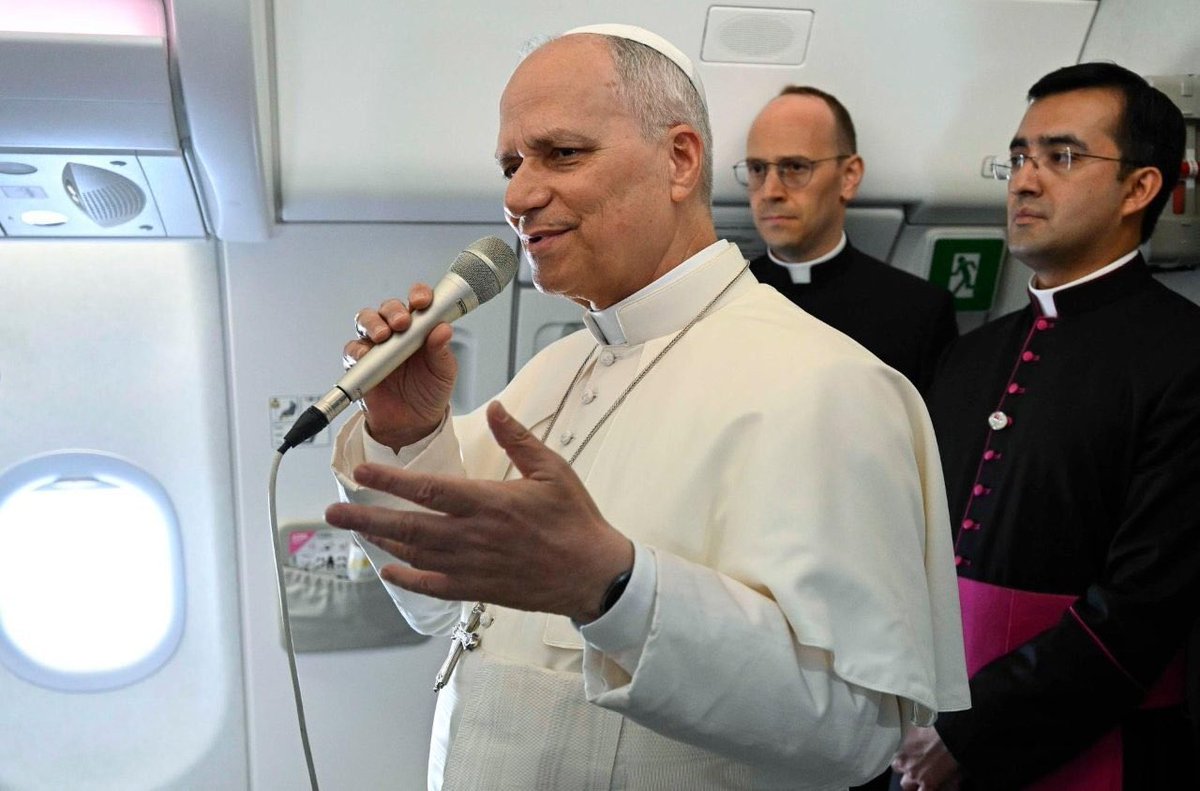
JUST IN: Pope Leo XIV responds to Cardinal Marx —
Says Vatican does not approve blessing of same sex couples.
Adds a blessing can be given to “all people” like at the end of Mass.
Leo states——
“First of all, I believe it is very important to understand that the unity or division of the Church should not revolve around sexual issues. We tend to think that when the Church speaks of morality, the only moral issue is a sexual one. In reality, I believe there are much larger and more important issues—such as justice, equality, the freedom of men and women, and religious freedom—that should take priority over that particular issue.
The Holy See has already spoken with the German bishops.
The Holy See has made it clear that we do not agree with the formal blessing of couples—in this case, same-sex couples, as you requested—or of couples in irregular situations, beyond what Pope Francis has specifically permitted by saying that all people should receive the blessing.
When a priest gives the blessing at the end of Mass, when the Pope gives the blessing at the end of a great celebration like the one we had today, there are blessings for all people.
Francis’s famous expression, “everyone, everyone, everyone,” expresses the Church’s conviction that everyone is welcomed, everyone is invited, everyone is invited to follow Jesus, and everyone is invited to seek conversion in their own lives.
To go beyond this today, I believe, could cause more disunity than unity, and that we should seek to build our unity on Jesus Christ and on what Jesus Christ teaches. This is my answer to the question.
#Peace is not something we must invent: it is something we must embrace by accepting our neighbor as a brother or sister. We do not choose our brothers and sisters: we must simply accept one another! We are one family, inhabiting the same home: this wonderful planet that ancient cultures have cared for over millennia. #ApostolicJourney #Cameroon
🚨 JUST NOW: Pope Leo drops this line in Cameroon
"Jesus told us, 'Blessed are the peacemakers,' but woe to those who manipulate religion in the very name of God for their own military, economic, or political gain, dragging that which is sacred into darkness and filth."
“St. Thérèse of Lisieux: “You cannot be half a saint; you must be a whole saint or no saint at all.”
St. Josemaría Escrivá: “Don’t say: ‘That person is a saint.’ Say: ‘I want to be a saint.’”
#proudlycatholic#catholicprayer#Lent2026#Lentenact2026
Fasting is a concrete way to prepare ourselves to receive the Word of God. Abstaining from food is an ancient ascetic practice that is essential on the path of conversion. It helps us to identify and order our “appetites,” keeping our hunger and thirst for justice alive and freeing us from complacency. It teaches us to pray and act responsibly towards our neighbor. #Lent
“Prayer is the best weapon we have; it is the key to God’s heart.” — Saint Pio of Pietrelcina
“If you wish to obtain for your neighbour the grace of God, pray for him.” — Saint John Vianney
St. Alphonsus Liguori: “He who desires to advance in the love of God should meditate often on the Passion of Jesus Christ.”
St. Paul of the Cross: “The Passion of Jesus is the greatest and most stupendous work of divine love.”
#olphvilagos#proudlycatholic#catholicprayer#Lent
St. Teresa of Calcutta: “Kind words can be short and easy to speak, but their echoes are truly endless.”
St. Josemaría Escrivá: “Don’t say anything that would harm another. Offer it up, and smile.”
St. Thérèse of Lisieux: "Kindness is my only guiding star. In its light, I sail a straight route, I have my motto written on my sail: 'To live in love'".
“Pope Francis: "Let us learn to live with kindness, to love everyone, even when they do not love us".
#olphvilagos#lent2026
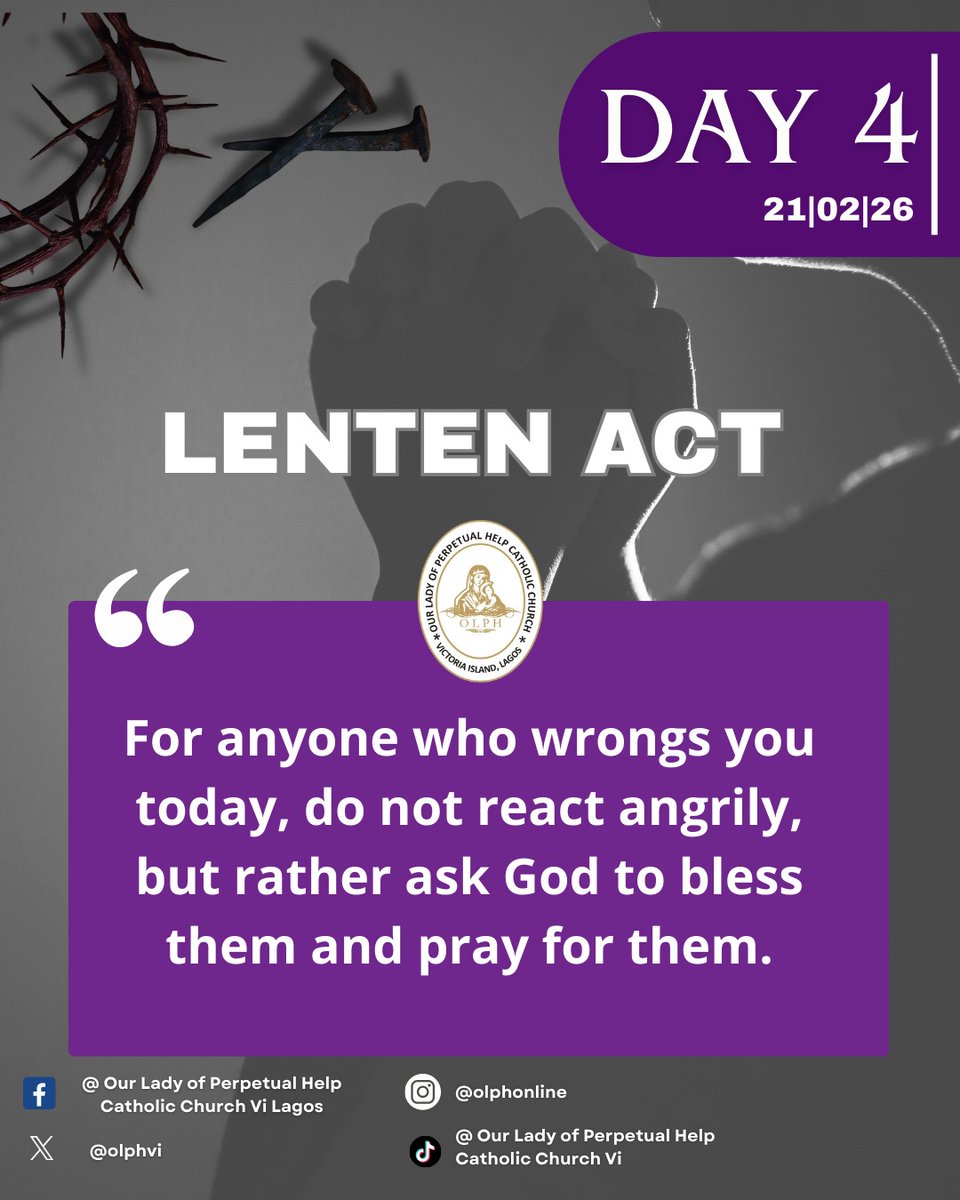
St. Ambrose: "Guard against anger. But if it cannot be averted, let it be kept within bounds. For indignation is a terrible incentive to sin".
St. Angela Merici: "You will accomplish more by kind words and a courteous manner than by anger or sharp rebuke".
"The want of proper examination, true contrition, and a firm purpose of amendment, is the cause of bad confessions, and the ruin of souls". - St. Benedict Joseph Labre
"Confession is an act of honesty and courage –