Only hope to take back our profession is to start our own PAC and fund it. Guess I’m going to look into doing this since no one else has. We are all busy, but unless we spend enough to compete we will continue to see our power degrade. Others have said we will likely need $350 PAC to compete and have our own lobbyists that will promote a physician first agenda. I’m still practicing,running a group, Chief at my hospital but I’m fed up like most of you. I hate this is the game we have to play, but we have done much more to get where we are. This is bigger than anyone of us. Our patients need us to do this.
This article mischaracterizes the issue and making doctors the villains as usual. At no point does the NYT article discuss that doctors made 3x for common surgeries in 1990. They want to use the outliers as the norm. Doctor may not have been paid for a majority of cases and wins one arbitration which still may not make up for all the revenue lost. INS took out of network billing away and then forced everyone to take their low ball reimbursement but pay hospitals much more favorably. It’s another tool to destroy private practice so doctors have to become hosp employees. Still at a loss as to why the disinformation campaign to always make doctors look greedy and bad for wanting fair pay. Not a peep on hospitals and admin.
Everyone wants me to rip on TrumpRx. Reality is, it’s saving patients money on IVF and a few other drugs. A lot of money.
IMO, anything that saves patients money is a win.
And they truly do have some great people that are making smart moves. You just don’t know their names. Chris Klomp. Mark Atalla, Abe Sutton and so many more.
When you talk to them, and see the work they put in, it’s obvious they are focused on trying to do the right thing for patients.
Don’t forget they didn’t give the insurance industry a price increase they wanted, and those stock prices got crushed.
TrumpRx is just getting started. @costplusdrugs is just getting started.
Telling physicians to stay independent while leaving in place every structural barrier to independence is not a policy. It is a wish.
Right now a physician who wants to leave a hospital employment arrangement faces a gauntlet that has nothing to do with clinical competence or patient demand. It has to do with contracts, regulations, and a practice environment that has been systematically engineered to make independence difficult.
Start with noncompetes. Most employed physicians signed agreements prohibiting practice within a defined radius for one to three years after departure. The practical effect is not inconvenience. It is forced displacement from the patient panel they built, the referral relationships they developed, and the community where their family lives. A surgeon who trained in San Antonio and then joined a hospital system should be able to leave that system and continue practicing in San Antonio. The Texas legislature thankfully advanced noncompete reform that would restore meaningful mobility to the physician workforce for new contracts (old contracts are grandfathered). That bill should become a national model. Federal preemption of physician noncompetes should be a companion provision to any site-neutral reform package.
Then there is the question of where to practice. An independent proceduralist needs access to an ASC or hospital to supplement income (recall that ASCs and hospitals see inflationary increases but doctors don’t), but in roughly 35 states, Certificate of Need laws require regulatory approval before a new facility can be licensed. This process is slow, expensive, and routinely captured by incumbent hospital systems that sit on the review committees. CON laws were sold as cost-containment tools. They function as incumbent protection statutes. The FTC and DOJ have said so explicitly. CON repeal is not peripheral to this conversation. It is a prerequisite.
Then there is Stark. The physician self-referral prohibition makes investment in ASCs and ancillary facilities legally complex for physicians who participate in Medicare fee-for-service. If we want physicians to own the alternative care settings that benefit from site-neutral payment reform, we need a safe harbor that makes that investment clean. A targeted fix: any service line subjected to and surviving prior authorization review should be exempt from Stark self-referral scrutiny. The insurer has already adjudicated medical necessity. The self-referral concern is analytically weaker when clinical appropriateness has been externally confirmed. This is the pathway for unlocking competition in the hospital market.
None of these reforms alone solves the problem. Together with site-neutral payment equalization they begin to construct an environment where independence is not just theoretically possible but financially rational. That is the standard we should be measuring against: not whether a physician can technically go independent, but whether doing so makes as much sense as taking a buyout offer.
Right now it does not. Every one of these barriers is a reason why. Tomorrow I will show you exactly what happens when we fix the hospital side of this equation without fixing the rest. It already happened in Oregon.
Dear @CMSGov
I was looking through some Medicare expenditure data, which I assume is not how most people spend their evenings, but I do…
And something jumped out at me.
Across five specialties, independent physicians had the lowest total Medicare expenditures:
$26,377 per beneficiary per year.
Okay. So that’s the baseline.
Now let’s look at the other models.
Private equity–affiliated practices: $26,824.
Corporate practices: $27,769.
Hospital-affiliated physicians: $30,416.
So just to make sure I understand this correctly…
The most expensive model in the system is the one where doctors are employed by hospitals.
And the least expensive model is the one where doctors run independent practices.
That’s a $4,039 difference per Medicare beneficiary every year.
Which would seem like the sort of thing policymakers might want to pay attention to.
But it gets better.
When physicians transition from independent practice to private equity, Medicare spending decreases by about $963 per beneficiary per year.
Okay. Interesting.
But when physicians transition to hospital employment, spending increases by $1,327 per beneficiary per year.
Corporate affiliation?
Also increases costs, by about $1,140.
So the pattern here seems… fairly consistent.
The model everyone keeps saying is “unsustainable” actually produces the lowest costs in the system.
Meanwhile, the model that keeps absorbing those practices is also the one that drives spending up.
And every time an independent physician disappears into a health system…
Costs go up.
Every time.
Which raises a small question:
If the goal is controlling healthcare costs…
why is the United States Government steadily replacing the least expensive model with the most expensive one?
Just asking….
-Rojas out
WATCH: ‘CBS Evening News’ anchor @TonyDokoupil on how the gold-medal-winning men’s hockey team and their unabashed patriotism “rang some sort of a bell in America” that “gave people chills, goose bumps, made them cry even” and reminded us that, while “America is a complicated place,” it’s our “home and, therefore, easy to love”.....
“Only in America, a moment that called to mind a picture of this country that it turns out millions of us were missing. I'm talking of course about Sunday's USA hockey game. The men's team won its first Olympic gold and 46 years, beating Canada in overtime and, by now, you've seen the images of Jack Hughes, 24, Florida born who left blood on the ice quite literally before scoring the winning goal and telling a reporter through broken teeth, ‘this is all about our country right now. I love the USA.’ 5,000 miles away, those comments, as much as the win itself, rang some sort of a bell in America. It gave people chills, goose bumps, made them cry even. Countless masses took a social media to say exactly that and more. It was everything about this team. A bunch of guys who played Toby Keith in the locker room celebration, drank beers during the postgame press conference, cheers to you guys, even thanked the troops in another interview. Hughes was even patriotic in his commentary on American health care.”
“They were gracious in victory and big hearted too, bringing to the ice the children of a teammate who was killed 18 months ago by an alleged drunk driver. They were, in short, American and nothing about that fact seemed complicated for them, even though we're all grown ups and we know America is a complicated place. What they remind us is that it is also home and, therefore, easy to love.”
Thank you, Rep Carter!
You faced patients at the pharmacy counter for many years, and fought hard for this PBM reform. 🎉
There is more to do.
I was delighted to meet you in December in support of the Pharmacists Fight Back Act, alongside @RepJamesComer@RepAuchincloss@RepHarshbarger@RepRashida@SanfordBishop
Let’s keep pushing for patients!
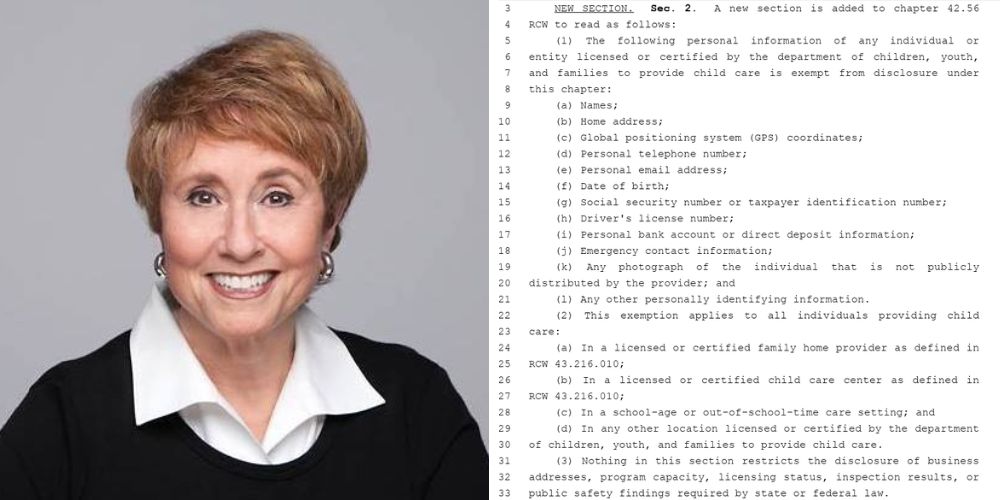
BREAKING: In response to the massive daycare fraud being exposed by independent journalists using state websites, WA State Senator Lisa Wellman has pre-filed legislation to hide information about daycares and their operators from the public
Talking to independent physicians, it's obvious that the big insurance carriers are doing to them, what their PBMs are doing to independent pharmacies.
They deny, underpay, slow pay, clawback, and create administrative mazes, knowing their victims don't have the time or resources to fight.
Why ? By putting financial pressures on physicians and pharmacies, it makes them more likely to sell their businesses to them , close their doors, or refer the business to their captive pharmacy or provider. All benefitting the biggest insurance companies
We need to ditch the concept of "claims" and make every delivery of medications or care as a billable event that must, by law, be paid on a timely basis , with interest charges for any delays. If the physician or pharmacy doesn't deliver , the carrier has plenty of legal options already. As does the patient.
This is not an efficient market. This is the big guy abusing the little guy. It needs to change to better the care we get in this country
We actually have been working in ERs, and they are slammed.
Patients face long waiting periods, and when they get into the ER, they may just be on a gurney in the hallway.
When they are finally seen and admitted to the hospital, they may spend 1-2 days waiting in the ER for a hospital bed.
The ERs are overloaded, patients are frustrated, the physicians and staff are frustrated, and it is a disaster.
The reason for this is that the ACA killed off private practice primary care, and now patients have no access.
The Medicaid expansion sounds good, but the money from Medicaid goes to the managed care organizations, and the physician reimbursement is so low that you can't accept Medicaid patients and keep your practice open.
Therefore, Medicaid expansion doesn't provide any more access for the patients who deserve it.
X is the only place to go for the truth about healthcare at the patient and physician level. I appreciate all of your interest in healthcare and please join us on our mission to reform it and put the patient back in charge!
Dear @AOC:
I watched your video. You want healthcare to be affordable and accessible for everyone everywhere.
May I ask a few questions?
Why does your area of New York make it illegal for physicians to build new hospitals, surgery centers, radiology centers, urgent cares, and nursing homes unless the existing health systems give permission through CON laws?
Why do you support closing hospitals while banning independent physicians from opening new ones?
Why do you support paying NYU Langone, Columbia, and the other “nonprofit” health systems 2–3X more per procedure than the tax-paying doctor down the street who mortgaged his home to build a practice and actually treats patients?
Why do these tax-exempt “nonprofits” get:
340B drug arbitrage, DSH “bonus bucks” payments, tax-free municipal bonds, property tax exemptions, and state-backed real estate financing
In the meantime, independent doctors get audits, reimbursement cuts, and legal barriers to building anything?
Why are nonprofit health systems allowed to operate like hedge funds and real estate developers, flipping property and building billion-dollar campuses, while physicians are blocked from opening a single surgery center?
Why is competition illegal in New York healthcare, and why do you support a system that protects financial empires instead of doctors and patients?
How do we get New York and the US out of the hands of these non-profit corporations?
Show me one Democrat Leader who has apologized for lying about the ACA.
“Keep your doctor.” Lie.
“Keep your plan.” Lie.
“Premiums will drop.” Lie.
They sold it like a Costco membership and vanished when it blew up.
Roll the tape:
I’m really sick of hearing this - the government is not subsidizing people. They’re subsidizing insurance companies.
The American people are paying thousands upon thousands of dollars for a product that is - for all intents and purposes - useless.
United Healthcare, whose revenue is about ~50% dependent upon government subsidies, denies ~33% of claims (2023 data).
Aetna denies ~29% of claims (2023 data).
Blue Cross Blue Shield (aggregate across states) denies ~18% of claims (2023 data).
Elevance, Cigna, and Centene denies ~16-17% of claims (2023 data).
Humana, which when you consider their military benefits administration, is basically a government payer denies ~12% (2023 data).
And of all denied insurance claims, in the entire United States, only ~1% of them are appealed. And of those appealed only ~46% of that 1% are overturned.
Health insurance is a scam. It’s a farce.
The subsidy isn’t for the patient. And the physicians don’t get paid - at all - ~20% of the time.
And when they do get paid, there’s always some kind of adjustment lowering the reimbursement; and it takes - on average - 71 days to get paid!
This is insanity!
@SecKennedy@CMSGov@HHS_Jim@HHSGov@DOGE_HHS@DOGE@RapidResponse47@realDonaldTrump@JDVance@mcuban@RayDalio@elonmusk@NicoleShanahan
The ACA has two ideas that are very popular and helpful. The first is excluding preexisting conditions, and the second is coverage of dependents up to age 26.
Where the ACA failed in the following areas:
• Mandating coverages instead of allowing patients
to choose the care they need
• Encouraging the vertical integration of insurance
companies with other entities
• The vertical integration allowed the insurance
companies to get around the medical loss ratio
and hide the increasing prices
• Prohibit physicians from owning hospitals, which limits
competition and increases prices
• Increase the metrics physicians have to comply with
and this increases the number of employed doctors
which increases the costs of care
The government should have rectified these flaws, and now that the costs are increasing, they want to hide those with subsidies.
We need to lower the cost of healthcare in the US and not just reward the large insurance companies with never-ending payments.